歐洲 BESS 最新商業模式與合約架構:英國、德國市場深度解析
# 歐洲 BESS 最新商業模式與合約架構:英國、德國市場深度解析
歐洲電池儲能系統(BESS)市場正在快速成熟,從早期以輔助服務為主的單一收益模式,演進為多元收益堆疊(revenue stacking)加上複雜合約架構的商業生態。英國與德國作為歐洲最活躍的兩個 BESS 市場,各自形成了獨特的市場結構與合約慣例,值得深入比較。
## 一、英國市場:從頻率服務到平衡機制的收益演進
英國 BESS 市場的發展歷程,是一部從高度依賴頻率回應服務(Frequency Response)到逐步轉向批發套利與平衡機制(Balancing Mechanism, BM)的演化史。
**頻率回應市場的飽和與轉型**
英國 BESS 的早期收益主要來自動態頻率回應(Dynamic Frequency Response, DFR)服務,包括動態調節(DC)、動態維持(DM)和動態抑制(DR)三種產品。然而,隨著 BESS 裝機容量快速增加,頻率服務市場逐漸飽和,單位收益持續下滑。根據 Modo Energy 的數據,2026 年 4 月英國 BESS 的平均月收益約為 £47,000/MW,其中批發套利(Wholesale Arbitrage)和平衡機制(BM)的貢獻比重顯著上升,合計已超過頻率服務收益。
**平衡機制的崛起**
平衡機制是英國 BESS 最具潛力的新興收益來源。當電網供需失衡時,國家電網電力系統運營商(NESO)透過 BM 向儲能資產發出充電(Bid)或放電(Offer)指令,並以市場出清價格結算。2025 年下半年以來,隨著太陽能滲透率提升導致日間負電價事件增加,BESS 在 BM 中的套利機會顯著擴大。
**負電價與太陽能過剩**
2026 年 4 月,英國創下太陽能發電量新高,日間出現多次負電價時段。這一現象與日本市場高度相似——太陽能過剩壓低了中午現貨價格,使 BESS 的最佳充電時段從傳統的夜間離峰轉移至日間太陽能過剩時段,峰谷價差的形成邏輯也從「夜低日高」演變為「午低晚高」。
## 二、德國市場:從輔助服務主導到批發套利的結構性轉型
德國 BESS 市場的收益結構正在經歷一場深刻的結構性轉型。根據 Modo Energy 2026 年第一季的德國 BESS 投資展望報告,這一轉型的核心驅動力是再生能源的大規模滲透。
**2026 年:輔助服務仍佔主導**
2026 年,輔助服務(主要是頻率遏制儲備 FCR 和自動頻率恢復儲備 aFRR)約佔德國 BESS 收益的 55%。FCR 和 aFRR 的合計市場規模僅約 4.5 GW,當電池裝機容量超過這一門檻後,批發交易將成為主要收益來源。
**2030 年:批發套利主導**
預計到 2030 年,日前市場(Day-Ahead)和日內市場(Intraday)交易將佔德國 BESS 收益的 95%。這一轉型的背後,是德國電力系統的根本性變化:再生能源發電量從 2026 年的 280 TWh 增長至 2040 年的 695 TWh(成長 150%),煤電於 2038 年退場,核電已於 2023 年全面關閉。隨著熱電容量萎縮,日間太陽能谷底與傍晚高峰之間的價差持續擴大,正是 BESS 套利的核心機會。
**投資回報率:4 小時系統優於 2 小時系統**
Modo Energy 的分析顯示,2026 年商業運轉的 4 小時德國 BESS 系統,未槓桿內部報酬率(Unlevered IRR)達 13.7%,高於 2 小時系統的 12.2%。儘管 4 小時系統的資本支出高出 34%(935,000 歐元/MW 對比 700,000 歐元/MW),但更長的儲能時長能夠捕捉更大的日內價差,使額外投資物有所值。
**新興收益來源**
德國市場還出現了兩個新興收益來源:一是 2026 年 1 月啟動的慣性採購(Inertia Procurement),配備電網成形逆變器(Grid-Forming Inverter)的電池每年可獲得約 8,000–20,000 歐元/MW 的額外收益;二是德國於 2026 年初確認的容量市場(Capacity Market),預計從 2031 年起每年貢獻約 10,000–15,000 歐元/MW。
## 三、BESS 合約架構:靈活購買協議(FPA)的四種主要結構
BESS 合約架構的核心是靈活購買協議(Flexibility Purchase Agreement, FPA),這是資產擁有者與套利商/優化商之間的合約安排。根據 Pexapark 的分析框架,FPA 主要分為以下四種結構:
### 1. 托管協議(Tolling Agreement)
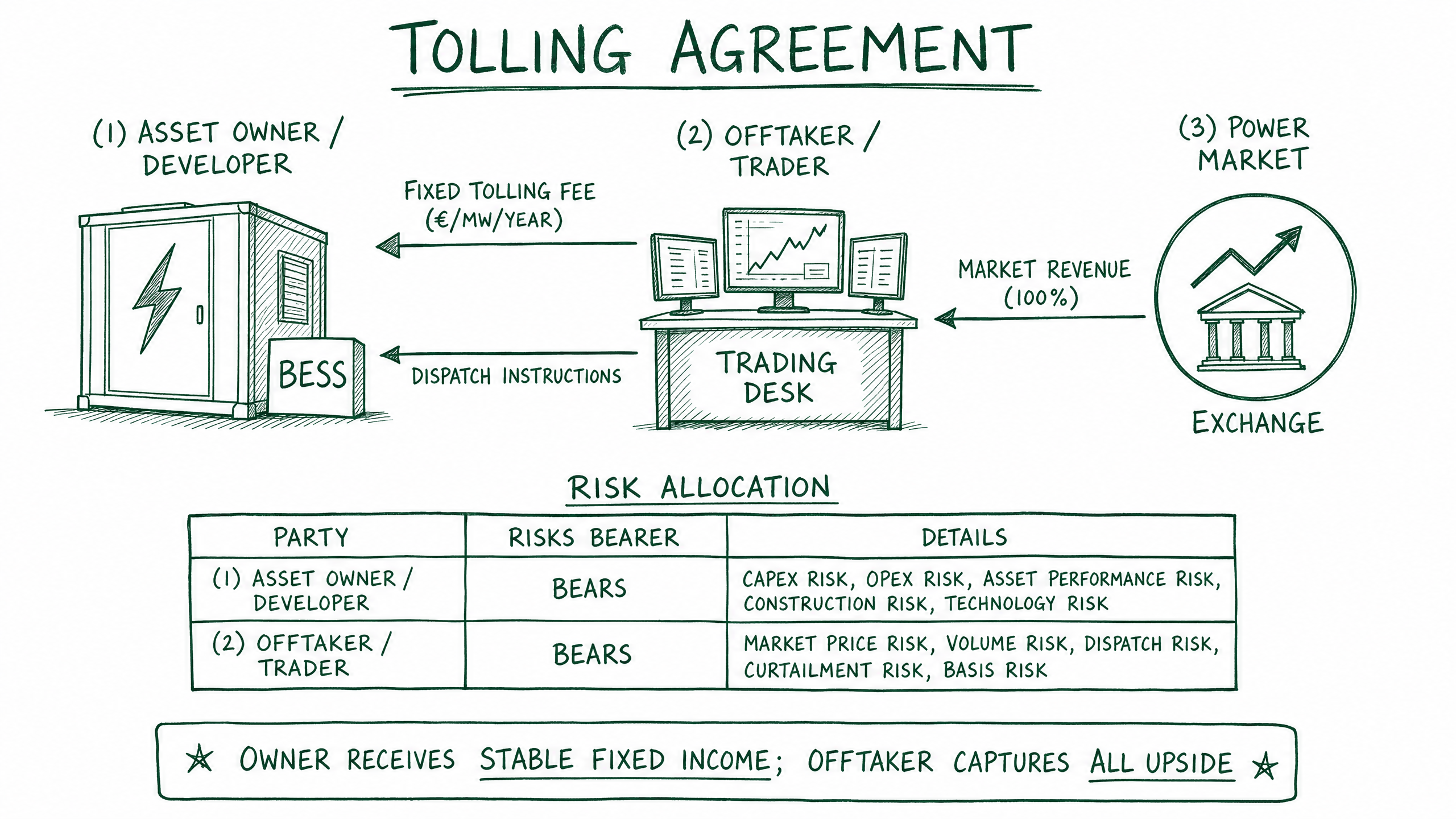
托管協議是目前歐洲最主流的 BESS 合約結構。在此安排下,套利商(Toller)支付固定費用(通常以歐元/MW/年計算),換取對 BESS 資產全部或部分調度權。資產擁有者獲得可預期的固定收益,市場風險由套利商承擔,但套利商也享有全部的交易上行空間。
托管協議可分為**實體托管**和**虛擬托管**兩種形式。實體托管下,套利商獲得 BESS 的實體調度權,承擔市場風險和資產性能風險;虛擬托管下,資產擁有者或資產聚合商保留實體調度責任,同時執行套利商的虛擬提名指令。虛擬托管通常依據 IFRS 9 作為衍生工具入帳,不在套利商資產負債表上產生租賃負債。
根據 Modo Energy 的數據,2025 年德國 BESS 市場披露的九筆合約中,有七筆採用實體托管結構,固定 70–100% 的容量,合約期限為 5–10 年,可支持高達 85% 的槓桿比率。
### 2. 收益下限加分成(Revenue Floor + Share)
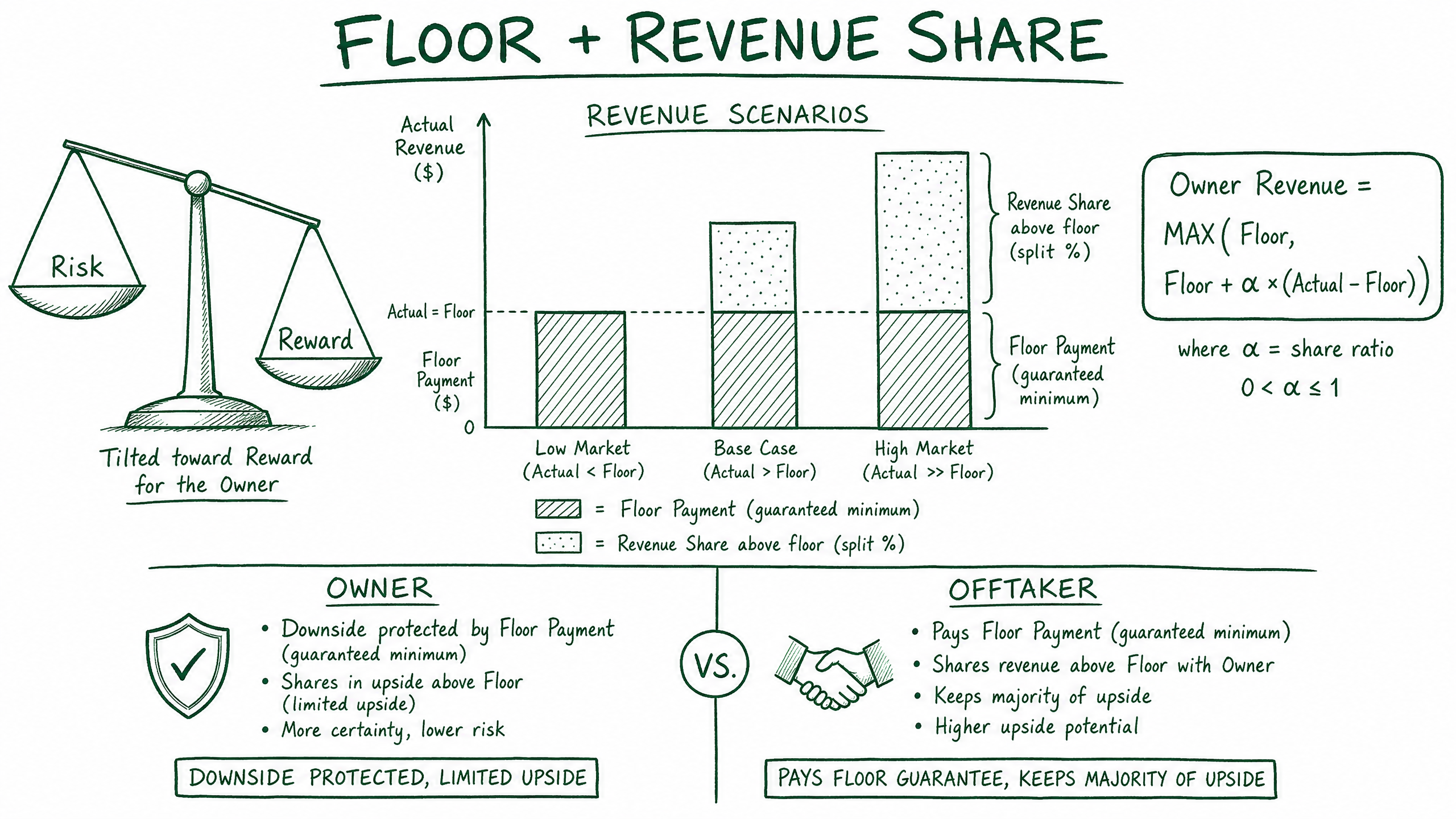
此結構為資產擁有者提供下行保護(Floor),確保最低收益,同時允許雙方分享超過下限的市場上行收益。套利商承擔部分市場風險,但也享有部分上行空間。這種結構特別適合工業用電大戶,他們有大規模的能源採購需求,但缺乏自行交易的基礎設施。
### 3. 日前掉期(Day-Ahead Swap)
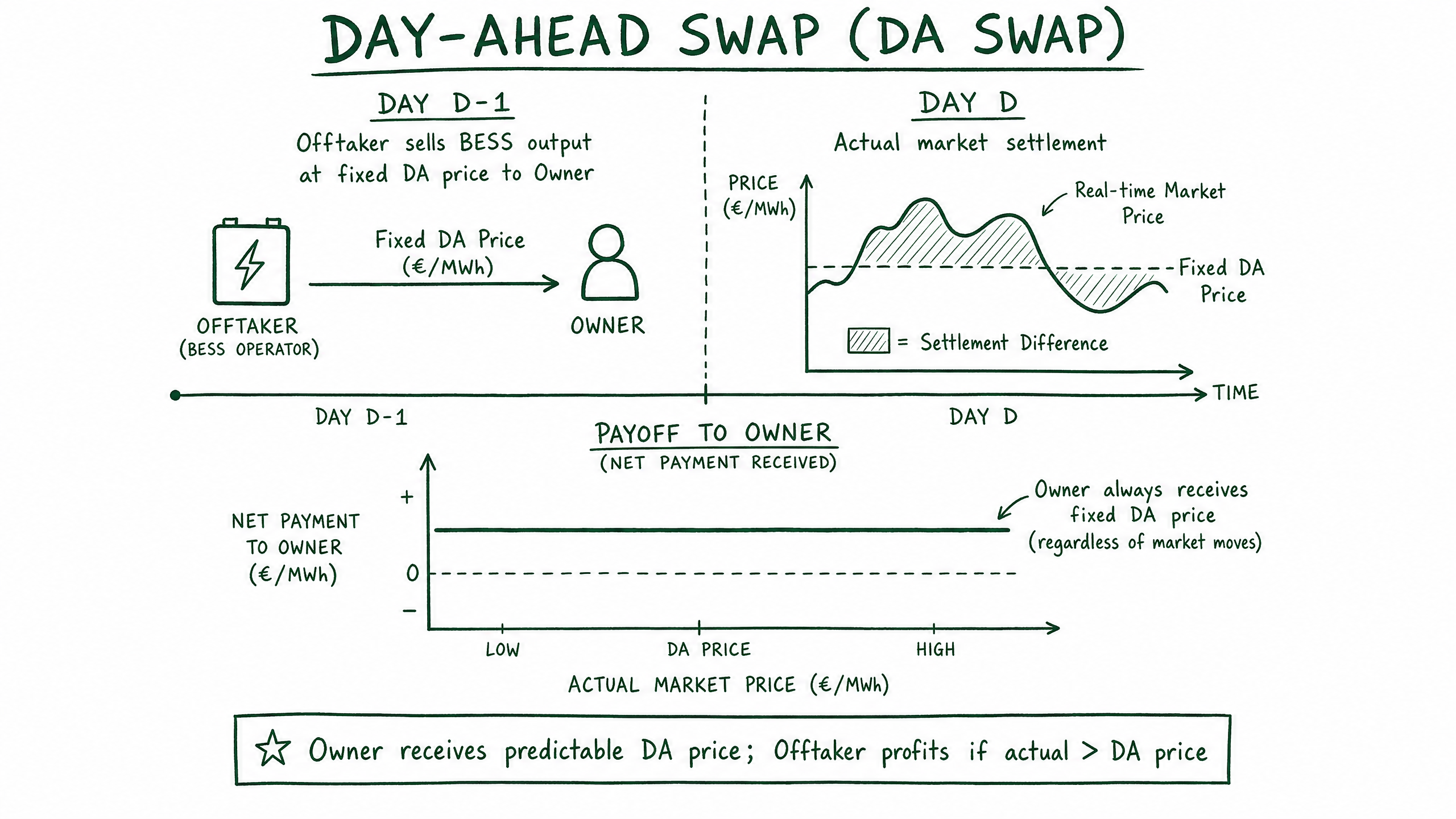
日前掉期是一種純金融結構,類似差價合約(CfD)。套利商以固定價格換取浮動指數(如日前市場)的市場敞口,資產擁有者獲得固定收益,但當市場價格超過固定水準時,需向套利商支付差額。這種結構允許套利商在不實際擁有或運營資產的情況下,從有利的日前市場發展中獲益,同時為資產擁有者提供下行保護。
### 4. 純商業收益分成(Merchant Revenue Share)
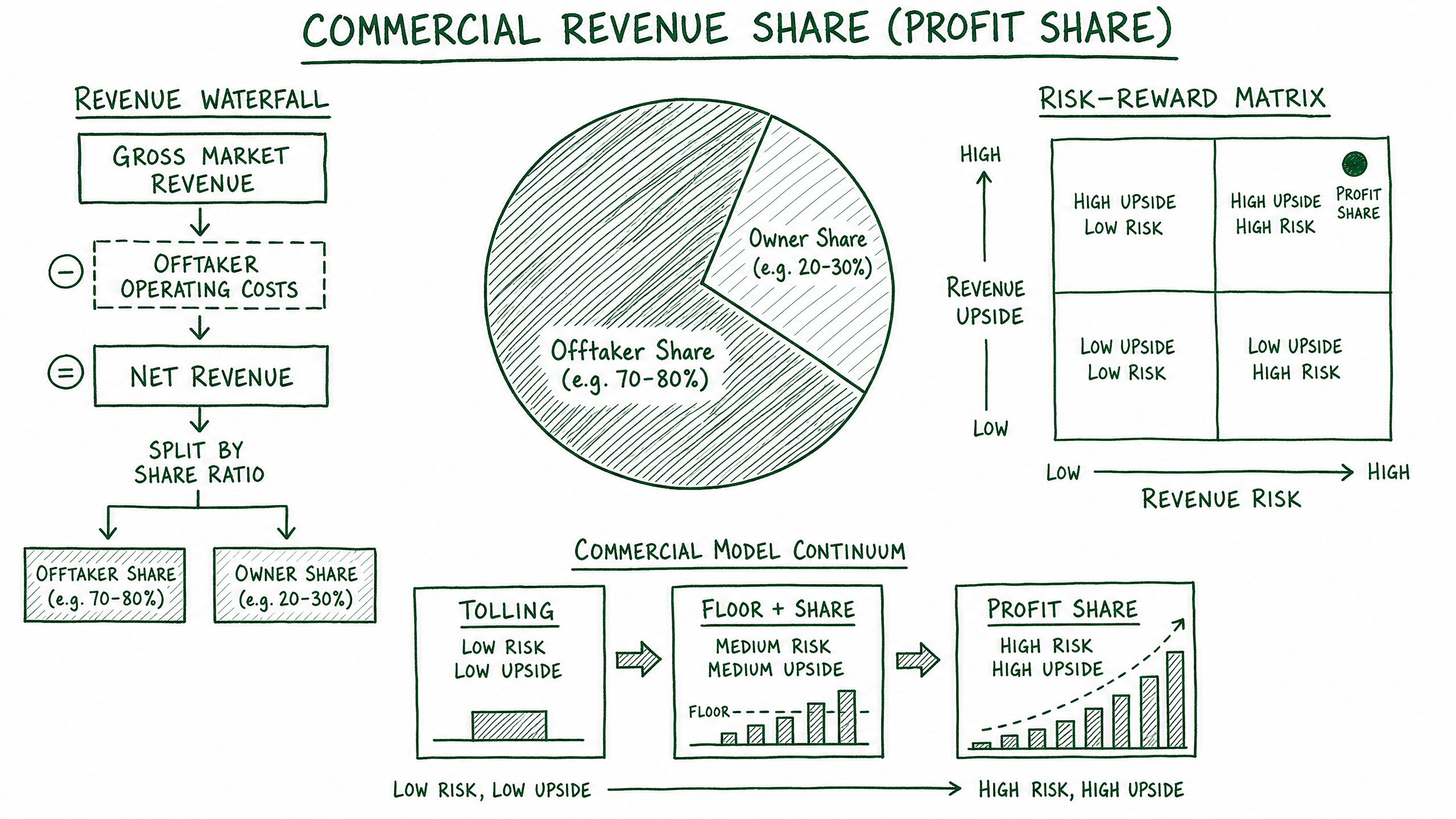
在此安排下,優化商代表資產擁有者在整個收益堆疊(批發市場、輔助服務等)中最大化電池收益,並以收益的一定比例作為優化費用。由於資產擁有者不享有任何保證收益,這被稱為「商業」協議。純商業協議通常期限較短(1–3 年),高度依賴市場表現。
### 合約結構比較
| 結構 | 保證收益 | 商業上行空間 | 可融資槓桿比率 |
|---|---|---|---|
| 托管協議(Tolling) | 高(固定費用) | 低(無或有上限) | 高(70–85%)|
| 收益下限加分成(Floor + Share) | 中至高(下限保護) | 中至高(超額分成) | 中至高(60–80%)|
| 日前掉期(DA Swap) | 中(固定掉期價格) | 中(不平衡與輔助服務) | 中(50–70%)|
| 商業收益分成(Merchant) | 低(無保證) | 高(全額商業敞口) | 低至中(30–60%)|
## 四、FPA 的核心談判要點
根據 Pexapark 的分析,BESS 靈活購買協議的主要談判要點包括:
**資產規格**:合約必須明確 BESS 的每日循環次數、保證衰減曲線和往返效率,這些技術參數直接影響 FPA 的定價。
**合約期限與商業運轉日期(COD)**:雙方需協商合約生效時間點及期限長度。托管協議通常為 5–10 年,商業協議通常為 1–3 年。
**資產性能與可用率**:可用率低於特定門檻可能觸發違約金或損害賠償。雙方可就計劃停機、不可抗力或電網限電等情況協商豁免條款。
**風險分配**:主要風險包括交易對手違約風險(可透過母公司擔保或信用狀緩解)、市場風險(電價波動)和運營風險(技術故障、電網限制)。
## 五、融資結構:FPA 如何使 BESS 專案「可融資」
BESS 專案的資本密集性使得融資結構至關重要。商業銀行在提供債務融資前,需要對未來現金流有足夠的可見度,這通常要求某種形式的保證收益。
完全商業模式的 BESS 在中性假設下每年可獲得約 115,000–130,000 歐元/MW,但在低情境下可能降至 70,000 歐元/MW,使高槓桿融資幾乎不可能。固定收益結構解決了這一問題:完全托管協議可將回報鎖定在 12% 並支持 85% 的槓桿,但放棄了全部商業上行空間;部分托管協議在保留上行空間的同時提供下行保護,在不同情境下可實現 9–17% 的未槓桿 IRR。
## 六、德國市場的三大監管風險
2026 年是德國 BESS 監管的關鍵年份,三項監管決定將決定德國 BESS 管線的走向:
**電網費用制度(BNetzA)**:德國聯邦網路局(BNetzA)的電網費用諮詢將決定 2029 年後新建專案是否仍具融資可行性。2029 年 8 月前接網的專案歷史上享有 20 年容量費豁免,此後接網的專案將面臨三項新費用。容量費是關鍵變數,不受限制的電池每年可承受約 20,000–25,000 歐元/MW,超過此門檻 IRR 將跌破門檻值。更令人擔憂的是,BNetzA 近期提案可能將新制度追溯適用於已在運行的專案,這已使許多融資進程陷入停滯。
**容量市場折算方法**:容量市場的折算方法將決定電池是否獲得出清價格的 50% 或 90%,對收益影響顯著。
**Mispel 法規**:若 Mispel 法規最終確定,將大規模解鎖共址(Co-location)模式,可能使管線規模超出目前預測。
## 七、共址模式:解決德國電網接入瓶頸
德國電網接入是 BESS 開發的最大瓶頸:700 GW 以上的儲能項目在排隊等待接網,但目前僅有 2.5 GW 已完成接網。德國輸電系統運營商(TSO)於 2026 年 2 月提出以成熟度為基礎的接網排隊制度,共址項目將獲得優先積分,改善其在獨立申請者之前接網的機會。
**灰色共址(Grey Co-location)**:電池透過與現有太陽能資產共享連接進行充放電,需要專用的進出口連接而非共享太陽能出口線路。灰色共址在 BESS 單獨計算的基礎上可實現 13.7% 的 IRR,與獨立項目回報相當,同時在成熟度制度下改善排隊位置。
**綠色共址(Green Co-location)**:電池只能向電網放電,並使用現場太陽能充電,可共享現有太陽能連接,是最實際的電網接入路徑。但綠色共址在 BESS 單獨計算的基礎上僅實現 8.5% 的 IRR,合併計算僅 2.9%,融資難度較高。
## 結語
英國與德國 BESS 市場的發展軌跡,揭示了儲能商業化的兩條路徑:英國以平衡機制和批發套利為核心,德國則正在從輔助服務主導向批發套利轉型。在合約架構層面,托管協議憑藉其高融資槓桿和可預期現金流,成為目前最主流的選擇;但隨著市場成熟,收益下限加分成等混合結構也在快速興起,為資產擁有者提供了在保護下行的同時保留上行空間的選擇。
對於有意進入歐洲 BESS 市場的投資者而言,理解各市場的收益結構演變趨勢、選擇適合自身風險偏好的合約架構,以及密切追蹤監管動態,是成功的三大關鍵。
---
**參考資料**
[1] Modo Energy, "German BESS Investment Outlook Q2 2026: Executive Summary", May 2026. https://modoenergy.com/research/en/germany-battery-investment-outlook-q2-2026-executive-summary
[2] Modo Energy, "GB BESS Revenues April 2026: Balancing Mechanism, Wholesale, Negative Prices, Solar Record", May 2026. https://modoenergy.com/research/en/gb-bess-revenues-april-2026-balancing-mechanism-wholesale-negative-prices-solar-record
[3] Pexapark, "What Are BESS Offtake and Optimization Agreements?", 2026. https://pexapark.com/what-are-bess-offtake-and-optimization-agreements/
[4] Timera Energy, "BESS Offtake Structures: 5 Key Considerations", 2025. https://timera-energy.com/blog/bess-offtake-structures-5-key-considerations/
欧州BESSの最新商業モデルと契約構造:英国・ドイツ市場の徹底分析
# 欧州BESSの最新商業モデルと契約構造:英国・ドイツ市場の徹底分析
欧州の電池エネルギー貯蔵システム(BESS)市場は急速に成熟しつつあり、補助サービスを中心とした単一収益モデルから、複数収益の積み重ね(レベニュースタッキング)と複雑な契約構造を組み合わせた商業エコシステムへと進化している。英国とドイツは欧州で最も活発なBESS市場として、それぞれ独自の市場構造と契約慣行を形成しており、詳細な比較分析が求められる。
## I. 英国市場:周波数サービスから需給調整市場(BM)への収益進化
英国のBESS市場の発展は、周波数応答サービスへの高度な依存から、卸売アービトラージと需給調整市場(Balancing Mechanism, BM)への移行という進化の歴史である。
**周波数応答市場の飽和と転換**
英国BESSの初期収益は、動的周波数応答(DFR)サービス——動的コンテインメント(DC)、動的モデレーション(DM)、動的レギュレーション(DR)——が中心だった。しかし、BESS設置容量の急速な増加に伴い、周波数サービス市場は次第に飽和し、単位収益は継続的に低下している。Modo Energyのデータによると、2026年4月の英国BESS平均月間収益は約£47,000/MWで、卸売アービトラージとBMの貢献比率が周波数サービスを大幅に上回るようになっている。
**需給調整市場(BM)の台頭**
需給調整市場は英国BESSにとって最も有望な新興収益源となっている。電力需給が不均衡になると、国家エネルギーシステム運営者(NESO)はBMを通じて貯蔵資産に充電(Bid)または放電(Offer)の指令を発し、市場清算価格で決済する。2025年後半以降、太陽光発電の普及によって昼間のマイナス価格事象が増加し、BM内でのBESSアービトラージ機会が大幅に拡大している。
**マイナス価格と太陽光余剰**
2026年4月、英国は太陽光発電量の新記録を更新し、昼間に複数のマイナス価格時間帯が発生した。この現象は日本市場と非常に類似している——太陽光余剰が昼間のスポット価格を押し下げ、BESSの最適充電時間帯が従来の夜間オフピークから昼間の太陽光余剰時間帯へとシフトしている。価格スプレッドの形成ロジックも「夜低昼高」から「昼低夕高」へと変化している。
## II. ドイツ市場:補助サービス主導から卸売アービトラージへの構造転換
ドイツのBESS市場の収益構造は、深刻な構造転換を経験している。Modo Energyの2026年第1四半期ドイツBESS投資見通しレポートによると、この転換の核心的な推進力は再生可能エネルギーの大規模普及である。
**2026年:補助サービスが依然として主導**
2026年、補助サービス——主に周波数コンテインメント予備力(FCR)と自動周波数回復予備力(aFRR)——はドイツBESS収益の約55%を占める。FCRとaFRRの合計市場規模はわずか約4.5GWであり、電池設置容量がこの閾値を超えると、卸売取引が主要収益源となる。
**2030年:卸売アービトラージが主導**
2030年までに、前日市場(Day-Ahead)と当日市場(Intraday)取引がドイツBESS収益の95%を占めると予測される。この転換の背景には、ドイツ電力システムの根本的な変化がある:再生可能エネルギー発電量は2026年の280TWhから2040年の695TWh(150%増)へと拡大し、石炭発電は2038年に退場、原子力発電はすでに2023年に全廃されている。熱電容量が縮小するにつれ、太陽光発電による昼間の谷底と夕方のピークの間のスプレッドが拡大し続けており、これがBESSアービトラージの核心的機会となっている。
**投資収益率:4時間システムが2時間システムを上回る**
Modo Energyの分析によると、2026年に商業運転を開始する4時間ドイツBESSシステムは、レバレッジなしの内部収益率(IRR)が13.7%に達し、2時間システムの12.2%を上回る。4時間システムの資本コストは34%高い(935,000ユーロ/MW対700,000ユーロ/MW)にもかかわらず、より長い貯蔵時間が大きな日内価格スプレッドを捕捉し、追加投資を正当化する。
**新興収益源**
ドイツ市場では二つの新興収益源が登場している。一つは2026年1月に開始された慣性調達(Inertia Procurement)で、グリッドフォーミングインバーターを搭載した電池は年間約8,000〜20,000ユーロ/MWの追加収益を得られる。もう一つは2026年初頭にドイツが確認した容量市場(Capacity Market)で、2031年以降に年間約10,000〜15,000ユーロ/MWの貢献が見込まれる。
## III. BESS契約構造:柔軟性購入契約(FPA)の4つの主要形態
BESS契約の核心は柔軟性購入契約(Flexibility Purchase Agreement, FPA)——資産所有者とオフテイカー/オプティマイザー間の契約取り決め——である。Pexaparkの分析フレームワークに基づくと、FPAは主に4つの構造に分類される。
### 1. トーリング契約(Tolling Agreement)

トーリング契約は現在、欧州で最も主流のBESS契約構造である。この取り決めの下、オフテイカー(「トーラー」)は固定料金(通常ユーロ/MW/年で表示)を支払い、BESS資産の全部または一部のディスパッチ権を取得する。資産所有者は予測可能な固定収益を確保し、市場リスクはトーラーが負担するが、トーラーは取引上昇益も享受する。
トーリング契約は**実物トーリング**と**バーチャルトーリング**の2形態に分けられる。実物トーリングでは、オフテイカーがBESS資産の実物ディスパッチ権を取得し、市場リスクと資産性能リスクの両方を負担する。バーチャルトーリングでは、資産所有者またはアグリゲーターが実物ディスパッチの責任を保持しながら、オフテイカーのバーチャルノミネーションを関連収益ストリームで実行する。バーチャルトーリングは通常IFRS 9に基づきデリバティブとして計上され、オフテイカーのバランスシートにリース負債を生じさせない。
Modo Energyのデータによると、2025年に開示されたドイツBESS契約9件のうち7件が実物トーリング構造を採用し、容量の70〜100%を5〜10年間固定し、最大85%のギアリングを可能にしている。
### 2. 収益フロア+シェア(Revenue Floor + Share)

この構造は、資産所有者にフロア(最低支払い)による下方保護を提供しながら、フロアを超えた市場上昇収益を双方で分配する。オフテイカーは一部の市場リスクを負担するが、上昇益にも参加できる。この構造は、大規模なエネルギー調達ニーズを持ちながら自社取引インフラを持たない産業用大口需要家に特に適している。
### 3. 前日スワップ(Day-Ahead Swap)
前日スワップは、差金決済契約(CfD)に類似した純粋な金融構造である。オフテイカーは固定価格と変動指数(前日市場など)の市場エクスポージャーを取得し、資産所有者は固定収益を受け取るが、市場価格が固定水準を超えた場合はオフテイカーに差額を支払う必要がある。この構造により、オフテイカーは資産を物理的に所有・運用することなく有利な前日市場の展開から利益を得られ、資産所有者には下方保護が提供される。
### 4. マーチャント収益シェア(Merchant Revenue Share)
この取り決めでは、オプティマイザーが資産所有者に代わって収益スタック全体(卸売市場、補助サービスなど)でバッテリーを最大限に活用し、収益の一定割合を最適化手数料として受け取る。資産所有者には保証収益がないため、これは「マーチャント」契約と呼ばれる。マーチャント専用契約は通常短期(1〜3年)で、市場パフォーマンスへの依存度が高い。
### 契約構造比較
| 構造 | 保証収益 | マーチャント上昇益 | 達成可能なギアリング |
|---|---|---|---|
| トーリング契約 | 高(固定料金) | 低(なしまたは上限付き) | 高(70〜85%)|
| 収益フロア+シェア | 中〜高(フロア保護) | 中〜高(フロア超過分を分配) | 中〜高(60〜80%)|
| 前日スワップ | 中(固定スワップ価格) | 中(不均衡・補助サービスから) | 中(50〜70%)|
| マーチャント収益シェア | 低(保証なし) | 高(完全なマーチャントエクスポージャー) | 低〜中(30〜60%)|
## IV. FPA交渉の主要ポイント
Pexaparkの分析によると、BESS柔軟性購入契約における主要な交渉ポイントは以下の通りである。
**資産仕様**:契約はBESSの1日あたりサイクル数、保証劣化プロファイル、往復効率を明確にしなければならない。これらの技術的パラメータはFPAの価格設定に直接影響する。
**契約期間と商業運転開始日(COD)**:当事者は契約発効時点と期間を交渉する。トーリング契約は通常5〜10年、マーチャント契約は通常1〜3年。
**資産性能と可用率**:特定の閾値を下回る可用率はペナルティや損害賠償を引き起こす可能性がある。計画停止、不可抗力、または資産所有者の制御外の系統制約に対する免除条項を交渉できる。
**リスク配分**:主要リスクには、取引相手の債務不履行リスク(親会社保証または信用状で軽減)、市場リスク(電力価格変動)、運用リスク(技術的障害、系統制約)が含まれる。
## V. ファイナンス構造:FPAがBESSプロジェクトを「ファイナンス可能」にする方法
BESSプロジェクトの資本集約的な性質により、ファイナンス構造は極めて重要である。商業銀行は債務融資を提供する前に将来のキャッシュフローに対する十分な可視性を必要とし、これは通常何らかの保証収益を必要とする。
完全マーチャントBESSは中央シナリオで年間約115,000〜130,000ユーロ/MWを生成するが、低シナリオでは70,000ユーロ/MWまで低下する可能性があり、収益安定化なしに高いギアリングはほぼ不可能となる。固定収益構造はこの問題を解決する:完全トーリングは収益を12%に固定し85%のギアリングをサポートするが、すべてのマーチャント上昇益を放棄する;部分トーリングはマーチャント構造が欠く下方保護を提供しながら、完全トーリングが放棄する上昇益を保持し、シナリオ全体で9〜17%の未レバレッジIRRを実現する。
## VI. ドイツ市場の3大規制リスク
2026年はドイツBESS規制の重要な年であり、3つの規制決定がドイツBESSパイプラインの方向性を決定する。
**系統料金制度(BNetzA)**:連邦ネットワーク庁の系統料金協議は、2029年以降のプロジェクトがファイナンス可能かどうかを決定する。2029年8月以前に系統接続したプロジェクトは歴史的に20年間の容量料金免除を享受してきたが、それ以降のプロジェクトは3つの新料金に直面する。容量料金が重要な変数であり、制約のない電池は年間約20,000〜25,000ユーロ/MWを吸収できるが、これを超えるとIRRがハードルレートを下回る。さらに懸念されるのは、BNetzAの最近の提案が新制度をすでに運用中のプロジェクトに遡及適用する可能性を示唆しており、多くのファイナンスプロセスが停滞していることである。
**容量市場の格下げ方法論**:格下げ方法論は電池が清算価格の50%または90%を受け取るかどうかを決定し、収益に大きな影響を与える。
**Mispel規制**:最終化されれば、Mispel規制は大規模なコロケーションを解放し、現在の予測を超えてパイプラインを加速させる可能性がある。
## VII. コロケーション:ドイツの系統接続ボトルネックの解決策
系統接続はドイツのBESS開発における最大のボトルネックである:700GW以上の貯蔵プロジェクトが接続待ちの列に並んでいるが、現在接続済みはわずか2.5GWである。ドイツのTSOは2026年2月に、現在の先着順キューを成熟度ベースのシステムに置き換える提案を行い、コロケーションプロジェクトが優先ポイントを獲得できるようにした。
**グレーコロケーション**:電池が既存の太陽光資産との共有接続を通じて充放電を行い、太陽光の輸出ラインを共有するのではなく専用の輸出入接続が必要。グレーコロケーションはBESS単独ベースで13.7%のIRRを実現し、スタンドアロン案件と同水準の収益を維持しながら、提案された成熟度ベースシステムの下でキュー位置を改善する。
**グリーンコロケーション**:電池は系統への放電のみが可能で、オンサイトの太陽光で充電し、既存の太陽光接続を共有できる——系統接続への最も実用的なルート。しかし、グリーンコロケーションはBESS単独ベースで8.5%のIRR、合算ベースでは2.9%しか実現せず、ファイナンスが困難である。
## 結論
英国とドイツのBESS市場の発展軌跡は、貯蔵商業化の2つの経路を示している:英国は需給調整市場と卸売アービトラージを中心とし、ドイツは補助サービス主導から卸売アービトラージへの移行を進めている。契約構造面では、トーリング契約が高いファイナンスレバレッジと予測可能なキャッシュフローにより最も主流の選択となっているが、市場が成熟するにつれて収益フロア+シェアなどのハイブリッド構造も急速に台頭し、資産所有者に下方保護を維持しながら上昇益を保持する選択肢を提供している。
欧州BESS市場への参入を検討する投資家にとって、各市場の収益構造の進化トレンドを理解すること、自身のリスク選好に合った契約構造を選択すること、そして規制動向を注視することが成功の3大鍵となる。
---
**参考文献**
[1] Modo Energy, "German BESS Investment Outlook Q2 2026: Executive Summary", 2026年5月. https://modoenergy.com/research/en/germany-battery-investment-outlook-q2-2026-executive-summary
[2] Modo Energy, "GB BESS Revenues April 2026: Balancing Mechanism, Wholesale, Negative Prices, Solar Record", 2026年5月. https://modoenergy.com/research/en/gb-bess-revenues-april-2026-balancing-mechanism-wholesale-negative-prices-solar-record
[3] Pexapark, "What Are BESS Offtake and Optimization Agreements?", 2026年. https://pexapark.com/what-are-bess-offtake-and-optimization-agreements/
[4] Timera Energy, "BESS Offtake Structures: 5 Key Considerations", 2025年. https://timera-energy.com/blog/bess-offtake-structures-5-key-considerations/
European BESS Commercial Models & Contract Structures: A Deep Dive into the UK and German Markets
# European BESS Commercial Models & Contract Structures: A Deep Dive into the UK and German Markets
The European battery energy storage system (BESS) market is rapidly maturing, evolving from a single-revenue model dominated by ancillary services to a sophisticated commercial ecosystem combining multi-stream revenue stacking with complex contract structures. The United Kingdom and Germany, as Europe's two most active BESS markets, have each developed distinctive market structures and contracting conventions that merit close comparison.
## I. The UK Market: Revenue Evolution from Frequency Services to the Balancing Mechanism
The development of the UK BESS market is a story of transition — from heavy reliance on frequency response services toward wholesale arbitrage and the Balancing Mechanism (BM).
**Saturation of Frequency Response Markets**
Early UK BESS revenues were dominated by Dynamic Frequency Response (DFR) services, including Dynamic Containment (DC), Dynamic Moderation (DM), and Dynamic Regulation (DR). However, as BESS installed capacity grew rapidly, the frequency services market became increasingly saturated and per-unit revenues declined steadily. According to Modo Energy data, average monthly UK BESS revenues in April 2026 were approximately £47,000/MW, with wholesale arbitrage and the Balancing Mechanism now contributing a significantly larger share than frequency services.
**The Rise of the Balancing Mechanism**
The Balancing Mechanism has emerged as one of the most promising new revenue streams for UK BESS. When grid supply and demand fall out of balance, the National Energy System Operator (NESO) issues charge (Bid) or discharge (Offer) instructions to storage assets through the BM, settling at market clearing prices. Since the second half of 2025, as solar penetration has increased and daytime negative pricing events have multiplied, BESS arbitrage opportunities within the BM have expanded significantly.
**Negative Prices and Solar Surplus**
In April 2026, the UK set new solar generation records, with multiple negative pricing periods during daylight hours. This phenomenon closely mirrors developments in the Japanese market: solar surplus has suppressed midday spot prices, shifting the optimal BESS charging window from the traditional overnight off-peak to daytime solar surplus hours. The spread logic has shifted from "low at night, high during the day" to "low at noon, high in the evening."
## II. The German Market: Structural Transition from Ancillary Services to Wholesale Arbitrage
The German BESS market's revenue structure is undergoing a profound structural transition. According to Modo Energy's Q1 2026 German BESS Investment Outlook, the core driver of this transition is the large-scale penetration of renewable energy.
**2026: Ancillary Services Still Dominant**
In 2026, ancillary services — primarily Frequency Containment Reserve (FCR) and automatic Frequency Restoration Reserve (aFRR) — account for approximately 55% of German BESS revenues. The combined market size for FCR and aFRR is only around 4.5 GW; once battery installed capacity exceeds this threshold, wholesale trading will become the primary revenue source.
**2030: Wholesale Arbitrage Takes Over**
By 2030, day-ahead and intraday trading are projected to account for 95% of German BESS revenues. Behind this transition lies a fundamental transformation of the German power system: renewable generation grows from 280 TWh in 2026 to 695 TWh in 2040 (a 150% increase), coal exits by 2038, and nuclear has already been fully decommissioned. As thermal capacity shrinks, the spread between solar-driven midday troughs and evening peaks continues to widen — the core arbitrage opportunity for BESS.
**Investment Returns: 4-Hour Systems Outperform 2-Hour**
Modo Energy's analysis shows that a 4-hour German BESS system entering commercial operation in 2026 achieves an unlevered IRR of 13.7%, compared to 12.2% for a 2-hour system. Although the 4-hour system carries 34% higher capex (€935,000/MW vs €700,000/MW), the longer storage duration captures a larger daily price spread, making the additional investment worthwhile.
**Emerging Revenue Streams**
Two new revenue streams are emerging in the German market. First, inertia procurement launched in January 2026 offers batteries with grid-forming inverters approximately €8,000–20,000/MW/year in additional revenue. Second, Germany confirmed a capacity market in early 2026, expected to contribute approximately €10,000–15,000/MW/year from 2031 onward.
## III. BESS Contract Structures: The Four Main Forms of Flexibility Purchase Agreements
The cornerstone of BESS contracting is the Flexibility Purchase Agreement (FPA) — a contractual arrangement between a BESS asset owner and an offtaker or optimizer. Drawing on Pexapark's analytical framework, FPAs fall into four main structures:
### 1. Tolling Agreement

The tolling agreement is currently the most prevalent BESS contract structure in Europe. Under this arrangement, the offtaker (or "toller") pays a fixed fee — typically denominated in €/MW/year — in exchange for dispatch rights over all or part of a BESS asset. The asset owner secures predictable, bankable revenue; market risk is borne by the toller, who also retains the full trading upside.
Tolling agreements can be structured as **physical** or **virtual**. Under a physical toll, the offtaker obtains physical dispatch rights over the BESS asset and assumes both market and asset performance risks. Under a virtual toll, the asset owner or aggregator retains responsibility for physically dispatching the asset while executing the offtaker's virtual nominations across relevant revenue streams. Virtual tolls are typically accounted for as derivatives under IFRS 9 and therefore do not create lease liabilities on the offtaker's balance sheet.
According to Modo Energy data, seven of the nine disclosed German BESS contracts in 2025 used physical tolling structures, fixing 70–100% of capacity for 5–10 years and unlocking gearing of up to 85%.
### 2. Revenue Floor + Share

This structure provides the asset owner with downside protection through a minimum payment floor, while allowing both parties to share revenues above the floor. The offtaker bears some market risk but also participates in the upside. This structure is particularly suited to large industrial energy buyers who have significant energy procurement mandates but lack their own trading infrastructure.
### 3. Day-Ahead Swap

The day-ahead swap is a purely financial structure with a Contract-for-Difference (CfD)-like payout. The offtaker takes market exposure by guaranteeing a fixed price against a floating day-ahead market index; the asset owner receives a fixed payment but must pay the offtaker when market prices exceed the fixed level. This structure allows the offtaker to benefit from favorable day-ahead market developments without physically owning or operating an asset, while providing downside protection for the asset owner.
### 4. Merchant Revenue Share

Under this arrangement, an optimizer dispatches and trades the battery on behalf of the asset owner across the full revenue stack (wholesale markets, ancillary services, etc.), receiving a percentage of profits as an optimization fee. Since the asset owner is not guaranteed any revenue stream, this is termed a "merchant" agreement. Merchant-only agreements tend to be shorter-term (1–3 years) and rely heavily on market performance.
### Contract Structure Comparison
| Structure | Guaranteed Revenue | Merchant Upside | Achievable Gearing |
|---|---|---|---|
| Tolling Agreement | High (fixed fee) | Low (none or capped) | High (70–85%) |
| Revenue Floor + Share | Medium–High (floor protection) | Medium–High (share above floor) | Medium–High (60–80%) |
| Day-Ahead Swap | Medium (fixed swap price) | Medium (from imbalance & ancillary) | Medium (50–70%) |
| Merchant Revenue Share | Low (no guarantee) | High (full merchant exposure) | Low–Medium (30–60%) |
## IV. Key FPA Negotiation Points
According to Pexapark's analysis, the main negotiation points in BESS Flexibility Purchase Agreements include:
**Asset Specifications**: The contract must specify the BESS's warranted daily cycle count, degradation profile, and round-trip efficiency. These technical parameters directly affect FPA pricing.
**Tenor and Commercial Operations Date (COD)**: Parties negotiate the contract commencement date and duration. Tolling agreements typically run 5–10 years; merchant agreements typically 1–3 years.
**Asset Performance and Availability**: Availability below a specified threshold may trigger penalties or liquidated damages. Parties may negotiate exemptions for planned outages, force majeure, or grid curtailments outside the asset owner's control.
**Risk Allocation**: Key risks include counterparty default risk (mitigated through parent guarantees or letters of credit), market risk (electricity price volatility), and operational risk (technical failures, grid constraints).
## V. Financing Structures: How FPAs Make BESS Projects Bankable
The capital-intensive nature of BESS projects makes financing structure critical. Commercial banks require visibility on future cash flows before extending debt, which typically necessitates some form of guaranteed revenue.
Fully merchant BESS generates approximately €115,000–130,000/MW/year under central assumptions, but this can fall to €70,000/MW/year in a low scenario, making high gearing virtually impossible without revenue stabilization. Fixed-revenue structures address this problem: a full toll locks returns at 12% and supports 85% gearing, but surrenders all merchant upside; a partial toll protects against the downside the merchant structure lacks while retaining the upside the full toll forfeits — delivering 9–17% unlevered IRR across scenarios.
## VI. Three Regulatory Risks in the German Market
2026 is a critical year for German BESS regulation. Three regulatory decisions will determine the trajectory of the German BESS pipeline:
**Grid Fee Regime (BNetzA)**: The Federal Network Agency's grid fee consultation will determine whether post-2029 projects remain financeable. Projects connecting before August 2029 have historically received a 20-year exemption from capacity charges; those connecting after 2029 will face three new charges. The capacity charge is the critical variable — unconstrained batteries can absorb approximately €20,000–25,000/MW/year before IRRs fall below hurdle rates. More significantly, recent BNetzA proposals suggest the new regime may be applied retroactively to projects already in operation, bringing many financing processes to a standstill.
**Capacity Market De-rating Methodology**: The de-rating methodology will determine whether batteries receive 50% or 90% of the clearing price, with significant revenue implications.
**Mispel Regulation**: If finalized, the Mispel regulation would unlock co-location at scale and could accelerate the pipeline beyond current projections.
## VII. Co-location: Solving Germany's Grid Access Bottleneck
Grid access is the biggest bottleneck for BESS development in Germany: over 700 GW of storage projects are queued for connection, but only 2.5 GW has been connected. Germany's TSOs proposed in February 2026 to replace the current first-come-first-served queue with a maturity-based system, under which co-located projects earn priority points.
**Grey Co-location**: The battery charges and discharges through a shared connection with an existing solar asset, requiring a dedicated import-export connection rather than sharing the solar export link. Grey co-location delivers 13.7% IRR on a BESS-only basis — in line with standalone returns — while improving queue position under the proposed maturity-based system.
**Green Co-location**: The battery can only discharge into the grid and uses onsite solar to charge, sharing the existing solar connection — the most practical route to grid access. However, green co-location delivers only 8.5% IRR on a BESS-only basis and 2.9% on a combined basis, making it difficult to finance.
## Conclusion
The development trajectories of the UK and German BESS markets reveal two pathways for storage commercialization: the UK centers on the Balancing Mechanism and wholesale arbitrage, while Germany is transitioning from ancillary service dominance to wholesale arbitrage. On the contract structure front, tolling agreements have become the most prevalent choice due to their high financing leverage and predictable cash flows; but as markets mature, hybrid structures such as revenue floor plus share are rapidly gaining traction, offering asset owners the ability to protect the downside while retaining upside exposure.
For investors considering entry into the European BESS market, three factors are key to success: understanding the evolving revenue structure in each market, selecting contract structures that match their risk appetite, and closely monitoring regulatory developments.
---
**References**
[1] Modo Energy, "German BESS Investment Outlook Q2 2026: Executive Summary", May 2026. https://modoenergy.com/research/en/germany-battery-investment-outlook-q2-2026-executive-summary
[2] Modo Energy, "GB BESS Revenues April 2026: Balancing Mechanism, Wholesale, Negative Prices, Solar Record", May 2026. https://modoenergy.com/research/en/gb-bess-revenues-april-2026-balancing-mechanism-wholesale-negative-prices-solar-record
[3] Pexapark, "What Are BESS Offtake and Optimization Agreements?", 2026. https://pexapark.com/what-are-bess-offtake-and-optimization-agreements/
[4] Timera Energy, "BESS Offtake Structures: 5 Key Considerations", 2025. https://timera-energy.com/blog/bess-offtake-structures-5-key-considerations/