JEPX 五種投標方式全解析:通常投標、區塊投標、連結區塊、循環區塊與條紋投標
前言:為什麼需要多種投標方式?
JEPX 現貨市場(日前市場)每日交易次日 48 個 30 分鐘時段的電力。由於電力生產具有物理約束——發電機組有最低出力限制、啟停成本高昂、部分機組必須聯合運行——單純的「每個時段各自投標」無法滿足所有市場參與者的需求。為此,JEPX 設計了五種投標方式,讓不同類型的發電業者與零售業者都能以符合自身運營邏輯的方式參與市場。
[五種投標方式速覽]
JEPX 現貨市場支援:通常投標(各時段獨立)、區塊投標(連續時段全有或全無)、連結區塊投標(主從機組聯合)、循環區塊投標(兩組聯動)、條紋投標(全 48 時段強制覆蓋)。各方式可搭配使用,以最佳化投標策略。
1. 通常投標(Normal Bid)
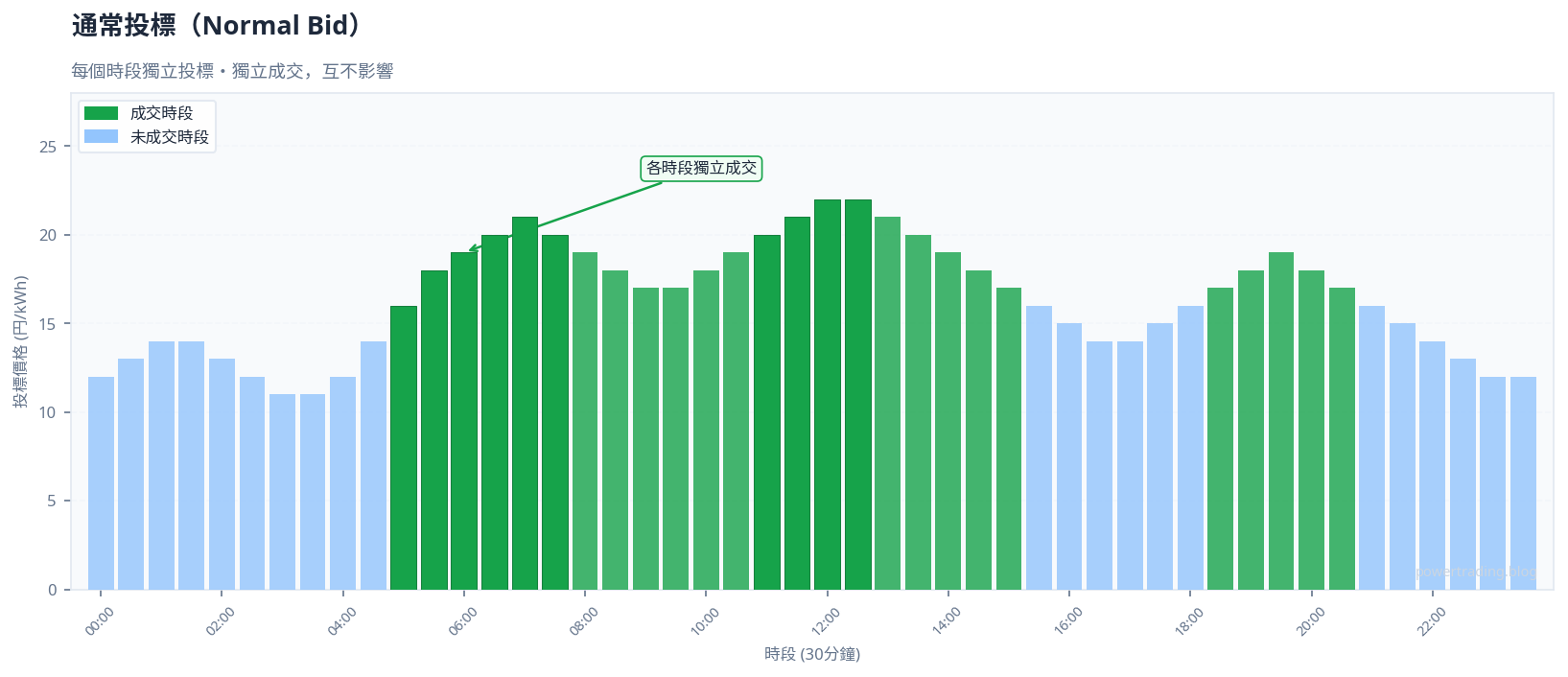
通常投標是最基本的投標方式,適用於所有市場參與者。每個 30 分鐘時段均獨立投標,各時段的成交與否互不影響。
1.1 投標規格
| 項目 | 規格 |
|---|---|
| 時段範圍 | 單一 30 分鐘時段 |
| 投標單位 | 0.1 MW(100 kW) |
| 價格範圍 | ¥0.01 ~ ¥200/kWh |
| 每時段最大投標組數 | 賣方 60 組、買方 60 組 |
| 成交方式 | 各時段獨立,盲標單一價格拍賣 |
1.2 適用場景
通常投標適合靈活性高的資源,例如水力發電、蓄電池、需量反應(DR)資源,以及希望在特定高價時段選擇性出售電力的零售業者。由於每個時段獨立成交,投標者可以針對不同時段設定不同的價格策略,充分利用日內價格差異。
2. 區塊投標(Block Bid)
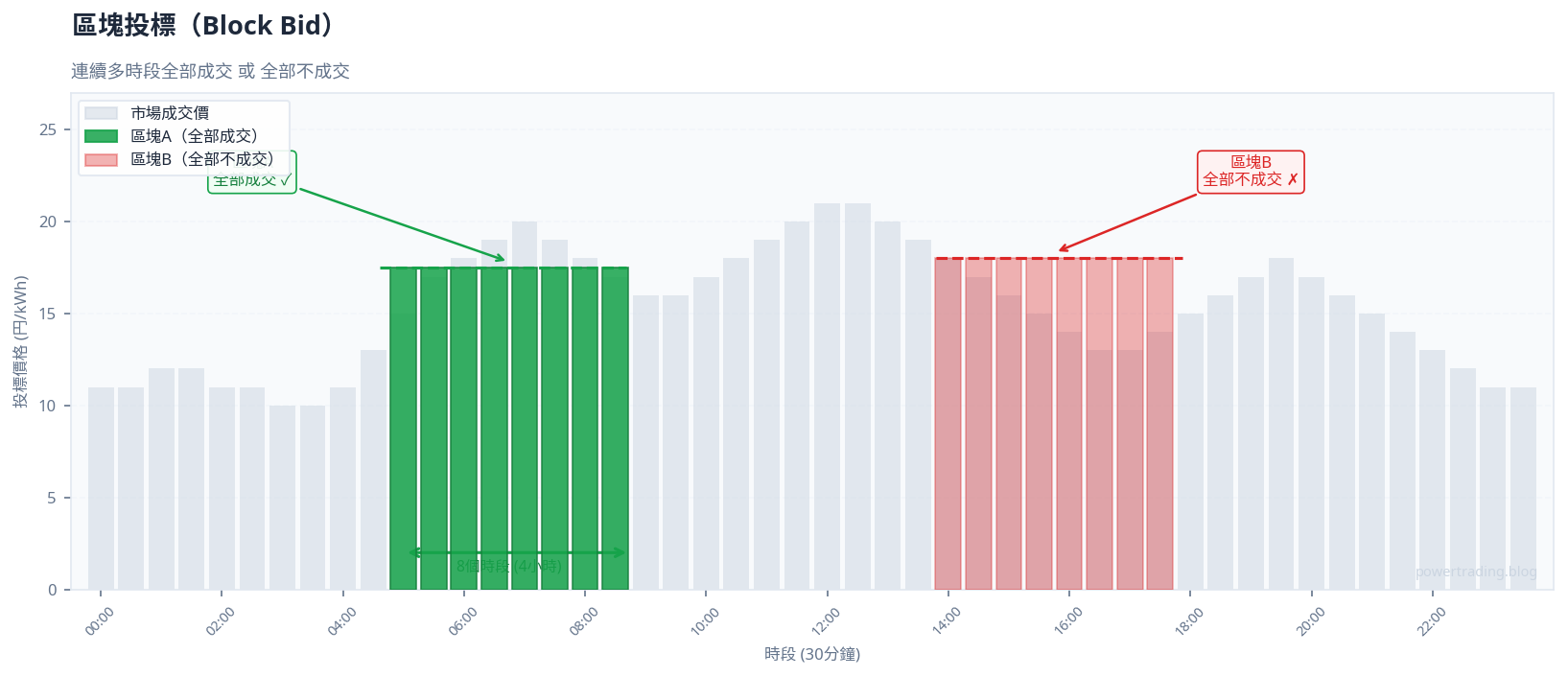
區塊投標允許投標者將連續多個時段打包為一個「區塊」,設定統一的投標價格。成交條件為全部時段同時成交,或全部時段均不成交(All-or-Nothing)。
2.1 投標規格
| 項目 | 規格 |
|---|---|
| 時段範圍 | 連續 2 ~ 48 個時段 |
| 投標價格 | 統一設定(加權平均概念) |
| 成交條件 | 區塊內所有時段的加權平均市場價 ≥ 投標價(賣方) |
| 成交方式 | 全部成交或全部不成交 |
| 每日最大區塊數 | 賣方 20 個、買方 20 個 |
2.2 適用場景
區塊投標主要用於保障火力發電機組的最低出力(Minimum Output)需求。火力機組一旦啟動,必須維持一定時間的最低出力才符合經濟效益;若市場只有部分時段成交,機組可能被迫在不經濟的條件下運行。區塊投標確保機組要麼在整個計劃運行時段內全部出售電力,要麼完全不進入市場,從而保護機組的經濟性。
[實務提示]
區塊投標的成交判斷基於各時段市場成交價的加權平均,而非每個時段單獨比較。因此,即使某些時段的市場價低於投標價,只要加權平均達標,整個區塊仍可成交。這為投標者提供了一定的靈活性。
3. 連結區塊投標(Linked Block Bid)
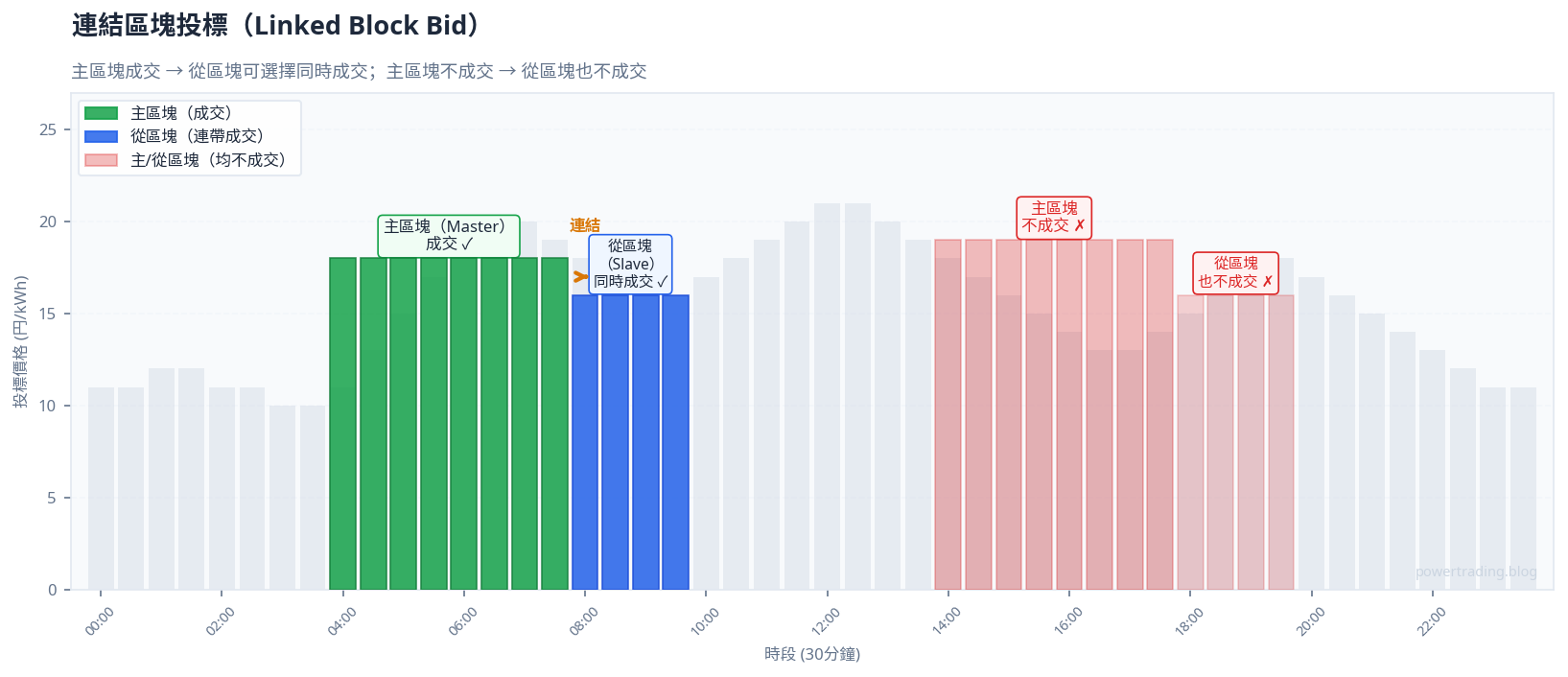
連結區塊投標是區塊投標的進階版本,允許設定「主區塊(Master Block)」與「從區塊(Slave Block)」的連結關係。成交規則為:主區塊成交時,從區塊可選擇同時成交;主區塊不成交時,從區塊也強制不成交。
3.1 投標規格
| 項目 | 規格 |
|---|---|
| 結構 | 1個主區塊 + 1個或多個從區塊 |
| 時段範圍 | 主從區塊各自為連續時段,時段可不重疊 |
| 成交條件 | 主區塊成交 → 從區塊可成交;主區塊不成交 → 從區塊必不成交 |
| 從區塊獨立成交 | 不允許(必須依附主區塊) |
3.2 適用場景
連結區塊投標適合主從機組聯合運行的場景。例如,一座大型火力電廠(主機)在啟動後,其餘熱可供給一座汽電共生機組(從機)使用;若主機未能成交,從機也無法單獨運行。透過連結區塊投標,兩台機組的出力可以在市場中作為一個整體進行管理,避免部分成交導致的運營困境。
4. 循環區塊投標(Exclusive Block Bid)
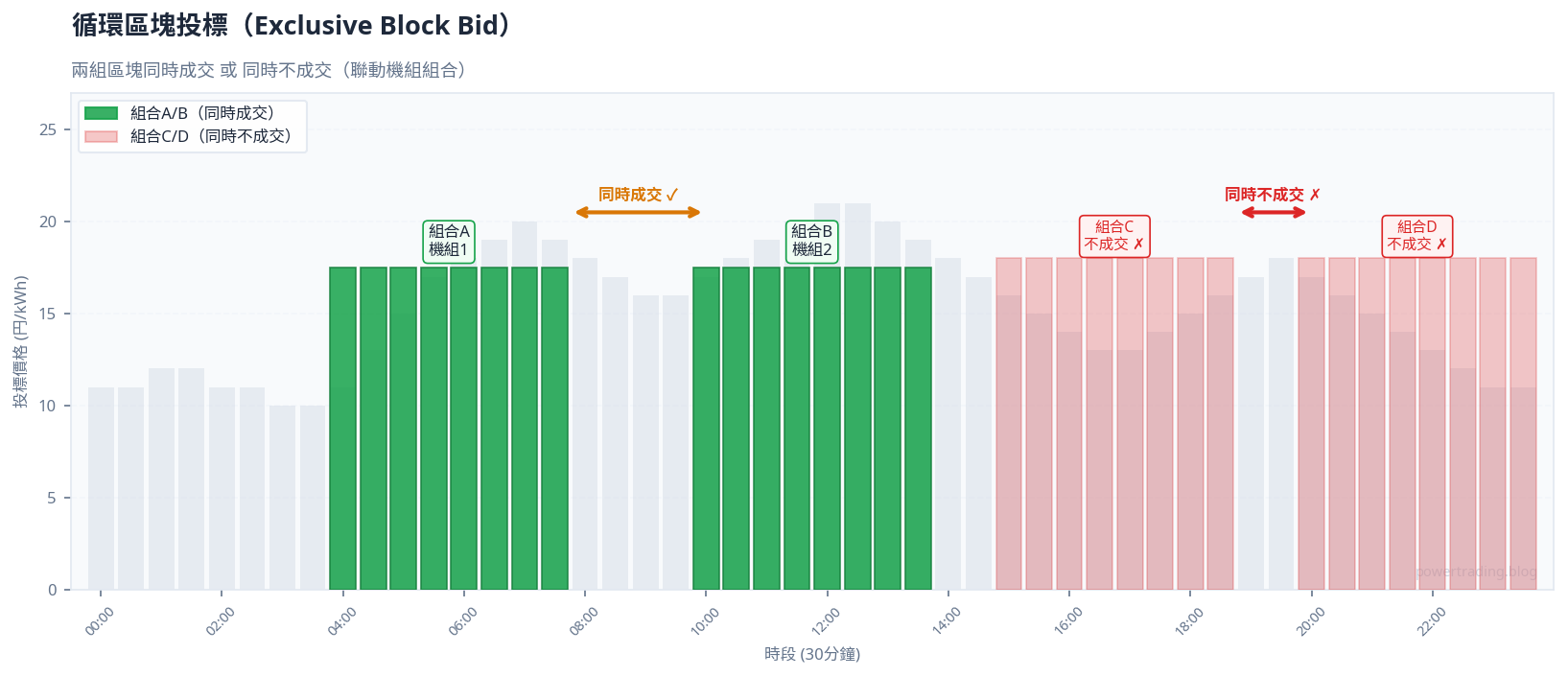
循環區塊投標允許投標者設定兩組區塊,要求兩組同時成交,或兩組同時不成交。與連結區塊不同,循環區塊中兩組的地位是對等的,沒有主從之分。
4.1 投標規格
| 項目 | 規格 |
|---|---|
| 結構 | 兩組對等區塊(Group A + Group B) |
| 時段範圍 | 各組為連續時段,兩組時段可不重疊 |
| 成交條件 | 兩組加權平均市場價均達標 → 同時成交;任一組未達標 → 兩組均不成交 |
| 單組獨立成交 | 不允許 |
4.2 適用場景
循環區塊投標適合兩台機組需要聯動運行的情境,例如兩台燃氣輪機組合循環(GTCC)中的燃氣輪機與蒸汽輪機,或兩座需要協同調度的水力機組。當兩台機組的出力必須同時進入市場才能達到最佳經濟效益時,循環區塊投標可確保市場要麼接受整個組合,要麼完全拒絕,避免單台機組孤立運行的低效狀況。
5. 條紋投標(Stripe Bid)
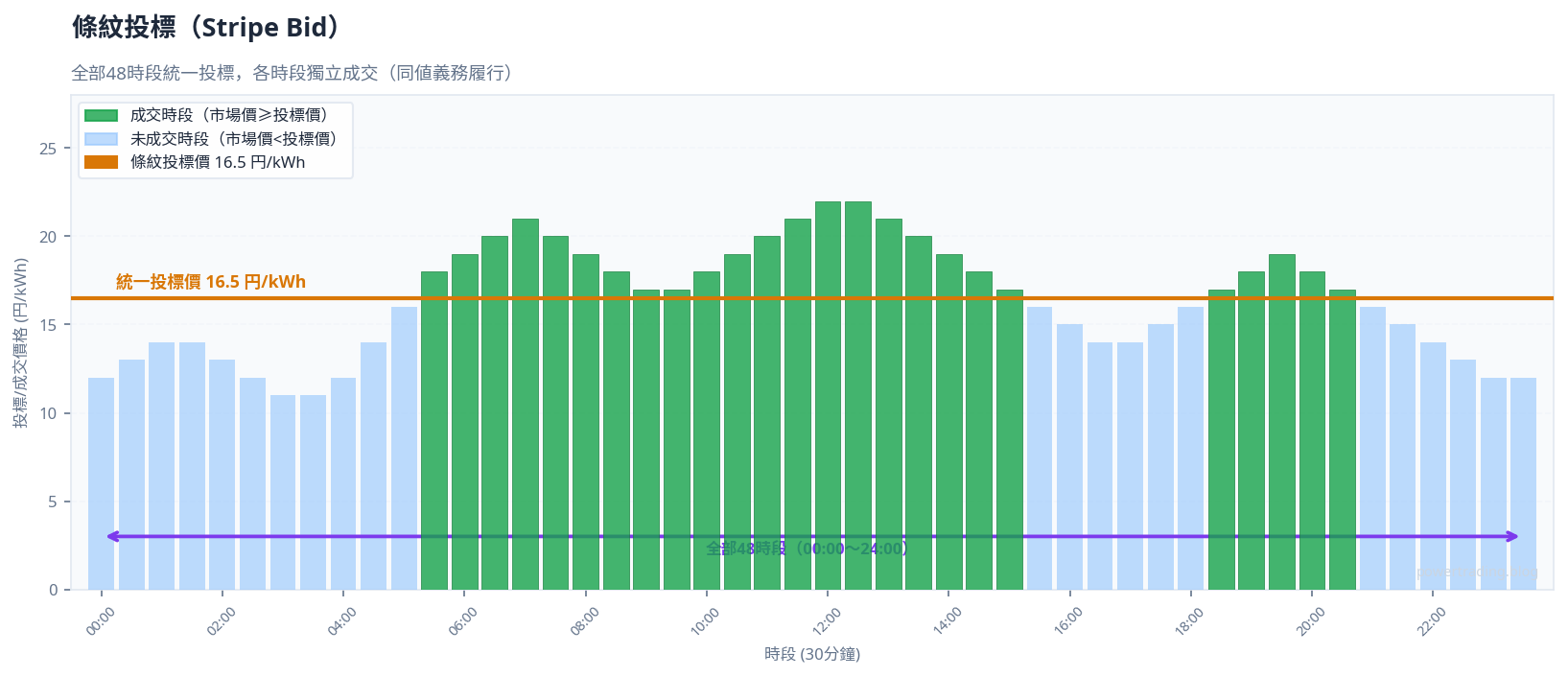
條紋投標是一種特殊的投標方式,強制覆蓋全部 48 個時段,每個時段可設定不同的投標價格,但各時段仍獨立成交。條紋投標的核心用途是履行同値義務(Same-Value Obligation)——日本零售電力業者依法必須在 JEPX 現貨市場對全部 48 個時段提交買入投標。
5.1 投標規格
| 項目 | 規格 |
|---|---|
| 時段範圍 | 強制覆蓋全部 48 個時段 |
| 每時段價格 | 可各自設定(不需統一) |
| 成交方式 | 各時段獨立成交(與通常投標相同) |
| 主要義務 | 零售電力業者同値義務履行 |
| 投標方向 | 買入投標(零售業者)或賣出投標 |
5.2 同値義務說明
根據日本電力系統改革規定,持有供電合約的零售電力業者必須在 JEPX 現貨市場對次日全部 48 個時段提交與其預測需求量相同的買入投標(同値義務)。條紋投標正是為此設計——業者可以一次性完成全 48 時段的投標,且每個時段可根據預測市場價格設定不同的投標價,兼顧合規義務與投標效率。
[合規提示]
未履行同値義務的零售電力業者將面臨不平衡費用的懲罰性收費。由於不平衡費用在供需緊張時期可能遠高於市場成交價,條紋投標的合規管理對零售業者的財務健康至關重要。
6. 五種投標方式比較
| 投標方式 | 時段範圍 | 成交方式 | 主要用途 | 典型使用者 |
|---|---|---|---|---|
| 通常投標 | 單一時段 | 各時段獨立 | 一般電力買賣 | 所有參與者 |
| 區塊投標 | 連續多時段 | 全部成交或全部不成交 | 機組最低出力保障 | 火力、核能發電業者 |
| 連結區塊 | 連續多時段(主從) | 主成交或主從同時成交 | 主從機組聯合運行 | 汽電共生、複合機組 |
| 循環區塊 | 連續多時段(兩組) | 兩組同時成交或不成交 | 聯動機組組合 | GTCC、協同水力機組 |
| 條紋投標 | 全部 48 時段 | 各時段獨立 | 同値義務履行 | 零售電力業者 |
7. 投標策略實務建議
混合使用多種投標方式:實務中,一個市場參與者往往同時使用多種投標方式。例如,一家擁有火力機組與蓄電池的電力公司,可能對火力機組使用區塊投標保障最低出力,同時對蓄電池使用通常投標靈活套利,並以條紋投標履行零售側的同値義務。
區塊投標的加權平均計算:在提交區塊投標前,應仔細計算各時段預期市場成交價的加權平均,確認投標價格設定合理。若市場價格波動較大,應考慮縮短區塊時段長度,或分拆為多個較短的區塊,以降低全部不成交的風險。
條紋投標的價格設定:零售業者在設定條紋投標價格時,通常會在預測市場成交價的基礎上加上一定溢價,確保在大多數時段都能成交,從而完成同値義務。但也需注意避免在低價時段以過高價格成交,增加不必要的採購成本。
詳細的 JEPX 市場制度說明,包括市場參與者類型、成交機制與合規義務,請參閱第 21 篇:JEPX 交易制度完全指南。
JEPX 五種類の入札方式完全解説:通常入札・ブロック入札・リンクブロック・エクスクルーシブブロック・ストライプ入札
はじめに:なぜ複数の入札方式が必要か?
JEPXスポット市場(一日前市場)では、翌日の48コマ(30分単位)の電力を毎日取引します。電力生産には物理的な制約があります——発電機には最低出力制限があり、起動・停止コストが高く、一部の機組は連携して運転する必要があります。このため、単純な「各コマ独立入札」だけでは全ての市場参加者のニーズを満たすことができません。JEPXはこうした実情に対応するため、5種類の入札方式を設計しており、異なるタイプの発電事業者と小売事業者が自社の運営ロジックに合った形で市場に参加できるようにしています。
[5種類の入札方式概要]
JEPXスポット市場は:通常入札(各コマ独立)・ブロック入札(連続コマ全約定または全不約定)・リンクブロック入札(主従機組合)・エクスクルーシブブロック入札(2組連動)・ストライプ入札(全48コマ強制カバー)に対応しています。
1. 通常入札(Normal Bid)
通常入札は最も基本的な入札方式で、全ての市場参加者が利用できます。各30分コマは独立して入札され、各コマの約定・不約定は互いに影響しません。
1.1 入札仕様
| 項目 | 仕様 |
|---|---|
| コマ範囲 | 単一30分コマ |
| 入札単位 | 0.1 MW(100 kW) |
| 価格範囲 | ¥0.01〜¥200/kWh |
| 1コマ最大入札組数 | 売り60組・買い60組 |
| 約定方式 | 各コマ独立、ブラインド・シングルプライスオークション |
1.2 適用場面
通常入札は、水力発電・蓄電池・デマンドレスポンス(DR)資源など柔軟性の高いリソースや、特定の高価格コマに選択的に電力を売却したい小売事業者に適しています。各コマが独立して約定するため、コマごとに異なる価格戦略を設定し、日内価格差を最大限に活用できます。
2. ブロック入札(Block Bid)
ブロック入札では、連続する複数のコマをひとつの「ブロック」としてまとめ、統一した入札価格を設定します。約定条件は全コマが同時に約定するか、全コマが不約定になるか(All-or-Nothing)のいずれかです。
2.1 入札仕様
| 項目 | 仕様 |
|---|---|
| コマ範囲 | 連続2〜48コマ |
| 入札価格 | 統一設定(加重平均概念) |
| 約定条件 | ブロック内全コマの加重平均市場価格 ≥ 入札価格(売り方) |
| 約定方式 | 全約定または全不約定 |
| 1日最大ブロック数 | 売り20個・買い20個 |
2.2 適用場面
ブロック入札は主に、火力発電機の最低出力(Minimum Output)確保に使用されます。火力機は一度起動すると、経済的に合理的な最低出力を一定時間維持する必要があります。一部のコマだけ約定すると、機組が不経済な条件で運転を強いられる可能性があります。ブロック入札を使うことで、計画運転時間全体で約定するか、全く市場に参加しないかを選択でき、機組の経済性を守ることができます。
[実務ポイント]
ブロック入札の約定判定は各コマの市場約定価格の加重平均に基づきます。一部のコマで市場価格が入札価格を下回っていても、加重平均が入札価格以上であれば、ブロック全体が約定します。これにより入札者にある程度の柔軟性が与えられます。
3. リンクブロック入札(Linked Block Bid)
リンクブロック入札はブロック入札の発展形で、「主ブロック(Master Block)」と「従ブロック(Slave Block)」の連携関係を設定できます。約定ルールは:主ブロックが約定した場合、従ブロックも同時に約定可能;主ブロックが不約定の場合、従ブロックも強制的に不約定。
3.1 入札仕様
| 項目 | 仕様 |
|---|---|
| 構造 | 主ブロック1個 + 従ブロック1個以上 |
| コマ範囲 | 主従各々が連続コマ(時間帯は重複不可) |
| 約定条件 | 主約定→従約定可;主不約定→従不約定必須 |
| 従ブロック単独約定 | 不可(主ブロックに依存) |
3.2 適用場面
リンクブロック入札は主従機組の連携運転シナリオに適しています。例えば、大型火力発電所(主機)が起動すると、その排熱を利用するコジェネレーション設備(従機)が稼働できる場合、主機が市場で約定しなければ従機も単独では運転できません。リンクブロック入札を使うことで、2台の機組の出力を市場において一体として管理し、部分約定による運営上の問題を回避できます。
4. エクスクルーシブブロック入札(Exclusive Block Bid)
エクスクルーシブブロック入札では、2組のブロックを設定し、2組が同時に約定するか、2組が同時に不約定になるかのいずれかとなります。リンクブロックと異なり、2組の関係は対等で、主従の区別はありません。
4.1 入札仕様
| 項目 | 仕様 |
|---|---|
| 構造 | 対等な2組のブロック(グループA + グループB) |
| コマ範囲 | 各組が連続コマ(2組の時間帯は重複不可) |
| 約定条件 | 両組の加重平均市場価格が共に基準達成→同時約定;一方でも未達→両組不約定 |
| 単組独立約定 | 不可 |
4.2 適用場面
エクスクルーシブブロック入札は2台の機組が連動して運転する必要があるシナリオに適しています。例えば、ガスタービン複合サイクル(GTCC)のガスタービンと蒸気タービン、または協調運転が必要な2台の水力機組などです。2台の機組の出力が同時に市場に参加することで初めて最適な経済効果が得られる場合、エクスクルーシブブロック入札により、市場が組合せ全体を受け入れるか完全に拒否するかのいずれかとなり、単独機組の孤立運転による非効率を回避できます。
5. ストライプ入札(Stripe Bid)
ストライプ入札は特殊な入札方式で、全48コマを強制的にカバーします。各コマに異なる入札価格を設定できますが、各コマは独立して約定します。ストライプ入札の主な用途は同値義務(Same-Value Obligation)の履行です——日本の小売電気事業者は法令により、JEPXスポット市場において翌日全48コマに対して買い入札を提出する義務があります。
5.1 入札仕様
| 項目 | 仕様 |
|---|---|
| コマ範囲 | 全48コマ強制カバー |
| 各コマ価格 | 個別設定可(統一不要) |
| 約定方式 | 各コマ独立約定(通常入札と同様) |
| 主な義務 | 小売電気事業者の同値義務履行 |
| 入札方向 | 買い入札(小売事業者)または売り入札 |
5.2 同値義務について
日本の電力システム改革の規定により、供給契約を保有する小売電気事業者は、JEPXスポット市場において翌日全48コマに対して予測需要量と同量の買い入札を提出する義務(同値義務)があります。ストライプ入札はこのために設計されており、事業者は一度に全48コマの入札を完了でき、各コマの予測市場価格に応じた入札価格を設定することで、コンプライアンス義務と入札効率を両立できます。
[コンプライアンス注意点]
同値義務を履行しない小売電気事業者はインバランス料金の罰則的な課金を受けます。需給逼迫時にはインバランス料金が市場約定価格を大幅に上回る可能性があるため、ストライプ入札によるコンプライアンス管理は小売事業者の財務健全性にとって極めて重要です。
6. 5種類の入札方式比較
| 入札方式 | コマ範囲 | 約定方式 | 主な用途 | 典型的な利用者 |
|---|---|---|---|---|
| 通常入札 | 単一コマ | 各コマ独立 | 一般電力売買 | 全参加者 |
| ブロック入札 | 連続複数コマ | 全約定または全不約定 | 最低出力保障 | 火力・原子力発電事業者 |
| リンクブロック | 連続複数コマ(主従) | 主約定または主従同時約定 | 主従機連携運転 | コジェネ・複合機組 |
| エクスクルーシブ | 連続複数コマ(2組) | 2組同時約定または不約定 | 連動機組合 | GTCC・協調水力機組 |
| ストライプ入札 | 全48コマ | 各コマ独立 | 同値義務履行 | 小売電気事業者 |
7. 実務上の入札戦略
複数の入札方式の組み合わせ:実務では、一つの市場参加者が複数の入札方式を同時に使用することが多いです。例えば、火力機組と蓄電池を保有する電力会社は、火力機組にはブロック入札で最低出力を確保しつつ、蓄電池には通常入札で柔軟な裁定取引を行い、さらにストライプ入札で小売側の同値義務を履行するといった組み合わせが考えられます。
ブロック入札の加重平均計算:ブロック入札を提出する前に、各コマの予想市場約定価格の加重平均を慎重に計算し、入札価格の妥当性を確認することが重要です。市場価格の変動が大きい場合は、ブロックのコマ数を短くするか、複数の短いブロックに分割して全不約定リスクを低減することを検討してください。
ストライプ入札の価格設定:小売事業者がストライプ入札価格を設定する際は、通常、予測市場約定価格に一定のプレミアムを上乗せして、大多数のコマで約定し同値義務を完了できるようにします。ただし、低価格コマで過高な価格で約定し、不必要な調達コストが増加しないよう注意が必要です。
JEPXの市場制度の詳細(市場参加者の種類・約定メカニズム・コンプライアンス義務)については、第21篇:JEPX取引制度完全ガイドをご参照ください。
JEPX Five Bidding Methods Explained: Normal, Block, Linked Block, Exclusive Block & Stripe Bids
Introduction: Why Multiple Bidding Methods?
The JEPX spot market (day-ahead market) trades electricity for the following day across 48 time slots of 30 minutes each. Electricity generation has physical constraints — generators have minimum output requirements, startup and shutdown costs are significant, and some units must operate in coordination. A simple "each slot bids independently" approach cannot meet the needs of all market participants. To address this, JEPX has designed five bidding methods, enabling different types of generators and retailers to participate in the market in ways that align with their operational logic.
[Five Bidding Methods at a Glance]
The JEPX spot market supports: Normal Bids (each slot independent), Block Bids (all-or-nothing over consecutive slots), Linked Block Bids (master-slave unit combinations), Exclusive Block Bids (two groups linked), and Stripe Bids (mandatory coverage of all 48 slots). These methods can be combined to optimize bidding strategies.
1. Normal Bid
The Normal Bid is the most fundamental bidding method, available to all market participants. Each 30-minute slot is bid independently, and the clearing outcome of each slot does not affect any other slot.
1.1 Bid Specifications
| Item | Specification |
|---|---|
| Slot Range | Single 30-minute slot |
| Bid Unit | 0.1 MW (100 kW) |
| Price Range | ¥0.01 – ¥200/kWh |
| Max Bid Orders per Slot | 60 sell orders, 60 buy orders |
| Clearing Method | Per-slot independent, blind single-price auction |
1.2 Use Cases
Normal Bids are suited for flexible resources such as hydropower, batteries, and demand response (DR) assets, as well as retailers who wish to selectively sell power in specific high-price slots. Since each slot clears independently, bidders can set different price strategies for different slots, fully exploiting intraday price differentials.
2. Block Bid
A Block Bid allows bidders to bundle consecutive slots into a single "block" with a unified bid price. The clearing condition is all slots clear simultaneously, or none clear at all (All-or-Nothing).
2.1 Bid Specifications
| Item | Specification |
|---|---|
| Slot Range | 2 to 48 consecutive slots |
| Bid Price | Unified (weighted average concept) |
| Clearing Condition | Weighted average market price across all block slots ≥ bid price (sell side) |
| Clearing Method | All contracted or all not contracted |
| Max Blocks per Day | 20 sell blocks, 20 buy blocks |
2.2 Use Cases
Block Bids are primarily used to guarantee the minimum output (Minimum Output) requirements of thermal power units. Once a thermal unit starts, it must maintain a minimum output level for a certain period to be economically viable. If only some slots clear, the unit may be forced to operate under uneconomic conditions. Block Bids ensure that the unit either sells power across the entire planned operating period or stays out of the market entirely, protecting the unit's economic viability.
[Practical Tip]
Block Bid clearing is determined by the weighted average of market clearing prices across all slots in the block, not slot-by-slot comparison. Therefore, even if some slots have market prices below the bid price, the entire block can still clear as long as the weighted average meets the threshold. This provides bidders with a degree of flexibility.
3. Linked Block Bid
The Linked Block Bid is an advanced form of the Block Bid, allowing bidders to establish a linkage between a "Master Block" and one or more "Slave Blocks." The clearing rule is: when the Master Block clears, the Slave Block(s) may also clear simultaneously; when the Master Block does not clear, the Slave Block(s) are also forced not to clear.
3.1 Bid Specifications
| Item | Specification |
|---|---|
| Structure | 1 Master Block + 1 or more Slave Blocks |
| Slot Range | Master and slave each cover consecutive slots (non-overlapping) |
| Clearing Condition | Master clears → Slave may clear; Master does not clear → Slave must not clear |
| Slave Independent Clearing | Not permitted (must depend on Master) |
3.2 Use Cases
Linked Block Bids are suited for master-slave unit combined operation scenarios. For example, when a large thermal power plant (master unit) starts up, its waste heat can be used by a cogeneration facility (slave unit); if the master unit fails to clear the market, the slave unit cannot operate independently. Through Linked Block Bids, the output of both units can be managed as a whole in the market, avoiding operational difficulties caused by partial clearing.
4. Exclusive Block Bid
The Exclusive Block Bid allows bidders to set two groups of blocks, requiring both groups to clear simultaneously, or both groups to be rejected simultaneously. Unlike Linked Block Bids, the two groups in an Exclusive Block Bid are equal in status — there is no master-slave distinction.
4.1 Bid Specifications
| Item | Specification |
|---|---|
| Structure | Two equal groups (Group A + Group B) |
| Slot Range | Each group covers consecutive slots (non-overlapping) |
| Clearing Condition | Both groups' weighted average market prices meet threshold → both clear; either group fails → both rejected |
| Single Group Independent Clearing | Not permitted |
4.2 Use Cases
Exclusive Block Bids are suited for scenarios where two generating units must operate in coordination, such as the gas turbine and steam turbine in a Gas Turbine Combined Cycle (GTCC) plant, or two hydropower units that require coordinated dispatch. When the output of two units can only achieve optimal economic benefit by entering the market simultaneously, the Exclusive Block Bid ensures the market either accepts the entire combination or rejects it completely, avoiding the inefficiency of isolated single-unit operation.
5. Stripe Bid
The Stripe Bid is a special bidding method that mandatorily covers all 48 time slots. Each slot can have a different bid price, but slots still clear independently. The core purpose of Stripe Bids is to fulfill the Same-Value Obligation — Japanese retail electricity suppliers are legally required to submit buy bids for all 48 slots in the JEPX spot market for the following day.
5.1 Bid Specifications
| Item | Specification |
|---|---|
| Slot Range | Mandatory coverage of all 48 slots |
| Per-Slot Price | Individually configurable (no need to be uniform) |
| Clearing Method | Per-slot independent (same as Normal Bid) |
| Primary Obligation | Retail supplier same-value obligation compliance |
| Bid Direction | Buy bids (retailers) or sell bids |
5.2 Same-Value Obligation Explained
Under Japan's electricity system reform regulations, retail electricity suppliers holding supply contracts are obligated to submit buy bids equal to their forecast demand quantity for all 48 slots in the JEPX spot market for the following day (Same-Value Obligation). Stripe Bids are designed precisely for this purpose — suppliers can complete bids for all 48 slots at once, setting different bid prices for each slot based on forecast market prices, balancing compliance obligations with bidding efficiency.
[Compliance Note]
Retail electricity suppliers that fail to fulfill the Same-Value Obligation face punitive imbalance charges (インバランス料金). Since imbalance charges can far exceed market clearing prices during periods of supply-demand tightness, compliance management through Stripe Bids is critical to the financial health of retail suppliers.
6. Comparison of Five Bidding Methods
| Bidding Method | Slot Range | Clearing Method | Primary Use | Typical Users |
|---|---|---|---|---|
| Normal Bid | Single slot | Per-slot independent | General electricity trading | All participants |
| Block Bid | Consecutive slots | All-or-nothing | Minimum output guarantee | Thermal/nuclear generators |
| Linked Block | Consecutive slots (master-slave) | Master clears or both clear | Master-slave combined operation | Cogeneration, combined units |
| Exclusive Block | Consecutive slots (two groups) | Both clear or neither clears | Linked unit combinations | GTCC, coordinated hydro units |
| Stripe Bid | All 48 slots | Per-slot independent | Same-value obligation compliance | Retail electricity suppliers |
7. Practical Bidding Strategy Recommendations
Combining multiple bidding methods: In practice, a single market participant often uses multiple bidding methods simultaneously. For example, a power company with both thermal units and batteries might use Block Bids to guarantee minimum output for the thermal units, Normal Bids for flexible arbitrage with the batteries, and Stripe Bids to fulfill the same-value obligation on the retail side.
Weighted average calculation for Block Bids: Before submitting a Block Bid, carefully calculate the weighted average of expected market clearing prices across all slots in the block to confirm the bid price is reasonable. When market prices are highly volatile, consider shortening the block duration or splitting into multiple shorter blocks to reduce the risk of full rejection.
Price setting for Stripe Bids: When setting Stripe Bid prices, retailers typically add a premium above the forecast market clearing price to ensure clearing in most slots, thereby completing the same-value obligation. However, care must be taken to avoid clearing at excessively high prices in low-price slots, which would unnecessarily increase procurement costs.
For a detailed explanation of the JEPX market system — including types of market participants, clearing mechanisms, and compliance obligations — please refer to Article 21: JEPX Trading System Complete Guide.