⚠️ Emergency Response Guide
This article is a practical operations manual for retail electricity providers during supply-demand tightening alert events, covering the complete flow from alert reception to post-event reporting. We recommend familiarizing yourself with this content in advance and establishing internal emergency response SOPs.
I. What is a Supply-Demand Tightening Alert?
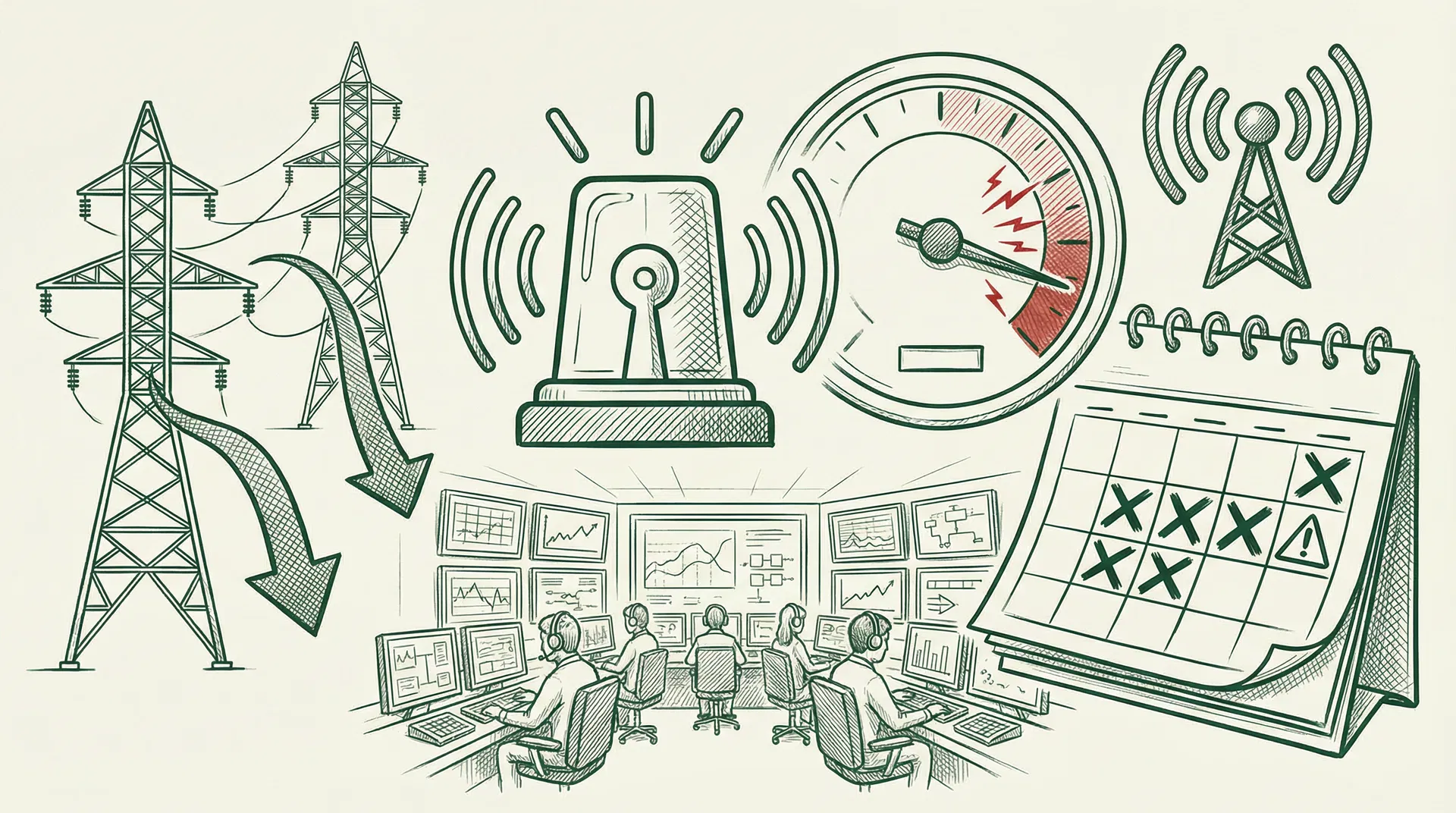
A supply-demand tightening alert (需給ひっ迫警報) is an emergency notification issued by the Organization for Cross-regional Coordination of Transmission Operators (OCCTO) when it predicts a serious deterioration in the electricity supply-demand balance. When the nationwide reserve margin is forecast to fall below specific thresholds, OCCTO issues alerts at different severity levels.
The 2022 post-earthquake event in eastern Japan, the January 2021 cold wave crisis, and the record summer heat of 2024 all triggered supply-demand tightening alerts. These events caused sharp spikes in electricity market prices and inflicted serious financial damage on retail providers who were unprepared.
Historical Alert Events
| Event | Period | Primary Cause | Market Impact |
|---|
| January 2021 Cold Wave | January 2021 | Record low temperatures, LNG inventory shortage | JEPX prices hit ¥200/kWh cap |
| March 2022 Earthquake | March 16, 2022 | Fukushima earthquake caused thermal plant shutdowns | TEPCO area reserve margin below 3% |
| June 2022 Heat Wave | June 27, 2022 | Record high temperatures, demand surge | First-ever "Emergency Power Alert" issued |
| Summer 2024 | August 2024 | Consecutive extreme heat days, reduced solar output | Advisory alerts issued across multiple areas |
II. OCCTO Alert Level System
OCCTO's supply-demand tightening notifications are divided into three levels, each with different issuance criteria and required response measures. Retail electricity providers must clearly understand the meaning of each level and prepare corresponding response plans in advance.
Alert Level Overview
| Level | Name | Reserve Margin Threshold | Issuance Timing | Key Requirements |
|---|
| Advisory | Supply-Demand Tightening Advisory | Reserve margin below 5% (forecast) | Day-ahead or early morning same day | Conservation requests, DR standby |
| Alert | Supply-Demand Tightening Alert | Reserve margin below 3% (forecast) | Day-ahead or same day | Emergency conservation request, DR activation prep |
| Emergency Alert | Emergency Power Supply-Demand Alert | Reserve margin below 1% (forecast or actual) | Same-day real-time | Immediate DR activation, emergency power procurement |
III. Alert Reception and Initial Assessment
OCCTO issues supply-demand tightening alerts through multiple channels. Retail electricity providers must establish reliable alert reception systems, including OCCTO website monitoring, email notification registration, and 24-hour staffing for supply-demand management.
Initial Assessment Checklist
⚡ Initial Confirmation Items After Alert Receipt
①
Confirm alert area: Verify whether your supply area is included in the alert scope
②
Confirm alert level: Distinguish between advisory, alert, and emergency alert, and confirm response flow
③
Check current supply-demand status: Verify deviation between planned and actual values
④
Check DR activation capacity: Confirm available DR volume and response time for contracted DR customers
⑤
Check intraday market: Confirm available procurement volume and current prices for remaining time slots
IV. Emergency DR Activation Procedure
Demand Response (DR) is the most direct and effective means of addressing supply-demand tightening. Retail electricity providers must establish advance DR contracts with high-voltage and extra-high-voltage customers, along with complete activation procedures.
🔴 Emergency DR Activation SOP (Within 30 minutes of alert issuance)
T+0 min: Alert receipt and initial confirmation
Confirm OCCTO alert → Verify own area is affected → Report to supply-demand manager
T+5 min: DR activation decision
Confirm current imbalance volume → Calculate required DR activation volume → List target customers
T+10 min: Activation instructions to customers
Phone/email notification to DR contract customers → Confirm activation volume and time slot → Confirm response
T+15 min: Additional procurement in intraday market
Procure shortfall in JEPX intraday market → Set price ceiling → Execute bids
T+30 min: Revised plan submission
Submit revised planned values to distribution system operator → Begin actual performance monitoring
V. Post-Event Reporting Requirements
| Reporting Recipient | Report Content | Submission Deadline | Legal Basis |
|---|
| Distribution System Operator | Planned vs. actual value deviation report, DR activation results | Next business day | Electricity Business Act, simultaneous supply-demand balancing rules |
| Electricity and Gas Market Surveillance Commission | Report when significant imbalance occurs | Within 10 business days of incident | Electricity Business Act Article 106 |
| OCCTO | DR activation results report (DR contract operators) | By the 10th of the following month | OCCTO Operating Rules |
Conclusion
Responding to supply-demand tightening alerts is an emergency situation where "thinking about it after it happens" is too late for retail electricity providers. During the January 2021 cold wave crisis, many new power retailers who were unprepared were forced to exit the market. With the April 2026 C-value increase, the financial risks during supply-demand tightening events have become even greater. Building the systematic emergency response framework described in this article during normal operations is the foundation for sustainable retail electricity business operations.