Introduction: A €50 Billion Power Bet
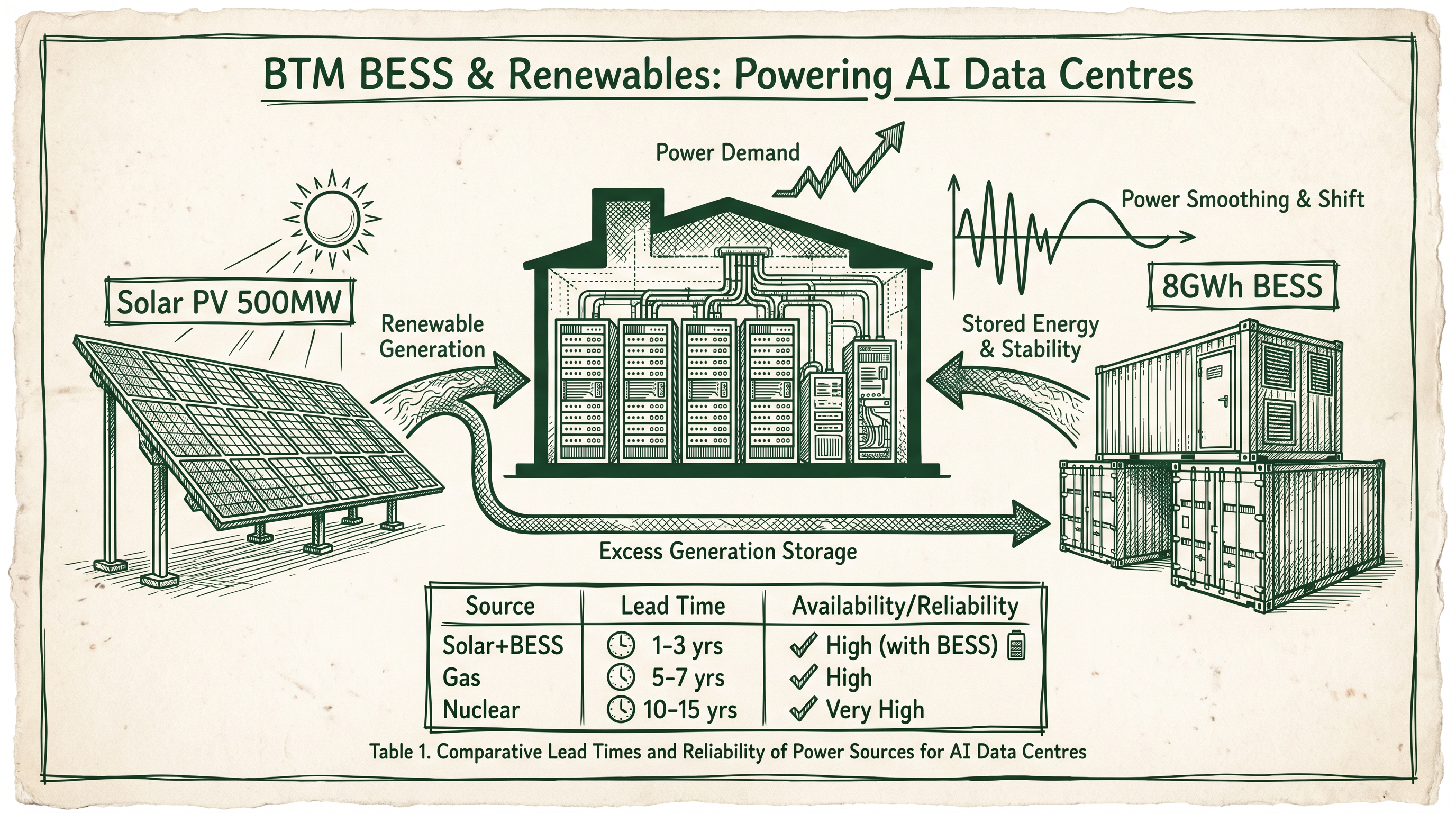
In April 2026, US investment group Pantheon Atlas LLC announced plans to build a 1GW hyperscaler data centre campus in Topusko, Croatia, with a total investment exceeding €50 billion. The headline figure is striking, but the more consequential detail is the power supply model: 500MW of solar generation paired with 8,000MWh (8GWh) of battery energy storage systems (BESS), bypassing conventional grid connections in favour of a fully behind-the-meter (BTM) renewable energy supply [1].
Partner Greenvolt (KKR-owned) will build the BTM renewable energy system. The data centre is scheduled to break ground in Q2 2027 and reach commercial operation in Q1 2029, compliant with NVIDIA's GW-Scale AI Factory standard and Tier IV (99.99999% uptime) certification requirements [1].
This is not an isolated case. It is a concentrated expression of the global tension between exploding AI compute demand and chronically lagging power infrastructure — and a harbinger of a fundamental shift in how data centres will be powered.
Section 1: AI Is Overwhelming Power Infrastructure
The commercialisation of generative AI over the past three years has driven a structural step-change in global data centre power demand. The IEA reports that data centre electricity consumption grew 17% year-on-year in 2025, with AI-dedicated facilities growing even faster [2]. Gartner projects global data centre power consumption will more than double from 448TWh in 2025 to 980TWh by 2030 [3].
Behind these numbers lies the distinctive power profile of AI training workloads. A modern AI training cluster can generate violent power demand swings of hundreds of megawatts on millisecond-to-second timescales — fundamentally different from the predictable, steady-state loads of traditional enterprise IT. This places unprecedented demands on the speed, stability, and capacity of power supply.
Against this backdrop, "Speed-to-Power" has emerged as a new core competitive dimension in hyperscaler site selection, standing alongside — and in many markets surpassing — the traditional priorities of cost and latency.
Section 2: Why Grid Connections Can No Longer Keep Up
The surge in power demand collides directly with the inherent slowness of power infrastructure construction. The wide disparity in lead times across generation types forms the fundamental constraint on data centre siting:
| Generation Type |
Construction Lead Time |
Notes |
| Solar + BESS (BTM) |
1–3 years |
LG Energy Solution estimate [1] |
| Gas / Coal |
5–7 years |
Including permitting and construction |
| Nuclear |
10–15 years |
Including regulatory review and construction |
| Gas turbine (Japan) |
Up to 10 years |
Japan-specific permitting regime [4] |
The consequences of this time gap are visible across major markets. The US PJM grid faces a 6GW+ shortfall in data centre connection capacity; Europe's established data centre hubs (Frankfurt, Amsterdam, Dublin, London) have vacancy rates below 8%, with new power connection slots nearly exhausted [1].
Japan's situation is particularly acute. Yasuo Suzuki, Executive Vice President and Managing Director for Japan and APAC at NTT Global Data Centers, has stated plainly: "In the most concentrated areas, like inner Tokyo, you might have to wait five to 10 years just to get power." [4] Meanwhile, AWS, Oracle, and Microsoft have collectively committed over $26 billion to AI infrastructure in Japan [4], but power supply bottlenecks are forcing many projects to defer to 2029 and beyond.
Section 3: The Technical Logic of BTM BESS
The reason BTM solar + BESS has emerged as the leading solution to the grid connection bottleneck is that it simultaneously satisfies the three core requirements of data centre power supply: speed (deployable in 1–3 years), stability (millisecond-response from BESS), and sustainability (renewable supply enabling 24/7 CFE certification).
Why Solar Alone Is Insufficient
The intermittency of solar generation is its critical weakness. Irradiance varies with cloud cover, season, and time of day, potentially causing large output swings within minutes. For data centres requiring continuous, stable power, this variability is unacceptable. BESS addresses this directly: it acts as a "power buffer" between solar output and data centre load, converting intermittent renewable generation into smooth, predictable electricity supply.
Six Use Cases for BTM BESS in Data Centres
The value of BTM BESS in data centre environments extends well beyond backup power:
| Use Case |
Description |
Primary Benefit |
| Solar output smoothing |
Absorbs irradiance variability, stabilises DC-side voltage |
Power quality assurance |
| Peak shaving |
Reduces demand peaks, lowers grid dependency |
Demand charge reduction |
| UPS replacement / extension |
Replaces lead-acid UPS with lithium BESS |
CapEx and space reduction |
| Grid outage backup |
Maintains operations during grid outages (Tier IV requirement) |
Uptime assurance |
| Grid connection capacity minimisation |
BTM generation reduces required grid connection capacity |
Connection cost reduction |
| Ancillary services monetisation |
Idle BESS capacity provides grid ancillary services |
Incremental revenue |
What AI Loads Demand from BESS
The essential difference between AI training workloads and traditional enterprise IT is their "bursty" character. GPU clusters can ramp from standby to full load within seconds at the start of a training job, generating instantaneous demand shocks of hundreds of megawatts. This requires BESS to deliver millisecond response speed (Power Conversion System performance), sufficient power density (C-rate) for short-duration high-current discharge, and a sophisticated Energy Management System (EMS) to precisely coordinate output allocation across solar, BESS, and grid (or diesel backup).
Section 4: Global Case Comparison
Pantheon AI's Croatia project is not an isolated case but the latest and largest manifestation of a global BTM BESS × data centre trend:
| Project |
Location |
Scale |
BTM Configuration |
Key Feature |
| Pantheon AI |
Topusko, Croatia |
1GW DC |
500MW solar + 8GWh BESS |
Europe's first GW-scale BTM fully-powered DC [1] |
| DTE Energy × Oracle |
Michigan, USA |
$16B |
BESS included in supply plan |
Utility froze rates in exchange for support [5] |
| PowerX × IIJ |
Japan |
Containerised DC |
BESS-integrated container data centre |
Exploring surplus power market sales [6] |
The Croatia project's particular significance lies in demonstrating the economic case for BTM in a market with relatively underdeveloped power infrastructure but abundant renewable resources (Croatia's renewable energy share: 52%) and land costs far below Western European data centre hubs [1]. This provides a replicable template for other emerging markets.
Section 5: Strategic Implications for Japan's Electricity Market
Japan's data centre power challenge is structurally aligned with global trends but carries its own institutional complexity.
Demand-Side Pressure
Wood Mackenzie analysis projects Japan's data centre power consumption will grow from 19TWh in 2024 to as much as 66TWh by 2034 — a 3.5x increase — driving 60% of Japan's total electricity demand growth over the decade [4]. The Tokyo and Kansai regions are expected to see data centres account for approximately 7% of electricity load by 2030.
Against this demand, Japan's power infrastructure faces unprecedented pressure. Inner Tokyo grid connection waits stretch to 5–10 years; the construction queue itself takes up to 3 years; and gas turbine power plants take up to 10 years to complete [4]. In the worst case, the time from decision to power delivery could exceed 15 years.
Opportunities and Challenges for BTM in Japan
For data centre developers deploying in Japan, BTM solar + BESS offers a realistic path around the grid connection bottleneck. However, Japan's market carries specific institutional constraints.
Land constraints are the primary challenge. Prime data centre locations in Japan (greater Tokyo, greater Osaka) carry high land prices, making it difficult to secure the acreage needed for large-scale solar. Distributed installation approaches — rooftop solar, carport solar — and off-site solar combined with self-wheeling (自己託送) arrangements become more practical alternatives.
Legal framework for self-supply: Japan's self-wheeling system allows companies to transmit self-generated power between their own facilities, though cross-jurisdiction procedures are complex. The specific supply (特定供給) system permits supply to specific users within a defined area, providing legal grounding for BTM models in data centre campus configurations.
Reverse power flow restrictions: In some areas, surplus BTM solar power flowing back to the grid is restricted, requiring precise power management to avoid regulatory violations.
Opportunities for Electricity Market Participants
The BTM BESS × data centre trend creates new commercial opportunities across multiple participant types in Japan's electricity market. For retail electricity suppliers, those able to offer integrated "BTM solar + BESS + grid backup" solutions will have a competitive edge in acquiring data centre customers. For BESS developers (PowerX, Sumitomo Corporation, Marubeni, and others with grid-scale BESS development experience), the data centre BTM market offers higher unit margins and more stable long-term contracts than grid-scale BESS. For renewable energy developers, long-term PPAs with data centre developers offer higher power sale prices and longer contract terms than FIT/FIP.
Conclusion: BTM BESS Is Becoming Standard AI Infrastructure
From Pantheon AI in Croatia to PowerX × IIJ in Japan, BTM BESS combined with renewable energy is evolving from "an alternative to grid connection" to "the standard power infrastructure configuration for AI data centres." The fundamental force driving this shift is the irreconcilable tension between explosive AI compute demand and the inherent slowness of power infrastructure construction.
For participants in Japan's electricity market, this trend represents both challenge and opportunity. Those who can most rapidly connect BTM solar + BESS solutions to the needs of data centre developers will be best positioned to capture value in Japan's coming wave of AI infrastructure investment.
References
[1] Energy Storage News, "US investors' €50 billion hyperscaler data centre in Croatia will be fully supplied by BTM solar and batteries" (April 2026),
[2] IEA, "Electricity 2025" (April 2026),
[3] Gartner, "Forecast: Data Center Power Consumption" (November 2025)
[4] Introl, "Japan's $26 Billion Data Center Paradox" (January 2026),
[5] Energy Storage News, "It depends: Designing battery storage for AI data centre co-location is a moving target" (2025),
[6] Data Center Dynamics, "PowerX, IIJ ink MoU to develop BESS-integrated containerized data centers in Japan" (February 2026), https://www.datacenterdynamics.com/en/news/powerx-iij-ink-mou-to-develop-bess-intergrated-containerized-data-centers-in-japan/