Introduction
Japan is at a critical juncture in its journey towards decarbonization, with the Emissions Trading System (ETS) entering full operation in fiscal year 2026. This pivotal moment underscores the nation's commitment to achieving its Green Transformation (GX) goals. However, a significant challenge persists: the market struggles to differentiate GX products and services from their conventional counterparts, making it difficult for buyers to justify the premium often associated with decarbonization value. In response to this, the Ministry of Economy, Trade and Industry (METI) has launched the GX Future Consortium and a new research group in April 2026, signaling a strategic shift towards fostering demand-side innovation and market mechanisms for GX products [1]. This article delves into the background, objectives, and implications of these new initiatives, providing a comprehensive overview for energy market professionals.
The Evolution of Japan's GX Initiatives
Japan's GX strategy has been evolving, moving from an initial focus on supply-side support to a more integrated approach that now actively addresses demand creation. The establishment of the GX Future Consortium marks a significant step in this evolution.
From GX League to GX Future Consortium
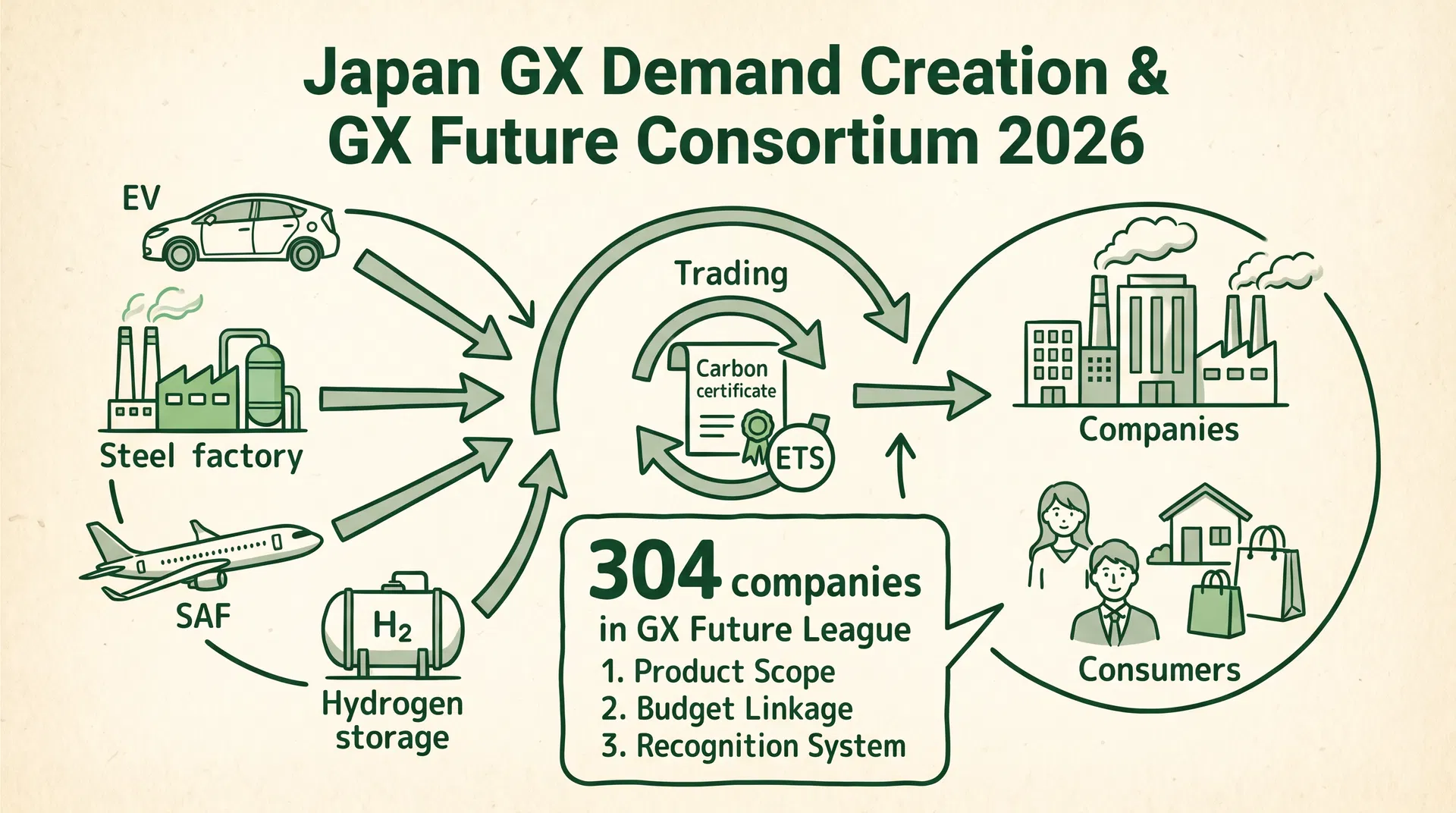
On April 1, 2026, the GX Future Consortium (GXフューチャー・コンソーシアム) was officially launched, succeeding the former GX League. This new entity integrates the functions of the traditional GX League and the TCFD Consortium, aiming for a more cohesive and impactful approach to GX promotion. The Consortium commenced operations with an impressive 304 participating companies, indicating broad industry engagement and a collective commitment to advancing Japan's decarbonization agenda [2].
Membership Requirements and Commitments
Membership in the GX Future Consortium comes with specific, actionable requirements designed to ensure genuine commitment to GX demand creation. Participating companies are mandated to:
- Report 2030 Emission Targets: By October of their joining year, members must report their Scope 1 and Scope 2 emission reduction targets for 2030.
- Report GX Demand Creation Initiatives: Concurrently, members must report their commitments regarding GX demand creation initiatives. These commitments fall into three main categories:
- GX Product/Service Demand Creation: This includes the implementation of the GX Pioneer Declaration and the proactive procurement of GX products.
- Supplier Collaboration: Initiatives aimed at expanding the supplier base for emission reduction efforts.
- Finance: Engagement with financial institutions to support GX-related investments and activities.
These requirements signify a shift from mere endorsement to tangible action, transforming the GX League from a platform for agreement into a mechanism for selecting and promoting concrete actions towards decarbonization [2].
Addressing the GX Product Valuation Challenge
The core problem identified by METI is the difficulty in valuing GX products and services due to their functional similarity to conventional alternatives. The new research group is tasked with tackling this challenge head-on.
The Problem of Undifferentiated GX Products
Many GX products and services, despite their environmental benefits, offer little functional differentiation from their high-carbon counterparts. This lack of perceived value makes it challenging for buyers to justify paying a premium, hindering market adoption and the broader decarbonization effort. The initial GX Pioneer Declaration, launched in December 2024 with 56 companies, aimed to address this by encouraging companies to voluntarily declare their intent to procure GX products. However, METI's research has identified several issues with the current framework [2]:
- Product Categorization: The existing categories are often aligned with supply-side support schemes, making them less intuitive for procurement teams.
- Limited Availability: Some declared products have low market circulation, making actual procurement difficult.
- Loose Association: Companies can declare products with weak links to their core business activities.
- Overstated Impact: Achieving a high grade for a single product can misleadingly elevate the perception of the entire company's GX commitment.
Focus Areas of the New Research Group
The new research group, established in April 2026, will focus on three main discussion topics to refine and strengthen GX demand creation [1]:
- Scope of GX Products/Services: The current GX Pioneer Declaration covers three categories: Industrial Competitiveness Base Products (e.g., EVs, green steel, green chemicals, SAF), Low-carbon hydrogen (e.g., water hydrogen, ammonia, synthetic fuel, synthetic methane), and GI Fund-supported technology products (e.g., offshore wind, next-gen solar, large-scale hydrogen supply chain, electrolytic hydrogen, hydrogen in steel). The research group will explore whether other products and services require early demand creation to accelerate market development.
- Linking Demand Creation with GX Budget: This topic focuses on coordinating supply-side GX subsidies with demand-side initiatives to create a synergistic effect and maximize the impact of government support.
- Publishing Companies with Excellent Demand Creation Initiatives: METI aims to build a system for recognizing and publicizing companies that demonstrate outstanding efforts in GX demand creation. This is intended to foster healthy competition and provide role models for other businesses.
These discussion points highlight a clear intention to make the GX demand creation framework more practical, impactful, and transparent. The goal is to create a market where the decarbonization value of GX products is clearly recognized and rewarded.
The Emissions Trading System Context
The launch of the GX Future Consortium and the new research group occurs within the broader context of Japan's Emissions Trading System (ETS). The ETS entered full operation in FY2026, following a voluntary Phase 1 that began in FY2023. This mandatory phase for large emitters is a cornerstone of Japan's carbon pricing mechanism, designed to incentivize emission reductions across industries [1]. The table below provides a comparison of the phases of Japan's Emissions Trading System.
| Feature |
Phase 1 (FY2023) |
Phase 2 (FY2026) |
| Participation |
Voluntary |
Mandatory for large emitters |
| Objective |
Trial and learning |
Full operation, incentivizing emission reductions |
| Mechanism |
Emissions trading |
Emissions trading |
The integration of demand-side initiatives with the ETS is crucial. While the ETS provides a regulatory push for decarbonization, the GX demand creation efforts aim to create a market pull, ensuring that the economic value of reduced emissions is recognized and rewarded throughout the supply chain. This dual approach is expected to accelerate Japan's transition to a green economy.
Conclusion
Japan's launch of the GX Future Consortium and the new research group in April 2026 represents a strategic and necessary evolution in its GX policy. By focusing on demand creation, refining product categorization, linking initiatives with the GX budget, and recognizing pioneering companies, METI is addressing the critical challenge of valuing decarbonization. These efforts, coupled with the full operation of the Emissions Trading System, are poised to create a robust framework that not only incentivizes emission reductions but also fosters a vibrant market for GX products and services. The success of these initiatives will be crucial in determining Japan's trajectory towards its ambitious climate goals and establishing a sustainable economic future.
References
[1] Ministry of Economy, Trade and Industry. (2026, April 2). 第1回 GX需要創出に向けた研究会 資料4 事務局資料. https://www.meti.go.jp/shingikai/energy_environment/gx_demand/pdf/001_04_00.pdf
[2] SusTB Communications. (2026, April 13). GX需要創出研究会が始動――GXフューチャー・リーグに「調達コミットメント」が加わった. https://sustb.com/hint/2357/