1. Why Does the Balancing Market Exist?
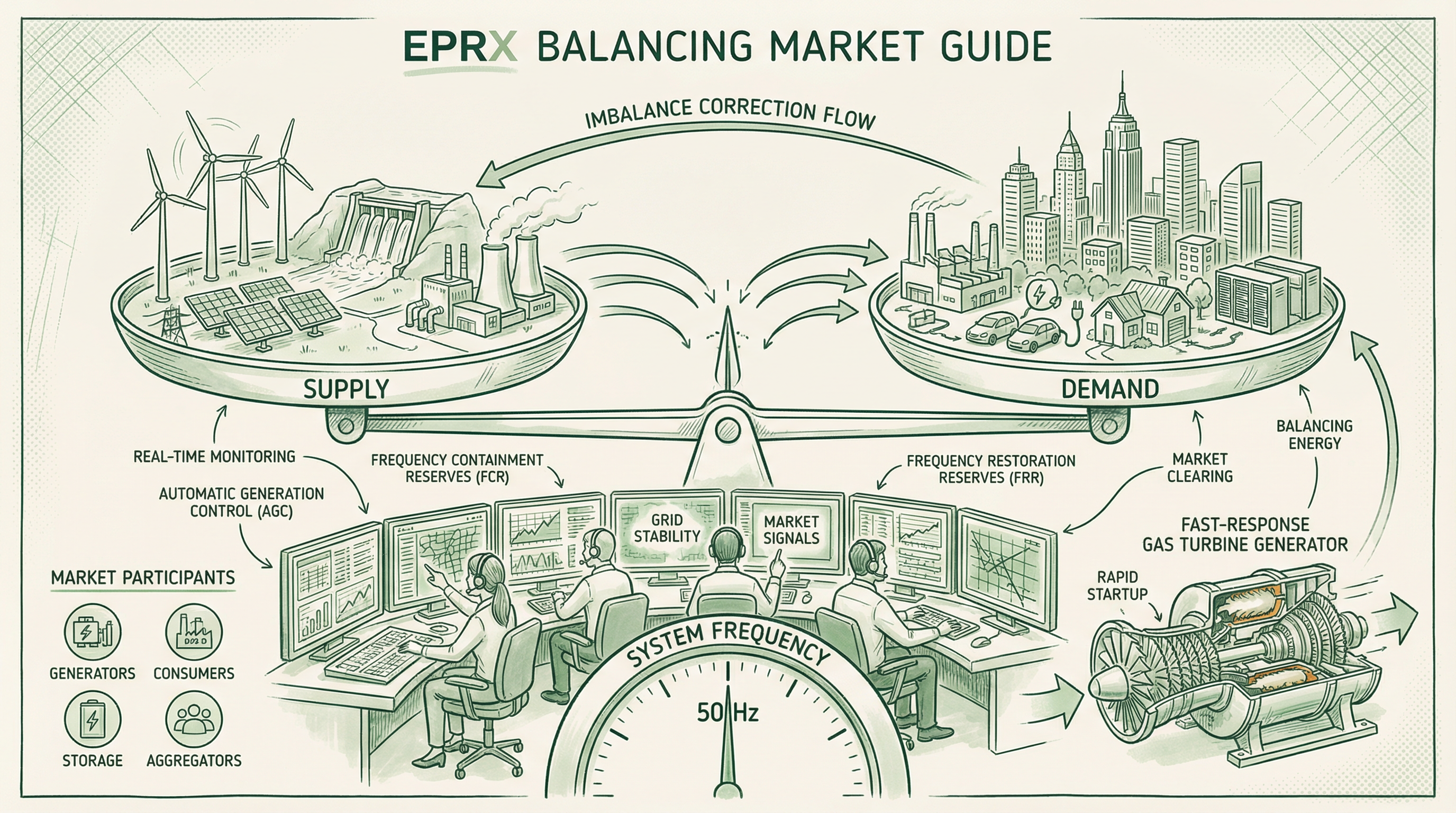
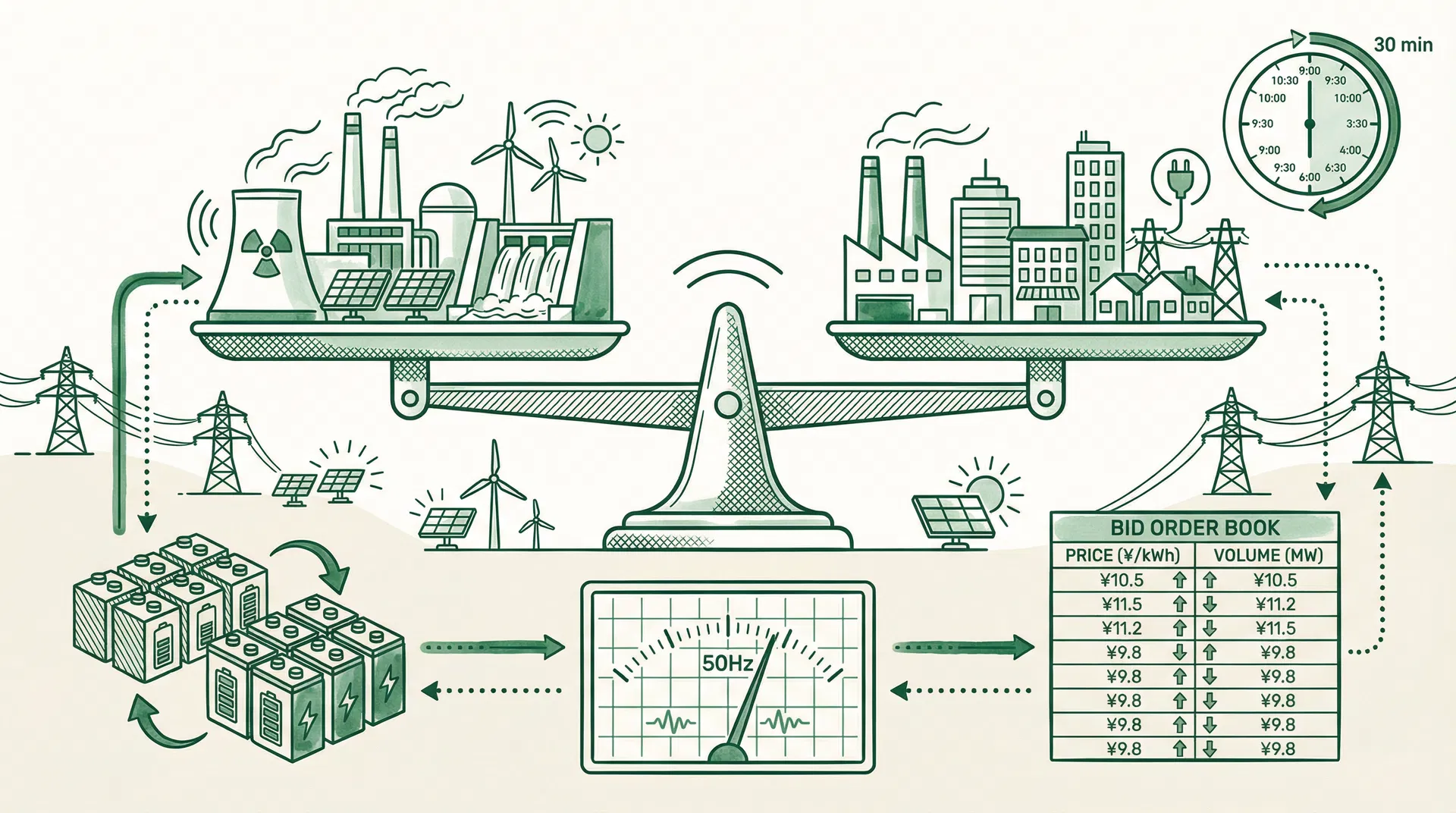
The physical nature of electricity — it cannot be stored at scale — means that generation and consumption must be balanced at every instant. Japan's power system operates under the "simultaneous equal-volume planning system" (keikaku-chi dōji dōryō seido), which requires generators and retailers to match their planned and actual values in 30-minute intervals. In practice, however, demand forecast errors, renewable output variability, and sub-30-minute fluctuations cannot be fully absorbed by planning alone.
Transmission system operators (TSOs) must adjust power output in real time whenever these unplanned deviations occur, maintaining system frequency stability (50 Hz in eastern Japan, 60 Hz in western Japan). This last-resort adjustment capability is known as ancillary services (調整力, chōsei-ryoku).
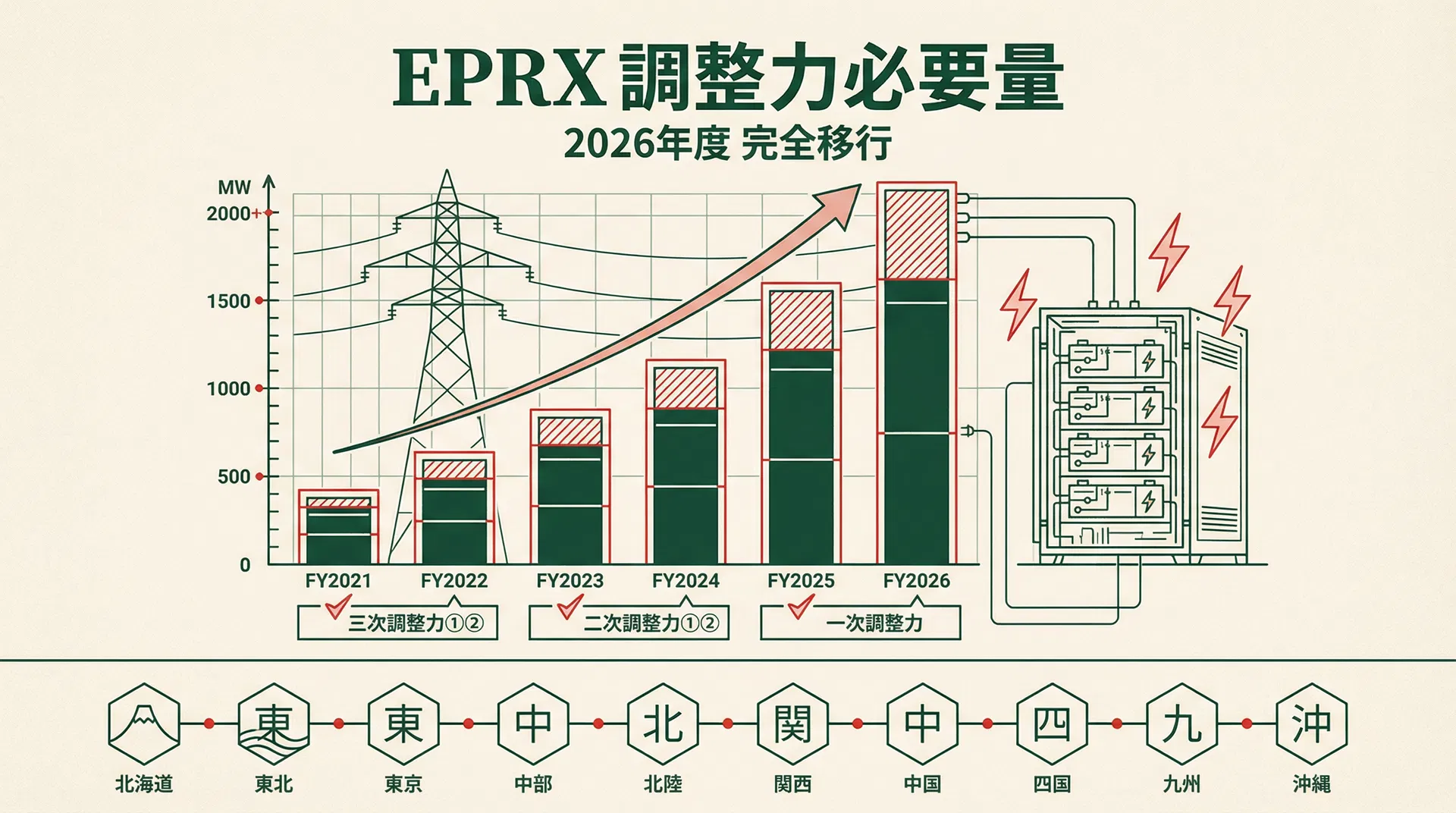
The Japan Electric Power Exchange for Balancing (EPRX) was established to procure these ancillary services transparently through competitive market mechanisms. Operations began in fiscal year 2021, and from fiscal year 2024, all ancillary service procurement has been fully transitioned to market-based acquisition.
### Four Scenarios Requiring Ancillary Services
TSOs require ancillary services to address four distinct scenarios:
| Scenario |
Description |
Primary Product |
| Demand forecast error |
Deviation between forecast and actual consumption |
Tertiary Reserve ② |
| Intra-period fluctuation |
Instantaneous variation within a 30-min planning period |
Primary & Secondary Reserve |
| Generation trip |
Sudden unexpected generator outage |
Tertiary Reserve ① |
| Renewable forecast error |
Solar/wind output prediction error |
Tertiary Reserve ② |
## 2. Five Ancillary Service Products
EPRX classifies ancillary services into five products based on response speed and frequency deviation cycle, each with distinct technical specifications.
### 2-1 Primary Reserve (Governor Free Function)
Primary Reserve addresses ultra-short-cycle (seconds to minutes) frequency deviations. Its defining characteristic is autonomous local control — the generating unit detects local frequency changes and automatically adjusts output without waiting for TSO instructions.
Response time requirement: within 10 seconds (within 30 seconds for offline-monitored units). Minimum duration: 5 minutes. This is the first line of defense for maintaining system inertia, traditionally provided automatically by the governors of large rotating machines (thermal, hydro).
### 2-2 Secondary Reserve ① (Load Frequency Control)
Secondary Reserve ① addresses short-cycle (minutes to tens of minutes) load fluctuations. The TSO's central dispatch center issues commands at 0.5-second to tens-of-seconds intervals, and resources must respond within 5 minutes and sustain output for 30 minutes.
LFC (Load Frequency Control) is the core mechanism for maintaining system frequency within allowable deviation bands, requiring fast and precise output adjustment capability.
### 2-3 Secondary Reserve ② (Economic Dispatch Control — Fast)
Secondary Reserve ② also falls under EDC (Economic Dispatch Control), but differs from Tertiary Reserve ① in its faster response speed. Command interval: seconds to minutes (or 5 minutes); response time: within 5 minutes; duration: 30 minutes.
This product design accommodates fast-responding resources such as battery storage and rapid-start gas turbines, complementing Tertiary Reserve ①.
### 2-4 Tertiary Reserve ① (Economic Dispatch Control — Standard)
Tertiary Reserve ① is the most common ancillary service product, addressing larger-scale supply-demand imbalances such as generation trips. Command interval: seconds to minutes (or 5 minutes); response time: within 15 minutes; duration: 30 minutes.
Most thermal generation units' startup characteristics meet this product's technical requirements, making it currently the highest-volume product in the market.
### 2-5 Tertiary Reserve ② (Renewable Forecast Error Response)
Tertiary Reserve ② is specifically designed to address renewable forecast errors up to gate closure (GC), and has the longest response time (within 60 minutes) and command interval (30 minutes) of all five products.
Because technical requirements are relatively lenient, Tertiary Reserve ② enables participation by a wider variety of resources, including slower-starting generators and distributed resources aggregated through aggregators.
## 3. The Core Logic of ΔkW Trading
### 3-1 What Is ΔkW?
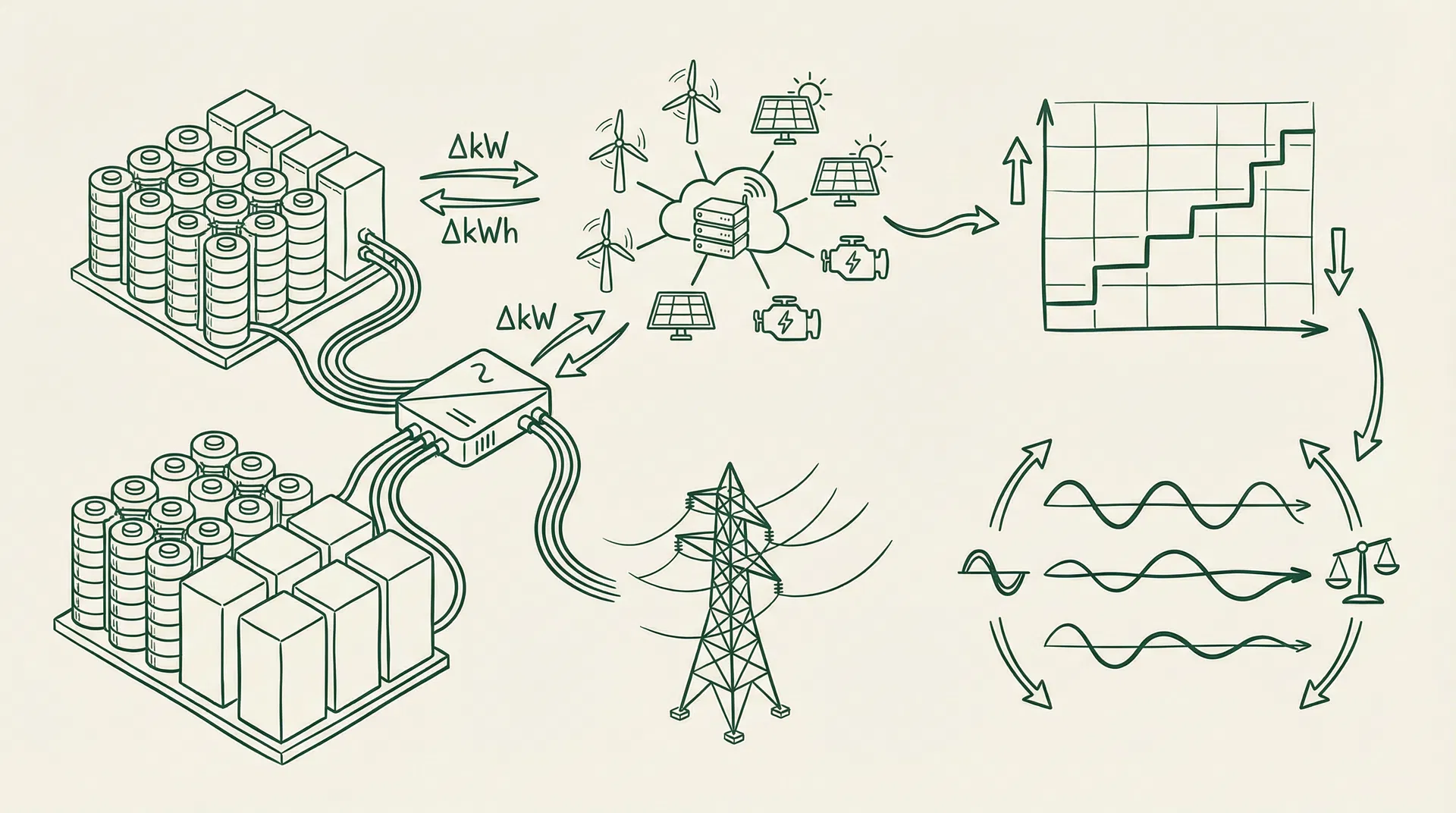
The commodity traded in the balancing market is ΔkW (delta kilowatt), not electricity volume (kWh) itself. ΔkW represents:
Pre-securing generating units and other resources with the necessary capability for each time slot at the point of actual supply, in a state where output can be adjusted.
In other words, what the TSO purchases is a reservation right for adjustment capability, not the actual electricity generated. This forms a three-tier complementary market system alongside the capacity market (kW value) and the wholesale electricity market (kWh value).
### 3-2 Roles of Buyers and Sellers
ΔkW sellers (generators, aggregators) are obligated, after winning a bid, to adjust output according to the contracted volume when a dispatch instruction is issued. In return for maintaining this reserved state, sellers receive ΔkW fees.
ΔkW buyers (TSOs) acquire the right to issue adjustment instructions when needed and pay the corresponding consideration.
Additionally, when the TSO actually issues an activation instruction and ancillary services are deployed, the resulting electricity volume (kWh) is billed separately as adjustment energy fees (調整電力量料金). Sellers set their adjustment energy unit prices in accordance with the Ministry of Economy, Trade and Industry's balancing market guidelines.
### 3-3 Calculating Available ΔkW Supply Capacity
The maximum volume a seller can bid (available ΔkW supply capacity) varies by resource type:
Single generator:
$$Delta kW_{available} = Generation upper limit - Generation plan$$
Demand response:
$$Delta kW_{available} = Total baseline value$$
Battery storage (generation plan submitted):
$$Biddable volume = Battery (discharge) upper limit - Generation plan$$
Battery storage (demand plan submitted):
$$Biddable volume = Battery (discharge) upper limit + Demand plan$$
Note: The April 2026 revision explicitly clarified that available ΔkW supply capacity refers to the value approved through prior screening, not the theoretical maximum.
## 4. Market Participants and Aggregation
### 4-1 Participation Requirements
The eligibility requirements for the balancing market are relatively accessible:
- Corporate legal entity status
- Net assets of at least ¥10 million
- Operator code (or aggregator operator code) from the Organization for Cross-regional Coordination of Transmission Operators (OCCTO)
Notably, no generation business license is required, and there are zero initial costs (membership fees, security deposits), annual fees, or system development/operation fees. This significantly lowers the market entry barrier for emerging resources such as battery storage, VPPs, and demand response.
### 4-2 Resource Types
The market accepts bids from three resource categories:
| Resource Type |
Description |
Representative Resources |
| Generation resource (posiwatt) |
Increases generation output |
Thermal, hydro, battery (discharge) |
| Demand resource (negawatt) |
Suppresses demand |
Industrial DR, battery (charge) |
| Nega-posi hybrid resource |
Suppresses demand then reverse-flows |
Self-generation + battery combination |
### 4-3 Aggregation Bidding Rules
Whether single or aggregated bidding is required depends on resource capacity:
- 1,000 kW or above: Can bid individually
- Below 1,000 kW: Must aggregate through an aggregator before bidding
Resource aggregators serve as bridges connecting households and small businesses to the market. Using VPP (Virtual Power Plant) technology, they bundle distributed resources — rooftop solar, home battery storage, electric vehicles (V2G) — into tradeable ancillary service products.
## 5. Surplus Capacity Utilization
Beyond formal ΔkW market trading, there is an important supplementary mechanism: surplus capacity utilization (余力活用).
Surplus capacity utilization allows TSOs to leverage generators' unplanned surplus output capacity after gate closure, reducing social costs and improving balancing efficiency. Contracts for surplus capacity utilization are concluded directly between resource owners and TSOs, bypassing the market.
At the point of actual supply, TSOs issue activation instructions from both ΔkW contracted resources and surplus capacity resources in ascending order of kWh price, achieving minimum-cost ancillary service deployment.
## 6. Key Points of the April 2026 Revision
EPRX published the second edition of its balancing market guidebook on April 1, 2026. The main updates are as follows:
Product specification changes (page 11): Technical specifications for ancillary service products have been updated, particularly response time and duration requirements for each product.
Clarification of available supply capacity (page 17): It is now explicitly stated that available ΔkW supply capacity refers to the value approved through prior screening. Resources must complete EPRX's prior screening process and can only bid within the approved capacity.
Day-ahead transition for composite products (page 20): The trading timeline for the composite market (primary through tertiary reserve ①) has been shifted to day-ahead. This further separates it structurally from the Tertiary Reserve ② market, carrying significant strategic implications for generators allocating resources between the day-ahead market (spot market) and the balancing market.
## 7. Strategic Implications for Electricity Retailers
For electricity retailers, the balancing market offers three primary strategic entry points:
First, participation in Tertiary Reserve ② through aggregators: If demand-side resources are available (DR capacity from factories or commercial facilities), bundling these through an aggregator for bidding can generate additional revenue without disrupting core operations.
Second, BESS multi-revenue stacking: Owned or leased battery energy storage systems can simultaneously participate in the wholesale market (kWh arbitrage) and the balancing market (ΔkW reservation), enabling multi-layered revenue maximization. The key is precisely calculating optimal resource allocation across time slots.
Third, understanding the balancing market's impact on imbalance fees: When system-wide ancillary service capacity is insufficient, TSOs must procure adjustment resources at higher cost, which indirectly drives up imbalance fee unit prices. Monitoring balancing market supply-demand dynamics enables more accurate forecasting of imbalance risk.
## References