Background: How the Termination of a Single Contract Shook the Market
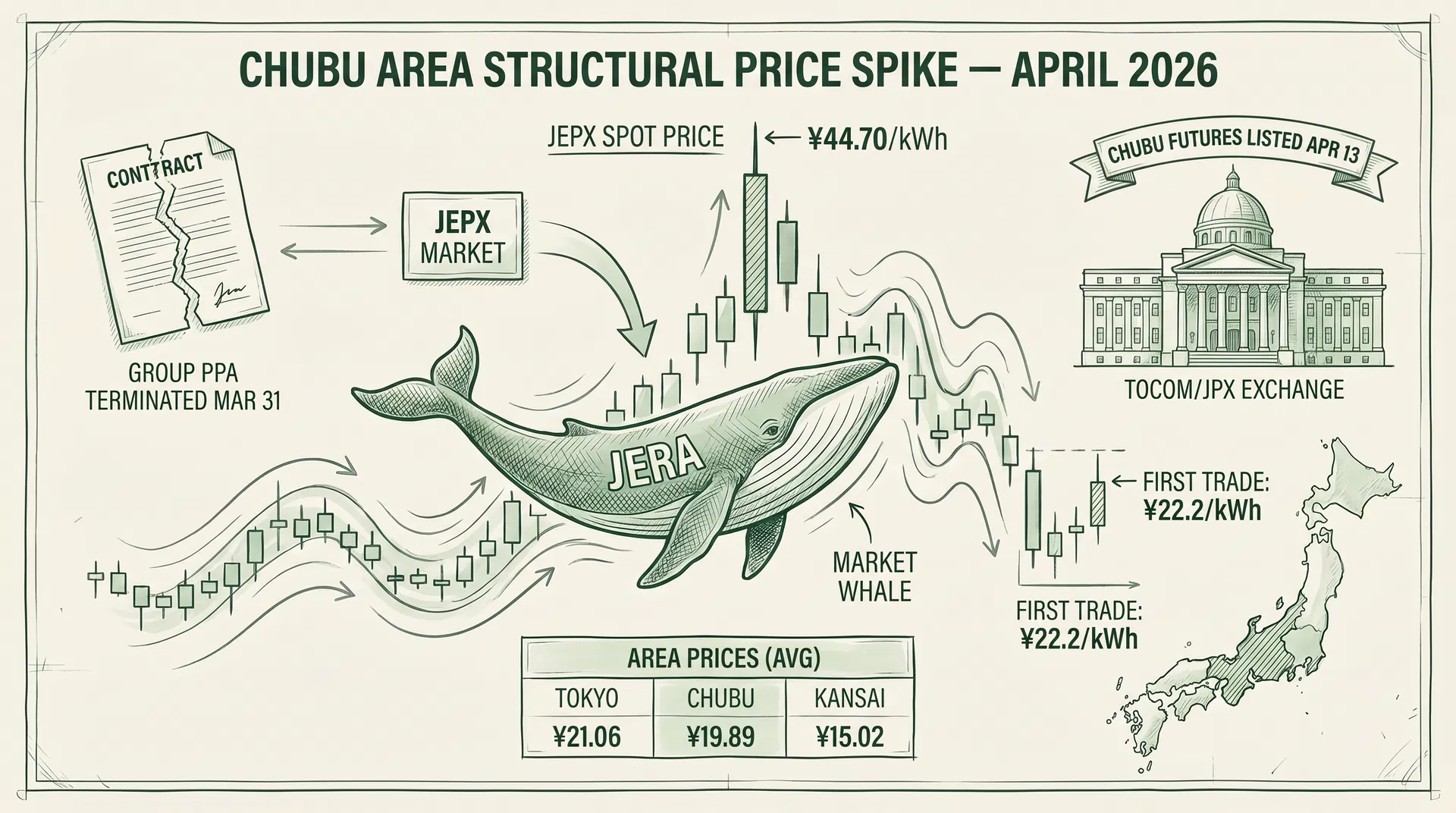
On March 31, 2026, a contract well-known throughout Japan's electricity industry quietly expired. JERA — established as a joint venture between Tokyo Electric Power and Chubu Electric Power, and currently Japan's largest power generation company — formally terminated its "Group-Internal Power Purchase Agreement (Group PPA)" with its parent companies' retail subsidiaries: TEPCO Energy Partner (TEPCO EP) and Chubu Electric Power Miraiz.
The existence of this agreement meant that a substantial volume of electricity produced by JERA could be supplied directly to these group retailers at agreed prices, bypassing the public market entirely. Following the termination, this electricity had to enter the JEPX spot market for open bidding, while TEPCO EP and Chubu Electric Miraiz were forced to procure from the market anew.
The impact was immediate. For the April 1 delivery date, the JEPX spot market saw the system price average jump to ¥23.15/kWh, with a peak of ¥34.6/kWh and the Tokyo area daily average reaching ¥26.96/kWh.
The Whale Enters the Water: The Procurement Behavior Shift of TEPCO EP and Chubu Electric Miraiz
Market analysts described the sudden large-scale entry of TEPCO EP and Chubu Electric Miraiz into the spot market as the "whale (kujira) effect." Both companies have enormous customer bases and face inelastic demand for electricity supply. As a result, they tend to bid at high prices to ensure procurement, rather than bidding at marginal cost.
Market observations indicate that in mid-March, the spot market procurement ratios for the two companies were approximately 2% (TEPCO EP) and approximately 7% (Chubu Electric Miraiz) respectively. By April, TEPCO EP's ratio had rapidly climbed to approximately 30%, while Chubu Electric Miraiz approached 50%. This dramatic shift in procurement behavior directly elevated the floor of the bidding curve, pushing the market equilibrium price upward across the board.
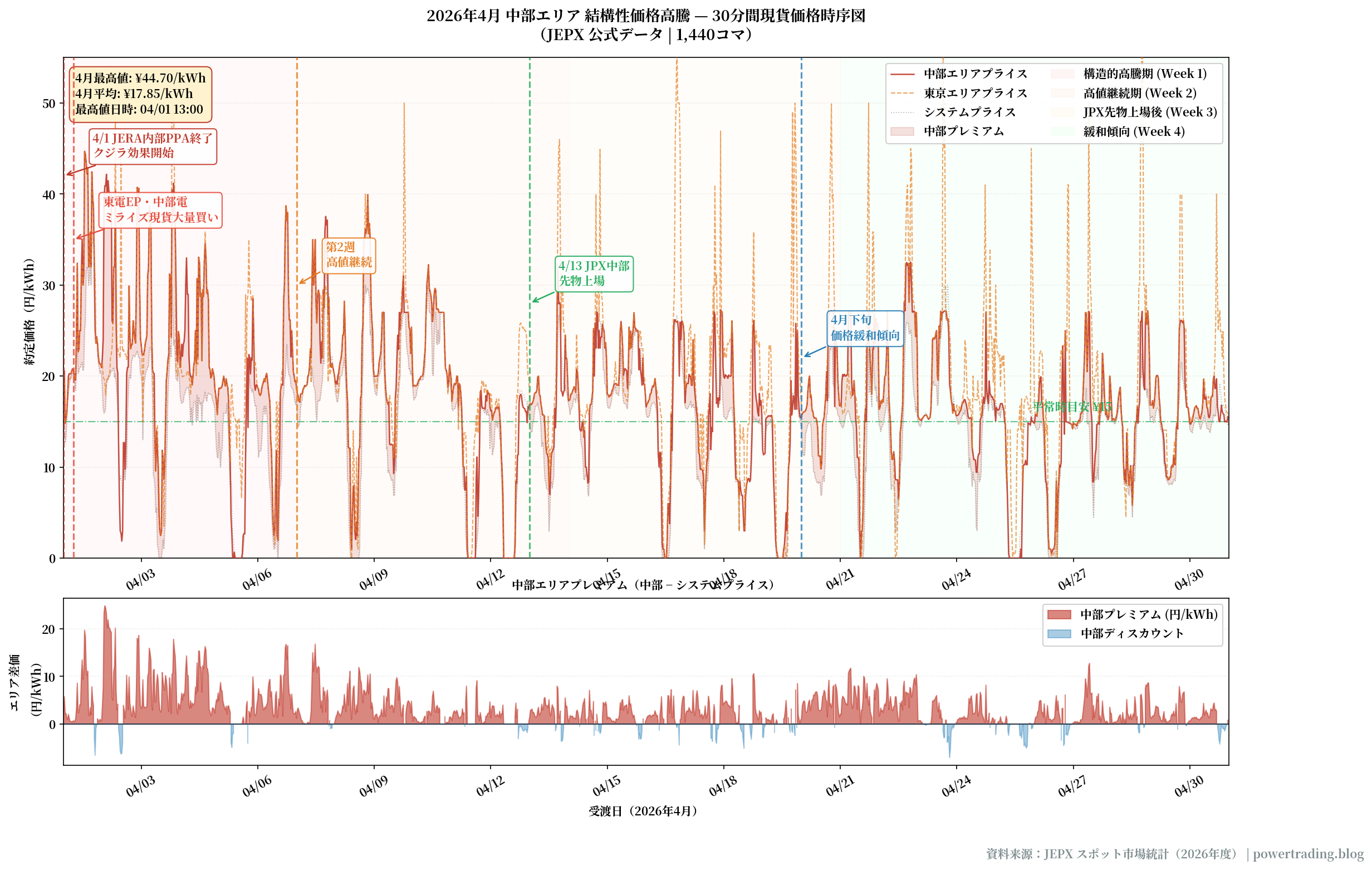
Chubu Area Price Dynamics: Peak at ¥44.70/kWh
The Chubu area price reached a peak of ¥44.70/kWh during April, with a monthly average of ¥17.85/kWh — a substantial increase from the previous month. Transmission capacity constraints between the Chubu and Tokyo areas contributed to isolated price formation in the Chubu region during certain periods.
The following table shows average spot prices for major areas from April 1 to 14:
| Area |
Apr 1–14 Average |
March Average |
Month-on-Month |
| Tokyo |
¥21.06/kWh |
¥14.4/kWh |
+46% |
| Chubu |
¥19.89/kWh |
~¥13.5/kWh |
+47% |
| Kansai |
¥15.02/kWh |
~¥11.0/kWh |
+37% |
| Shikoku |
¥7.63/kWh |
~¥9.0/kWh |
-15% |
While Chubu recorded the second-highest prices after Tokyo, Shikoku actually declined, highlighting a notable expansion of inter-area price divergence.
Multiple Compounding Factors Behind the Price Surge
The price spike was not caused by a single factor, but rather represented a structural phenomenon driven by the convergence of multiple forces.
First factor: JERA's marginal cost bidding and JKM linkage. JERA submits bids based on marginal cost in compliance with market competition regulations. In April 2026, the Japan Korea Marker (JKM) — the Asian LNG spot price benchmark — was trading at elevated levels, which pushed up the baseline of JERA's bid prices.
Second factor: Fuel price increases due to Middle East tensions. Geopolitical risks related to Iran heightened concerns about LNG supply, creating upward pressure on fuel costs.
Third factor: Spring demand-supply dynamics. While spring typically sees lower demand and lower prices, April 2026 saw elevated residual demand on days with reduced solar generation output, with prices spiking particularly in the evening and nighttime hours. Multiple days recorded prices exceeding ¥30/kWh in the 18:00 time slot.
Fourth factor: Market adjustment clause pass-through. Many retail electricity suppliers have incorporated "market adjustment clauses" into their contracts, automatically passing through spot price increases to end consumers. This mechanism caused the price spike to ripple through to actual electricity users.
JPX Chubu Electricity Futures Listing: Expanding Hedging Tools
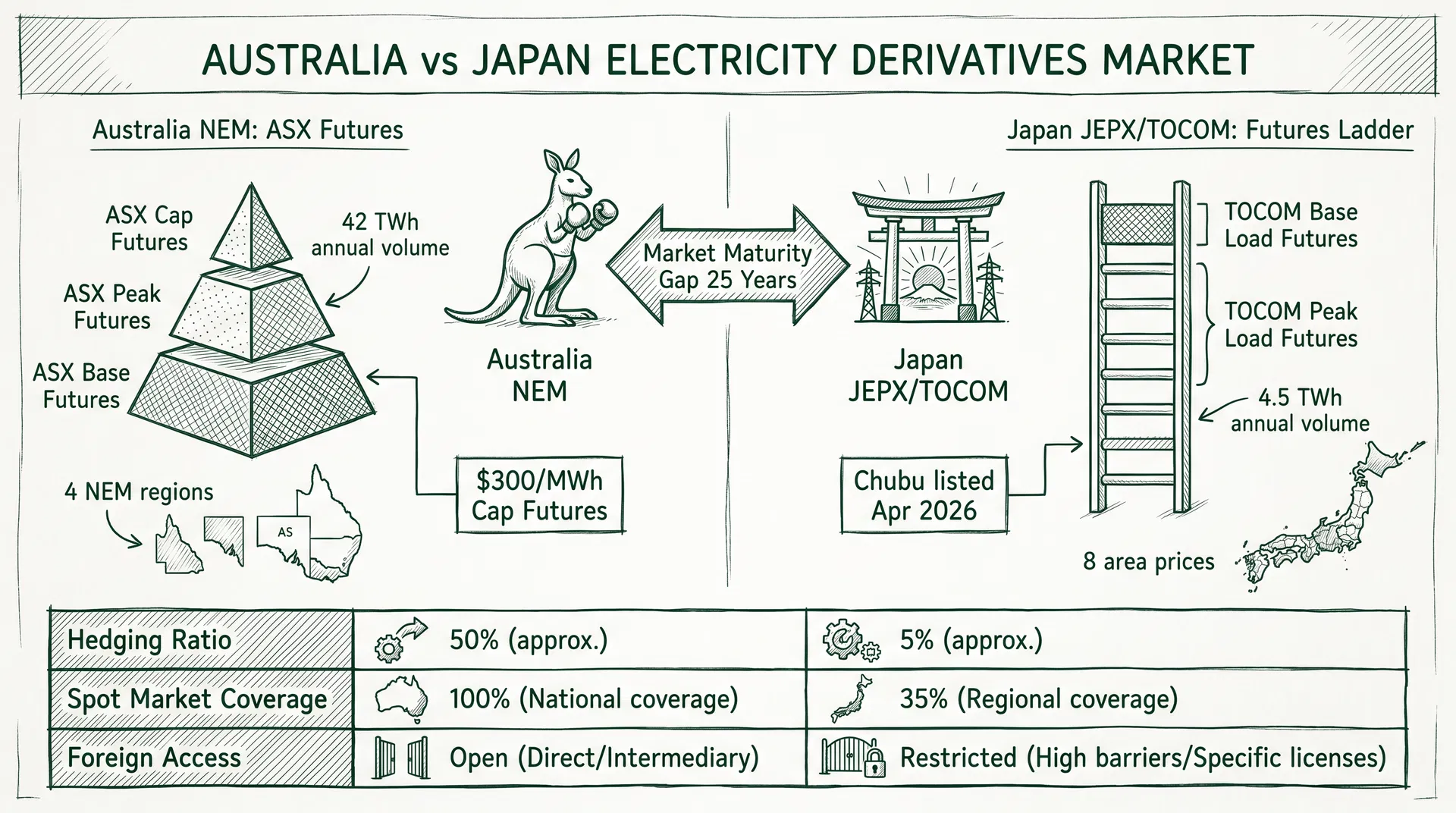
Amid the ongoing price surge, JPX (Tokyo Commodity Exchange, TOCOM Group) commenced trading of Chubu area electricity futures on April 13, 2026. This marked the first domestic exchange-listed futures for the Chubu area, significantly expanding the risk hedging tools available to market participants.
On the first day of trading, 30 contracts (totaling 1.47 million kWh) were executed, with 5 contracts each for the July, August, and September maturities. The base load settlement price was established at ¥22.2/kWh, and the daytime load settlement price at ¥28.15/kWh. The first buyer was Jounetsu Denryoku (based in Matsumoto, Nagano Prefecture), and the first seller was EREX.
While EEX had already been offering Chubu area futures, the TOCOM listing is expected to improve liquidity in the domestic market. Major Chubu area retailers including Toho Gas have expressed expectations for increased futures trading activity.
Market Design Questions at the 10th Anniversary of Full Liberalization
April 1, 2026 marked exactly the 10th anniversary of Japan's full retail electricity liberalization. The fact that on this milestone date, the market's largest player entered the public market and prices surged dramatically raises important questions about Japan's electricity market design.
The termination of the group-internal PPA is a welcome development from the perspective of improving market liquidity. However, the abruptness of the transition left market participants insufficient time to adapt. The Electricity and Gas Market Surveillance Commission addressed this issue at its 605th meeting on April 20, and institutional responses going forward will be closely watched.
Practical Implications: For Retailers and End Consumers
This event has once again highlighted the structural risks inherent in Japan's electricity market. For retail electricity suppliers, diversifying procurement portfolios through TOCOM futures and bilateral contracts is urgent, with particular emphasis on increasing the futures hedging ratio in the Chubu area.
For end consumers, this event provides an opportunity to reassess the risks of market-linked pricing plans. A combination of fixed-price and market-linked plans, or price stabilization through corporate PPAs, may be effective options.
Ten years into electricity liberalization, Japan's electricity market is maturing. Yet the magnitude of the price impact from structural changes such as this one demonstrates that continuous improvement of market design and enhancement of participants' risk management capabilities remain critical challenges.