1. What Is Demand Response?
Demand Response (DR) refers to mechanisms by which electricity consumers voluntarily adjust their consumption patterns in response to grid supply-demand conditions, in exchange for financial compensation or tariff discounts. Unlike traditional supply-side balancing — which involves dispatching additional generation — DR operates on the demand side, stabilizing the grid through load curtailment or time-shifting of consumption.
Japan's DR framework accelerated significantly after the March 2011 Great East Japan Earthquake. The sudden loss of nuclear capacity forced the government to impose mandatory curtailment on industrial users, exposing the fragility of a system that had no structured mechanism for demand-side flexibility. The 2016 full liberalization of the electricity retail market created the regulatory foundation for DR to evolve from emergency rationing into a tradeable market resource.
2. Japan's Three-Tier DR Market Structure
Japan's DR ecosystem is not a single market but a layered structure with three interconnected tiers.
Tier 1: OCCTO Balancing Market (需給調整市場)
The Organization for Cross-regional Coordination of Transmission Operators (OCCTO) began phasing in its balancing market from 2021, allowing utilities, new power suppliers, and aggregators to bid standardized balancing products. Products are classified by response time:
| Product | Response Time | Duration | Typical Resource |
|---|
| Primary Reserve | Within 10 sec | 5 min | Thermal governor |
| Secondary ① (ΔkW) | Within 5 min | 30 min | Fast thermal, battery |
| Secondary ② (kW) | Within 5 min | 30 min | Battery, VPP |
| Tertiary ① (kW) | Within 15 min | 3 hours (changing to 30 min from Apr 2026) | DR, VPP, pumped hydro |
| Tertiary ② (kW) | Within 60 min | 30 min | Industrial DR, controllable load |
For VPP aggregators, Tertiary ① and ② represent the primary entry points, as their response time requirements are relatively relaxed and well-suited to aggregating distributed resources.
Tier 2: TSO Bilateral Contracts
Until the balancing market fully matures, regional Transmission System Operators (TSOs) such as Tokyo Electric Power Grid and Kansai Electric Power Transmission continue to procure balancing capacity through bilateral contracts with large industrial consumers. These contracts are typically annual, requiring specified load reduction (kW) during designated peak periods (primarily summer and winter peaks).
Tier 3: Retail Supplier Load Management
New Power Suppliers (PPS) procuring electricity on the JEPX spot market bear responsibility for their supply-demand plans (計画値). Deviations from plan trigger imbalance charges. This creates a strong incentive for retailers to use DR to reduce customer peak consumption, lowering both procurement costs and imbalance risk. This "retailer-led DR" typically takes the form of tariff incentives such as dynamic pricing rather than direct DR payments.
3. VPP Aggregators: Bridging Distributed Resources and Markets
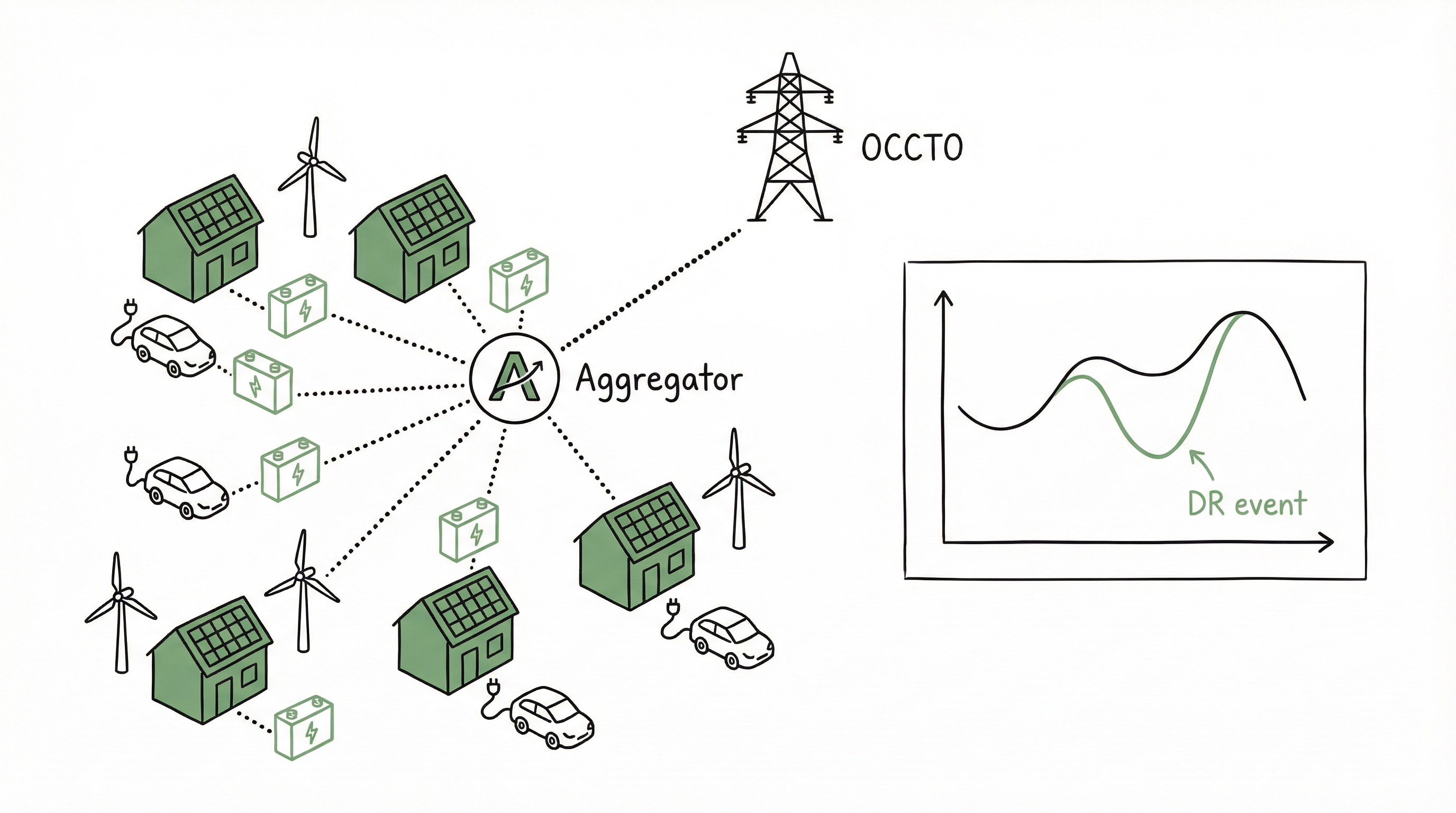
A Virtual Power Plant (VPP) is a system that uses information and communication technology (ICT) to aggregate large numbers of small distributed generation assets, storage systems, and controllable loads, enabling them to participate in electricity markets as a single entity. The VPP aggregator is the core operator of this system.
The Aggregator Business Model
- Resource recruitment: Signing resource provision contracts with factories, commercial buildings, residential solar-plus-storage systems, and EV charging stations, securing the right to dispatch their assets during DR events.
- System integration: Using Energy Management Systems (EMS) and IoT devices to monitor and remotely control each resource's output or consumption in real time.
- Market participation: Bidding the aggregated total capacity (kW) into the OCCTO balancing market or TSO procurement processes, earning capacity payments (kW fees) and dispatch payments (kWh fees).
- Revenue sharing: Distributing market revenues to resource providers according to contractual terms.
4. Practical Participation in OCCTO's Balancing Market
Step 1: Qualification
To participate as an aggregator, registration as a "Specified Wholesale Supplier" (特定卸売供給事業者) with OCCTO is required, along with: building an EMS compliant with OCCTO specifications; standardizing communication interfaces with the regional TSO (typically ECHONET Lite or B-route protocol); completing resource registration (each controllable resource must be individually registered).
Step 2: Product Selection and Bidding
Aggregators select products suited to their resource mix. Battery-dominant VPPs typically target Secondary ②; industrial DR-dominant aggregators typically target Tertiary ①. Bids must specify available capacity (kW), minimum bid volume (currently 500 kW minimum), and bid price (JPY/kW/week).
Step 3: Dispatch and Settlement
Upon award, OCCTO issues dispatch instructions when balancing is needed. Aggregators must complete dispatch within the required timeframe and submit performance reports. Settlement comprises capacity payments (kW fee, based on awarded capacity) and dispatch payments (kWh fee, based on actual dispatch volume).
5. Strategic Implications for Retail Electricity Suppliers
Reducing Imbalance Charge Exposure
When JEPX spot prices spike due to supply-demand tightness (as occurred in January 2021, when system prices briefly exceeded JPY 200/kWh), retailers able to trigger DR and reduce customer consumption can simultaneously reduce high-cost procurement and minimize plan deviations that generate imbalance charges.
Dynamic Pricing Design
Forward-thinking retailers are introducing dynamic pricing tariffs that pass JEPX spot price volatility directly to end users. When spot prices are high, electricity tariffs automatically rise, incentivizing voluntary conservation; when prices are low (e.g., midday solar surplus), tariffs fall, encouraging consumption increases such as EV charging. This "price signal DR" requires no aggregator intermediary and has the lowest operational cost, but depends on customers having smart meters (スマートメーター) and automated equipment.
6. 2026 Policy Reform Priorities
Japan's 7th Strategic Energy Plan (published 2024) sets an explicit target for demand response resources to account for more than 10% of national balancing capacity by 2030. METI and OCCTO are advancing the following reforms:
- Simplified aggregator registration: Lowering entry barriers for small and medium aggregators to enable more startups to participate.
- Reduced minimum bid volume: Progressively reducing the balancing market minimum from 500 kW to 100 kW, enabling smaller VPPs to participate.
- EV as balancing resource: Standardizing Vehicle-to-Grid (V2G) technology to enable EV batteries to serve as dispatchable VPP resources.
- Residential battery integration: Using subsidy policy to accelerate residential battery installation, with VPP interface requirements for newly installed systems.
7. Practical Recommendations
Resource quality matters more than quantity. OCCTO imposes strict dispatch reliability requirements. Aggregators unable to deliver committed reductions at dispatch time face penalty charges. Prioritize high-controllability, stable-response resources such as industrial refrigeration systems and batteries over unpredictable residential load behavior.
The EMS is the core competitive differentiator. The aggregator's competitive advantage lies in the EMS's forecasting accuracy and dispatch speed. The ability to predict each resource's available capacity in advance and respond rapidly to dispatch instructions is the decisive factor in market competitiveness.
Integrate with retail operations. Operators with both retail electricity and aggregation businesses can design integrated "retail + DR" offerings, automatically enrolling customers as VPP resources in exchange for tariff discounts. This model dramatically reduces resource recruitment costs and creates a virtuous cycle between retail customer acquisition and VPP capacity growth.
"Demand response is not merely load shedding — it is the liquidity infrastructure of the electricity market. Retailers who master DR/VPP tools will hold a decisive competitive advantage in tomorrow's high-volatility power market."