Policy Background
The Japanese electricity market has undergone significant structural reforms in recent years, aimed at enhancing market efficiency, ensuring stable power supply, and promoting the integration of renewable energy. A key milestone in this transformation was the Japan Electric Power Exchange (EPRX) abolishing the Weekly Market on March 13, 2026, and fully transitioning to a trading mechanism centered on the Day-Ahead Market. This move is designed to provide more immediate and accurate price signals to cope with the increasingly complex dynamics of electricity supply and demand. Against this backdrop, the importance of the Ancillary Services Market has grown, particularly the Tertiary Reserve, which is responsible for maintaining grid frequency stability and responding to sudden supply-demand imbalances. EPRX regularly updates the required volumes and associated factors for various ancillary services to reflect the latest power system needs and market conditions. This update to the required volume and bidding reduction factor for Tertiary Reserve 2 for April 2026 is precisely to adapt to the new operational mode of the day-ahead market and ensure the stability and economic efficiency of the power system.
Tertiary Reserve 2 is primarily used to respond to unexpected supply and demand fluctuations, operating over a relatively longer duration, and is crucial for the overall stability of the grid. The setting of its required volume and reduction factor directly influences the bidding strategies of power companies and generators in the ancillary services market, which in turn affects the overall supply-demand balance and price levels in the day-ahead market. With the increase in renewable energy generation, its intermittency and uncertainty place higher demands on grid stability, making precise management of the ancillary services market even more critical.
Key Contents
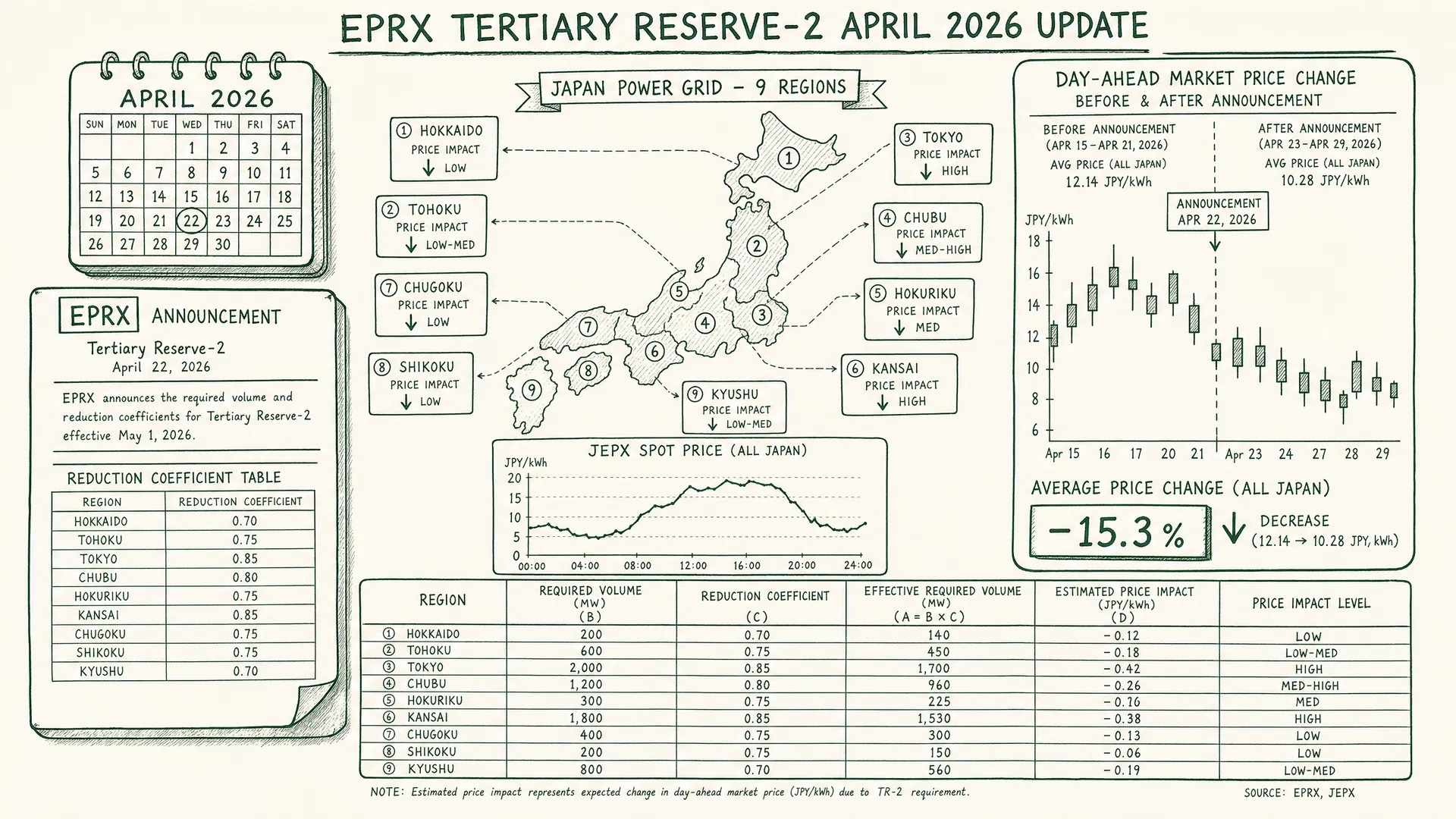
According to the latest announcement from EPRX, the required volume and bidding reduction factor for Tertiary Reserve 2 for April 2026 have been updated. While specific numerical values from the announcement are not provided here, the core meaning is that EPRX has finely tuned the parameters of the ancillary services market based on the latest electricity demand forecasts, generation forecasts (including renewables), system stability requirements, and historical behavior data of market participants. These adjustments typically involve the following aspects:
- Adjustment of Required Volume: This refers to the total amount of Tertiary Reserve 2 needed for the power system to maintain stable operation. An increase in the required volume means the system demands more reserve capacity; a decrease might reflect improved system stability expectations or more accurate forecasting models.
- Update of Bidding Reduction Factor: This factor is used to adjust the bid volumes submitted by market participants. For example, if the factor is 0.9, it means the actual procured volume will be 90% of the bid volume. Adjustments to this factor will affect the actual procurement volume in the market, thereby influencing market liquidity and prices.
- Impact on the Day-Ahead Market: With the weekly market abolished, all ancillary service requirements will be more closely linked to the outcomes of day-ahead market transactions. Any changes in ancillary service parameters will directly affect the expected prices and trading volumes in the day-ahead market, as market participants will factor in their potential revenues or costs from the ancillary services market when bidding in the day-ahead market.
- Settlement Unit: Notably, the settlement unit remains yen/DeltakW, settled every 30 minutes. This aligns with the day-ahead market's settlement method, ensuring consistency in market operations.
These parameter adjustments aim to optimize the operational efficiency of the ancillary services market, ensuring that system stability requirements are met while minimizing overall electricity costs. For market participants, understanding the specific details of these changes is crucial, as they will directly impact their bidding strategies and financial performance.
Impact on Electricity Traders
EPRX's update to the required volume and bidding reduction factor for Tertiary Reserve 2 for April 2026 will have multi-faceted impacts on energy traders, BESS (Battery Energy Storage System) operators, and other electricity market participants:
- Adjustment of Trading Strategies: Traders need to closely monitor the specific numerical changes in these parameters. An increase in the required volume may signal higher ancillary service prices, encouraging more generation resources or storage systems to participate in ancillary service market bidding. Conversely, if the required volume decreases or the reduction factor increases, it could lead to intensified competition and downward pressure on prices in the ancillary services market.
- Opportunities and Challenges for BESS Operators: BESS systems have a natural advantage in providing ancillary services. If ancillary service demand increases, BESS operators will have more opportunities to participate in the market and profit. However, if the reduction factor increases, it means that even if a bid volume is submitted, the actual procured volume might decrease. This requires BESS operators to make more sophisticated arbitrage decisions between the day-ahead market and the ancillary services market. Their profitability model will increasingly depend on accurate forecasting of market fluctuations and rapid response capabilities.
- Day-Ahead Market Price Volatility: The ancillary services market and the day-ahead market are closely linked. Changes in ancillary service demand affect the allocation of generation resources between the two markets. For example, if the ancillary services market becomes more lucrative, some generation opportunities may shift from the day-ahead market to the ancillary services market, potentially pushing up day-ahead market prices. Traders need to incorporate the expected revenues and costs from the ancillary services market into their day-ahead market bidding strategies.
- Risk Management: Changes in parameters increase market uncertainty. Traders need to re-evaluate their risk exposure and may need to adjust their hedging strategies. In-depth analysis of market data and the accuracy of forecasting models will be key to success.
- System Stability and Cost: From a macro perspective, these adjustments aim to ensure the stable operation of the power system while optimizing costs. For all market participants, understanding EPRX's policy intentions helps them better adapt to market changes and provides a basis for future investment and operational decisions.
In summary, as the Japanese electricity market fully transitions to the day-ahead market, every update by EPRX to the ancillary services market parameters has profound implications. Market participants must remain highly vigilant, continuously optimize their strategies, and respond to these dynamic changes to maintain a leading position in the competitive market.
Source: EPRX Announcement