Policy Background
Japan's electricity market is undergoing a significant transformation to address renewable energy integration, grid stability challenges, and carbon neutrality goals. In this context, the balancing capability of the power system, known as ancillary services or reserves, is becoming increasingly important. Tertiary Reserve 2 is a crucial component in Japan's electricity market for ensuring system frequency stability and supply-demand balance. It is typically used to respond to power supply and demand fluctuations over a relatively longer timescale, such as forecasting errors in renewable energy output or unexpected outages of large generation units.
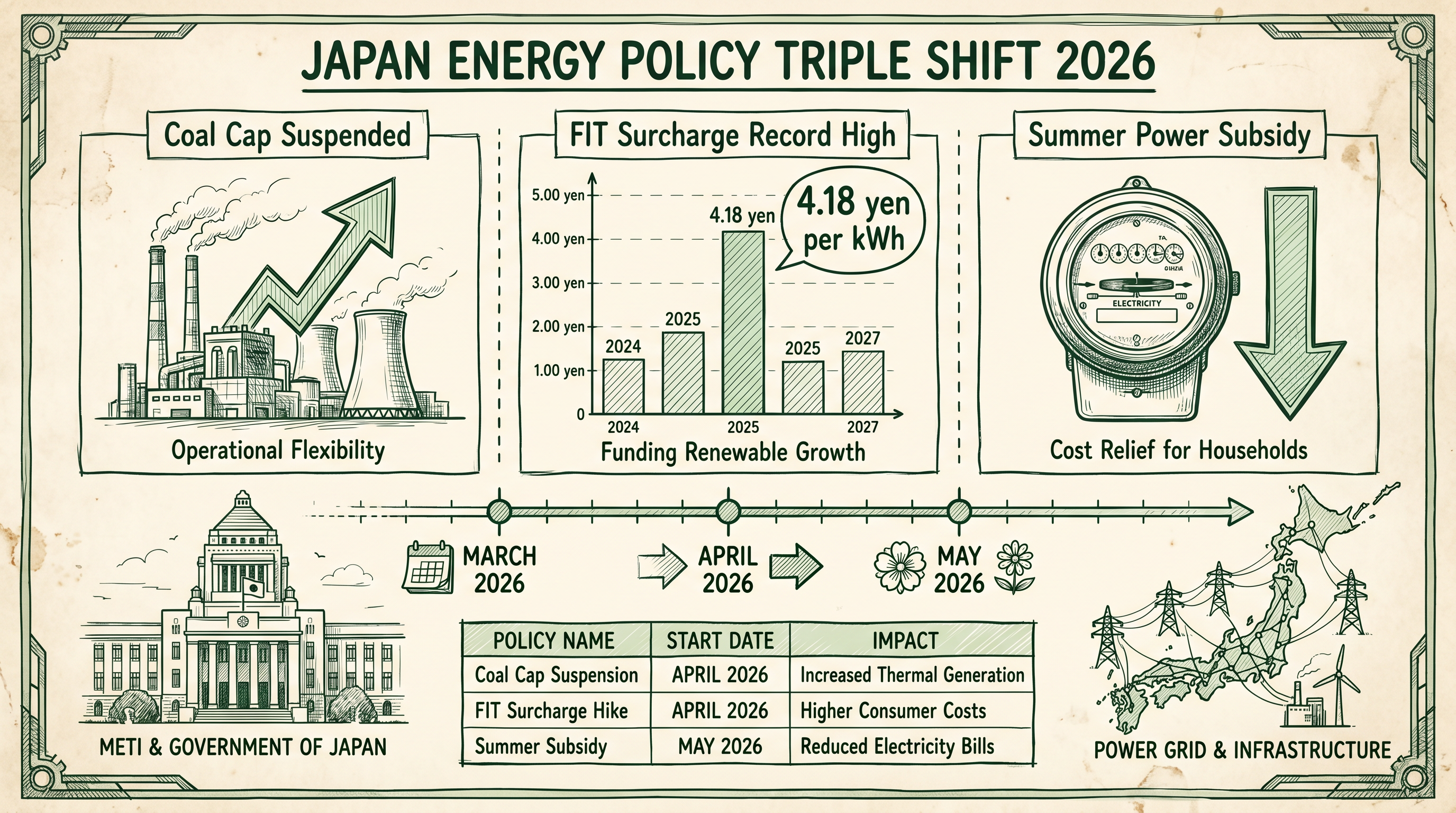
The Japan Electric Power Exchange (EPRX), as the central platform for electricity trading in Japan, has policy adjustments that directly impact the operational strategies and profitability of market participants. As of March 13, 2026, EPRX has fully transitioned to the Day-ahead Market, and the Weekly Market has been abolished. The settlement unit has also been standardized to yen/DeltakW (per 30 minutes), requiring market participants to more accurately forecast and manage their power assets, especially in the ancillary services market.
EPRX regularly reviews and updates the requirement and reduction factors for various types of reserves to ensure that market mechanisms effectively reflect actual system needs and encourage market participants to provide necessary ancillary services. This update for the Tertiary Reserve 2 for May 2026 is part of this continuous optimization process, aiming to maintain a high level of reliability and efficiency in the power system as it faces an increasingly complex operating environment.
Key Contents
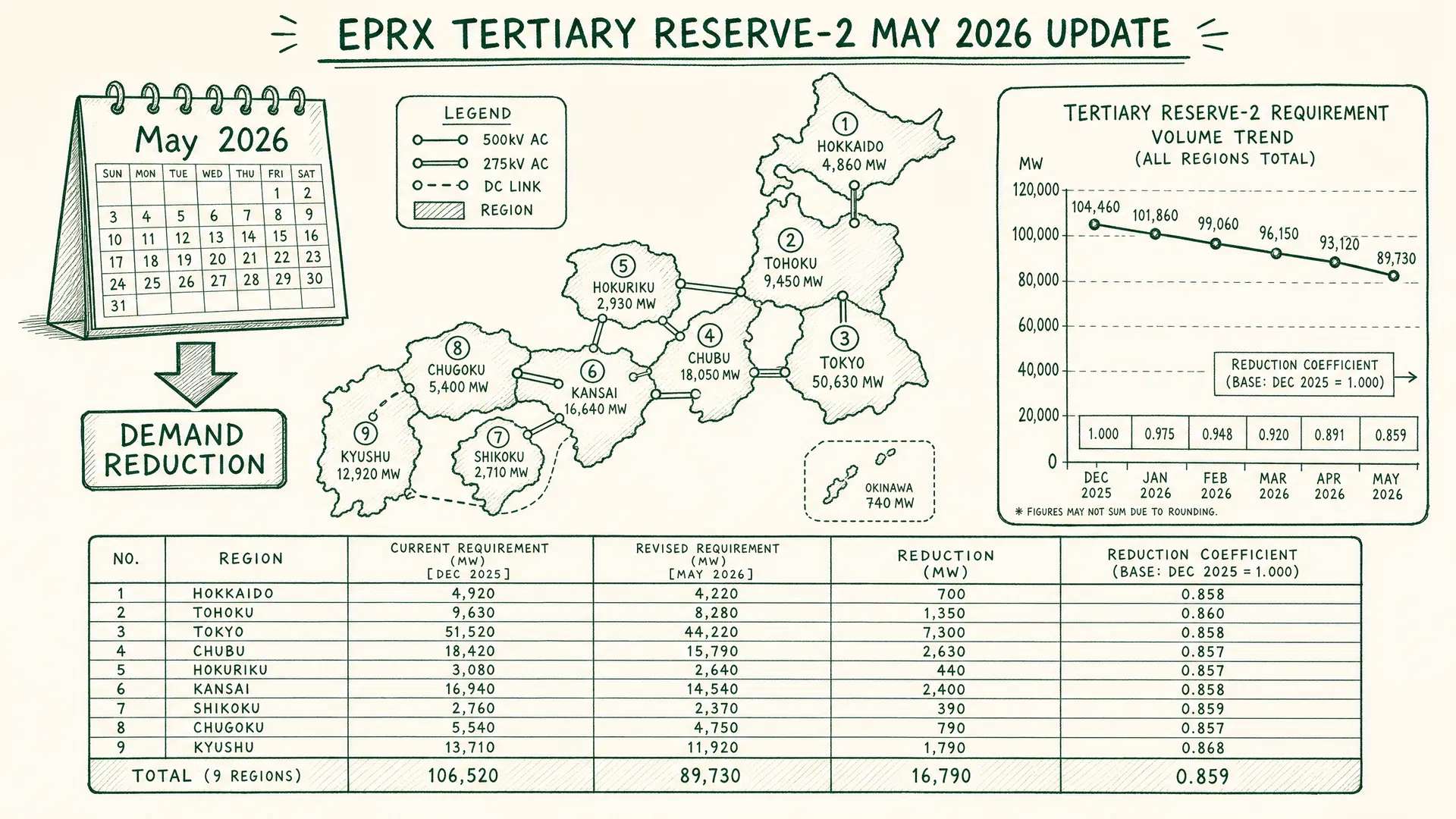
According to EPRX's latest announcement, the Tertiary Reserve 2 requirement and reduction factor for May 2026 will be adjusted. While the specific numerical details of the announcement require consulting the original document, such adjustments typically involve several aspects:
- Changes in Requirement: This refers to the total amount of Tertiary Reserve 2 needed for the power system to maintain stable operation during a specific period. An increase or decrease in the requirement directly impacts the market demand for ancillary services. If the requirement increases, it usually stimulates more suppliers to participate, potentially leading to higher prices; conversely, it may lead to lower prices.
- Adjustment of Reduction Factor for Procurement Volume: This factor is used to adjust the actual amount of reserve procured from the market. It may be used to balance market supply capacity with actual demand, or in some cases, as a risk management tool. Changes in the reduction factor will affect the amount of reserve suppliers can actually provide and their potential for remuneration. For example, if the reduction factor increases, it means the actual procurement volume may decrease, even if suppliers offer sufficient reserve.
- Influencing Factors: Updates to these values are typically based on a comprehensive consideration of various factors, including the power supply and demand forecast for the coming month, renewable energy output forecasts, changes in grid topology, historical data analysis, and system stability assessments. For instance, an anticipated increase in renewable energy output volatility in May, or planned maintenance of large generation units, could lead to changes in reserve requirements.
These adjustments will take effect in the Day-ahead Market for May 2026. Market participants must closely monitor these changes and adjust their bidding strategies and asset dispatch plans accordingly to ensure they can remain competitive and fulfill their obligations under the new market conditions.
Impact on Electricity Traders
This EPRX update regarding the Tertiary Reserve 2 requirement and reduction factor will have multi-faceted impacts on electricity traders, BESS operators, and all market participants:
- Price Volatility in the Ancillary Services Market: Adjustments to the requirement and reduction factor will directly affect the supply-demand balance in the Tertiary Reserve 2 market. If the requirement increases or the reduction factor decreases (meaning actual procurement increases), it may drive up the prices of ancillary services. Conversely, it could lead to price drops. Electricity traders need to re-evaluate their bidding strategies in the ancillary services market.
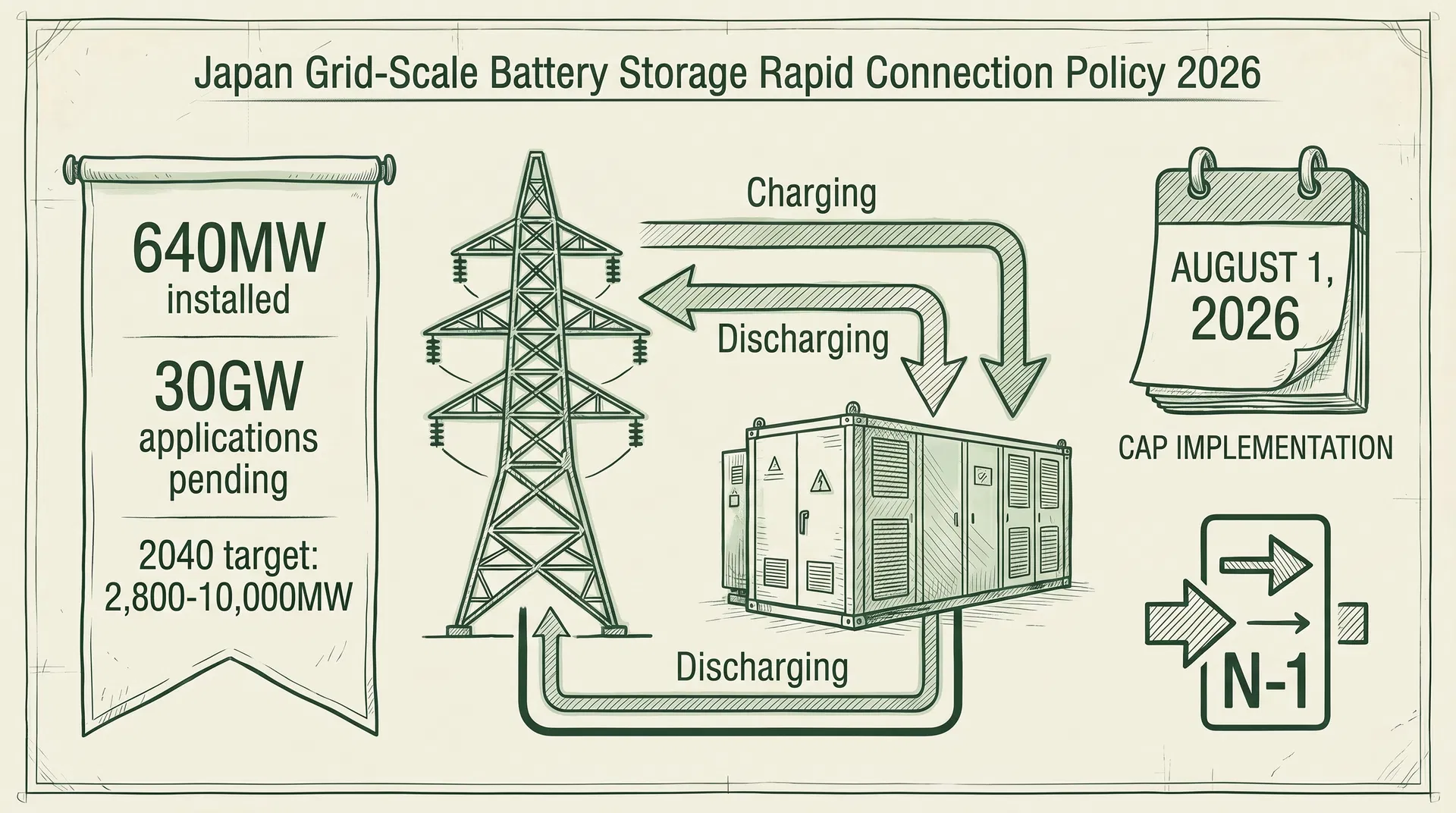
- Arbitrage Opportunities and Risks for BESS Operators: For Battery Energy Storage System (BESS) operators, this means a need for more flexible adjustment of their storage asset charging and discharging strategies. If Tertiary Reserve 2 prices are expected to rise, BESS can earn higher revenues by providing this service. However, changes in the reduction factor may also increase revenue uncertainty. Accurate market forecasting and optimized dispatch will become even more critical.
- Interconnected Effects with the Day-ahead Market: As EPRX has fully transitioned to the Day-ahead Market, changes in the ancillary services market will be more closely linked to Day-ahead electricity trading prices. For example, if the demand for Tertiary Reserve 2 increases, it may affect the generation costs in the Day-ahead market, thereby influencing Day-ahead electricity prices. Traders need to incorporate ancillary services market forecasts into their Day-ahead electricity trading strategies.
- Risk Management and Compliance: Market participants need to carefully analyze the new requirement and reduction factor to ensure they can meet the corresponding system requirements and avoid penalties for failing to provide sufficient reserve. This also involves assessing risks of future market volatility and adjusting hedging strategies.
- Importance of Data Analysis and Forecasting Capabilities: In the new market environment, strong data analysis and forecasting capabilities will be a core competitive advantage. Market participants who can accurately predict the demand and price trends of Tertiary Reserve 2 will be better able to optimize their asset allocation and trading strategies.
In conclusion, market participants should closely follow EPRX's official announcements, deeply understand the specific details of these adjustments, and promptly adapt their market strategies to navigate the evolving challenges and opportunities in Japan's electricity market.
Source: Japan Electric Power Exchange (EPRX) Announcement "三次調整力②の必要量および募集量削減係数の5月分更新について"