Introduction
Japan's energy landscape is currently navigating a critical juncture, balancing the dual imperatives of decarbonization and maintaining a stable power supply. As the nation transitions towards a greener energy mix, the reliability of its electricity grid faces unprecedented challenges. The Ministry of Economy, Trade and Industry (METI) has recently highlighted a looming crisis: a projected power supply shortage for the summer of 2026. This projection underscores the fragility of the current system and the urgent need for robust countermeasures to ensure that economic activities and daily life remain uninterrupted.
The stability of the power supply is not merely a matter of convenience; it is a foundational element for Japan's economic resilience. With the increasing electrification of various sectors and the rapid expansion of energy-intensive industries, any disruption in power availability could have far-reaching consequences. The 2026 summer projection serves as a stark reminder that proactive and innovative approaches are required to secure the nation's energy future.
The Looming Crisis: Summer 2026 Power Supply Shortage
METI's Projection and Concerns
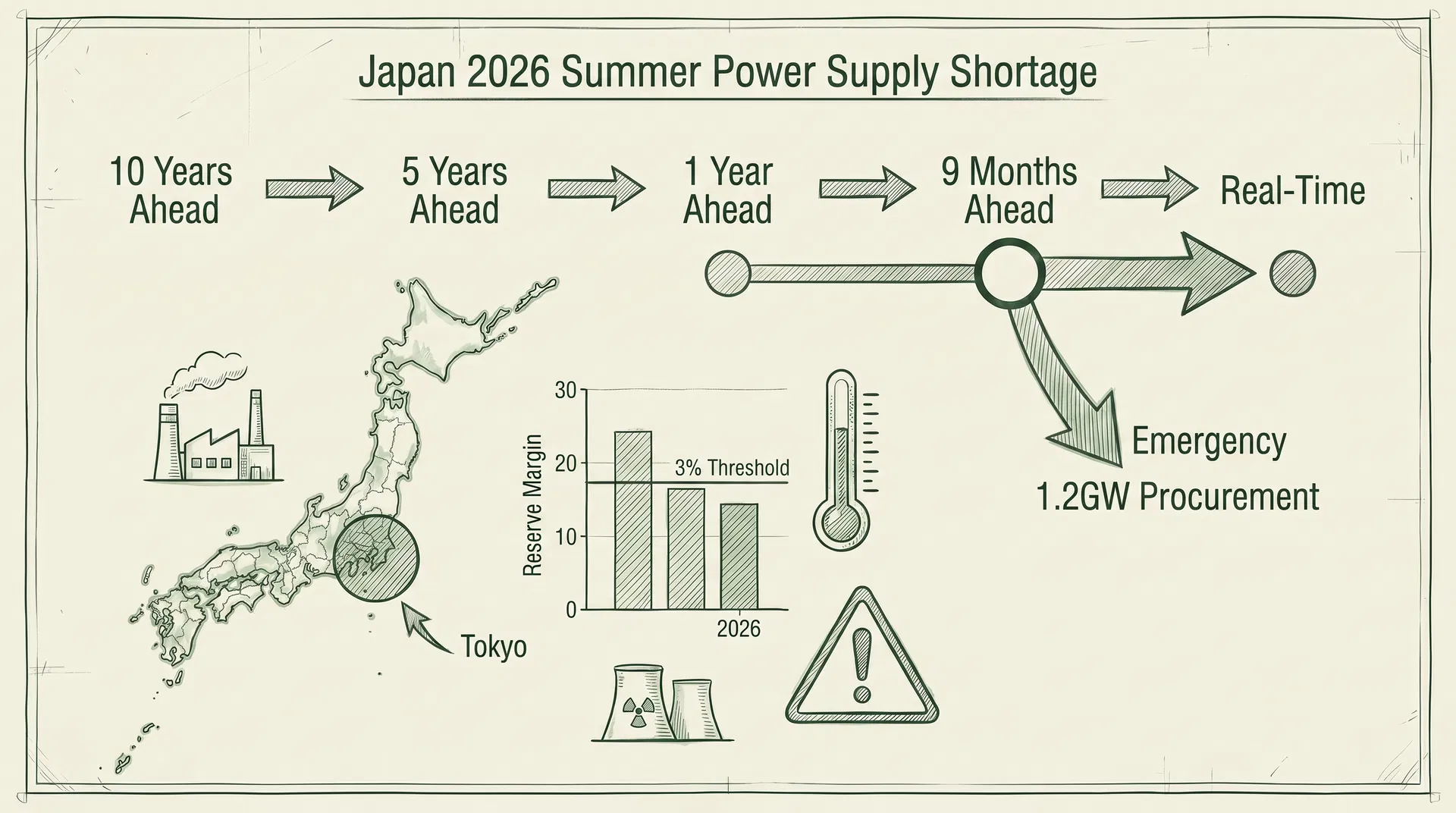
During the 3rd Next-Generation Power and Gas Subcommittee meeting held on October 31, 2025, METI disclosed alarming projections regarding the power supply for the upcoming summer of 2026. The data indicated that the reserve margin in the Tokyo area is expected to fall below the critical 3% threshold. This minimum threshold is generally considered the absolute baseline required to maintain a stable and reliable electricity supply during peak demand periods.
The implications of a reserve margin dropping below 3% are severe. It significantly increases the risk of power outages, brownouts, and the need for emergency load shedding. Such scenarios would not only disrupt daily life for millions of residents but also pose a substantial threat to industrial operations, particularly in the highly concentrated economic hub of the Tokyo metropolitan area. The disclosure by METI has thus triggered immediate concern among energy market professionals and policymakers alike.
Underlying Causes of Supply Tightness
The projected supply tightness is not an isolated incident but rather the culmination of several systemic issues within Japan's energy sector. One of the primary drivers is the accelerated retirement of aging thermal power plants. As Japan commits to reducing its carbon footprint, many older, less efficient fossil fuel plants are being decommissioned. While this is a necessary step for environmental sustainability, it simultaneously removes a significant portion of the dispatchable baseload capacity from the grid.
Compounding this issue is the delayed connection of renewable energy sources to the grid. Although there has been a substantial push to increase the share of solar and wind power, infrastructural bottlenecks and regulatory hurdles have slowed down the integration of these intermittent sources. Furthermore, the demand side of the equation is experiencing a surge. The rapid proliferation of data centers, driven by the AI boom and digitalization, along with the expansion of semiconductor manufacturing facilities, has led to a sharp increase in electricity consumption. This combination of reduced conventional capacity, delayed renewable integration, and rising demand creates a perfect storm for the projected 2026 shortage.
METI's Immediate Response: Emergency Procurement
1.2 GW Emergency kW Public Tender
In response to the dire projections for the summer of 2026, METI has taken decisive and immediate action. Recognizing the urgency of the situation, the ministry has decided to procure 1.2 gigawatts (GW), equivalent to 1.2 million kilowatts (kW), of additional supply capacity. This procurement will be executed through an emergency kW public tender (kW公募), a mechanism designed to rapidly secure necessary power resources to bridge the anticipated gap.
The emergency kW public tender is a critical intervention tool. It allows the government to solicit bids from various power producers, including those with idled or underutilized generation assets, to bring additional capacity online specifically for the high-demand summer months. By securing this 1.2 GW, METI aims to restore the reserve margin in the Tokyo area to a safer level, thereby mitigating the immediate risk of supply disruptions. This proactive measure demonstrates the government's commitment to maintaining grid stability even in the face of significant structural challenges.
Towards a Sustainable Solution: New Short-Term Capacity Procurement Framework
Institutionalizing Emergency Procurement
While the emergency kW public tender addresses the immediate crisis, METI recognizes that ad-hoc measures are insufficient for long-term stability. Therefore, the ministry, in cooperation with the Organization for Cross-regional Coordination of Transmission Operators (OCCTO), has initiated an urgent study to develop a new "Short-term Supply Capacity Procurement Framework." The primary objective of this initiative is to institutionalize the emergency procurement mechanism, transforming it from a reactive, ad-hoc response into a structured, predictable component of the energy market.
By formalizing this framework, METI aims to provide greater certainty and transparency for power producers and investors. An institutionalized system will allow for better planning, more efficient allocation of resources, and a more robust safety net against unforeseen supply-demand imbalances. This move is a crucial step towards creating a resilient energy market that can adapt to the evolving dynamics of Japan's power sector.
Comparison of Capacity Procurement Timelines
To understand the significance of the new short-term framework, it is essential to examine Japan's overall capacity procurement strategy. The system is designed to secure power at various intervals leading up to the actual time of delivery. The introduction of the new framework fills a critical gap in this timeline.
| Procurement Mechanism |
Timeline Ahead of Delivery |
Purpose and Scope |
| Long-term Decarbonization Power Auction (LTDA) |
4 years ahead |
Encourages investment in new, low-carbon generation assets to ensure long-term capacity adequacy. |
| Capacity Market (Main Auction) |
4 years |
Secures the bulk of the required capacity to meet anticipated peak demand, providing revenue certainty for existing plants. |
| Reserve Power System (Yobidengen) |
1–2 years |
A supplementary procurement mechanism activated when the main capacity market auction results fall short of required levels, securing additional capacity to ensure supply adequacy. |
| Capacity Market (Additional Auction) |
1 year |
Adjusts procured capacity based on updated demand forecasts and changes in the supply landscape. |
| Additional Supply Capacity Procurement (kW公募) |
9 months |
The new framework under discussion; designed to address short-term, acute shortages identified closer to real-time. |
| Actual Supply |
Real-time |
The physical delivery of electricity to meet instantaneous demand. |
As illustrated in the table above, the new 9-month procurement window provides a vital mechanism to correct imbalances that become apparent only as the delivery period approaches. This layered approach ensures that the grid operators have multiple opportunities to secure the necessary resources, enhancing overall system reliability.
Broader Context and Future Outlook
Japan's Energy Policy and Challenges
The current situation highlights the intricate balancing act required by Japan's energy policy. The nation is steadfast in its commitment to achieving carbon neutrality by 2050, which necessitates a massive shift away from fossil fuels. However, the transition period is fraught with challenges, particularly the need to maintain a stable and affordable power supply while the new, greener infrastructure is being built and integrated.
The reliance on intermittent renewable sources introduces volatility into the grid, requiring sophisticated management and substantial backup capacity. Furthermore, the geopolitical landscape and global supply chain disruptions continue to pose risks to energy security, particularly for a resource-scarce nation like Japan. Navigating these complexities requires a dynamic and adaptable policy framework that can respond to both long-term goals and short-term crises.
Implications for Energy Market Professionals
For energy market professionals, the evolving regulatory landscape and the introduction of new procurement frameworks present both challenges and opportunities. Power producers must navigate the shifting economics of generation, balancing the costs of maintaining older assets against the incentives provided by the various capacity markets. Retailers face the task of managing price volatility and ensuring reliable supply for their customers in a tightening market.
Conversely, these challenges also create opportunities for innovation. There is a growing demand for advanced grid management technologies, energy storage solutions, and demand response programs. Companies that can provide flexible, reliable, and low-carbon energy solutions will be well-positioned to thrive in this new environment. The institutionalization of the short-term procurement framework, in particular, may offer new revenue streams for agile market participants capable of rapidly deploying capacity.
Conclusion
The projected power supply shortage for the summer of 2026 serves as a critical stress test for Japan's energy infrastructure. METI's immediate response through the 1.2 GW emergency kW public tender demonstrates a proactive approach to mitigating the immediate risks. However, the true significance lies in the ongoing efforts to institutionalize a new Short-term Supply Capacity Procurement Framework. By creating a structured mechanism to address acute shortages, Japan is taking a vital step towards building a more resilient and adaptable energy market. As the nation continues its transition towards a decarbonized future, the ability to balance sustainability with unwavering supply stability will remain the paramount challenge for policymakers and industry professionals alike.
References
[1] Ministry of Economy, Trade and Industry (METI). "113th System Review Working Group, Agenda Item 7." April 3, 2026. https://www.meti.go.jp/shingikai/enecho/denryoku_gas/jisedai_kiban/system_review/pdf/113_07_00.pdf