Japan Capacity Market Reform: Net CONE Revision and Two-Stage Auction Design (April 2026)
Introduction
Japan's electricity market is undergoing significant reforms to ensure a stable and reliable power supply while transitioning towards a decarbonized future. A pivotal aspect of these reforms is the Capacity Market, a mechanism designed to secure future power generation capacity. The 113th System Review Working Group of the Ministry of Economy, Trade and Industry (METI), held on April 3, 2026, addressed critical adjustments to this market, focusing on the revision of the Net Cost of New Entry (Net CONE) and the design of future auctions. This article delves into the discussions and conclusions from this crucial meeting, outlining the proposed changes and their implications for Japan's energy landscape.
The Evolution of Japan's Capacity Market
Current Function and Challenges
The Capacity Market in Japan was established to ensure long-term supply security by providing payments to power generators for their available capacity, regardless of actual electricity generation. This mechanism aims to incentivize investment in new power plants and maintain existing ones, thereby preventing future power shortages. However, the working group acknowledged that the market has primarily functioned to maintain existing power sources, indicating a need for adjustments to better stimulate new entry and reflect current economic realities [1].
Understanding Net CONE
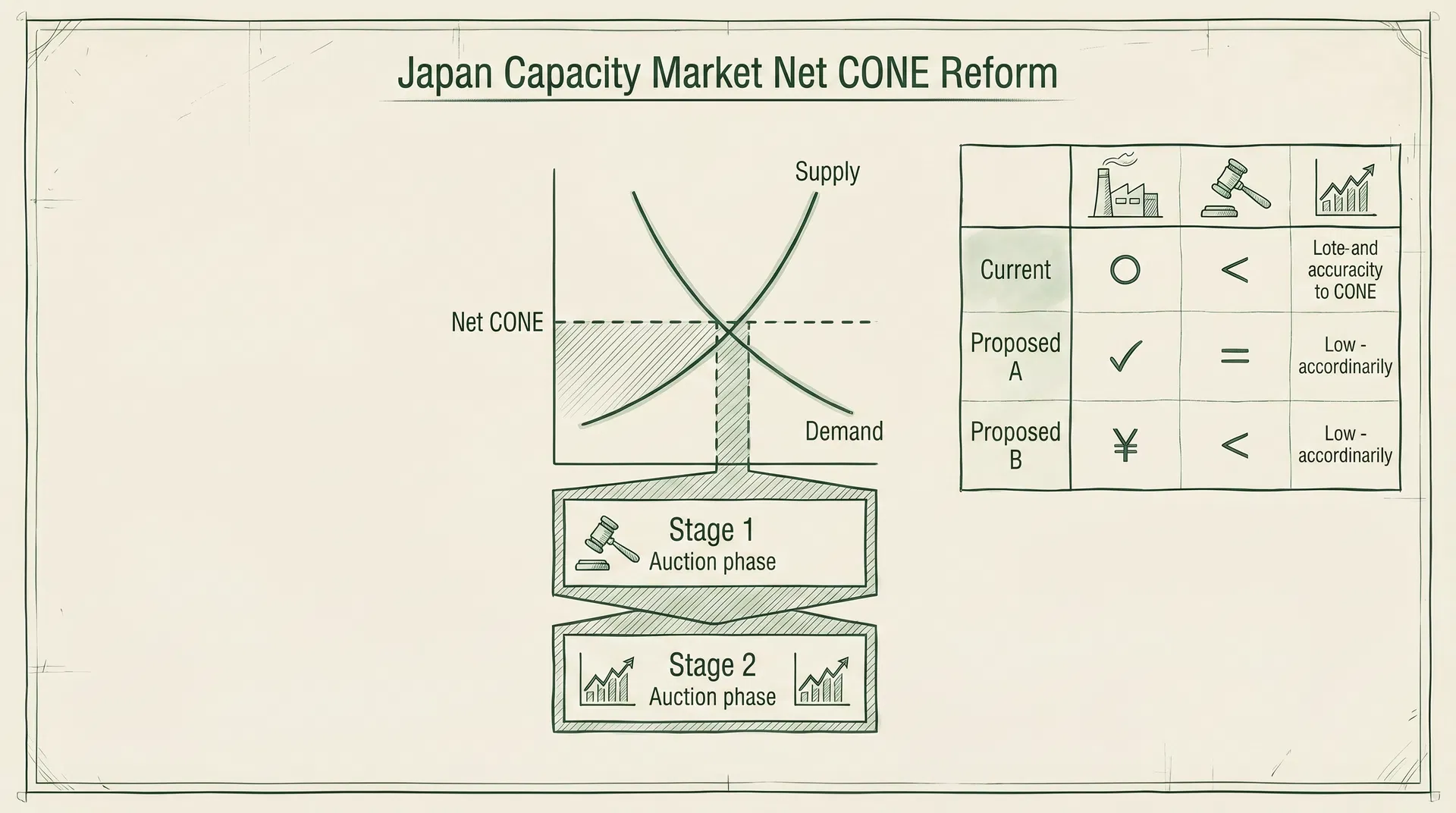
Net CONE (Net Cost of New Entry) is a crucial metric in capacity markets. It represents the net cost incurred by a hypothetical new power plant to enter the market, taking into account its fixed costs and subtracting expected revenues from energy and ancillary service markets. Essentially, Net CONE serves as a benchmark for determining the ceiling price in capacity auctions, influencing the profitability and viability of new generation projects. A higher Net CONE generally makes it more attractive for new plants to enter the market, as it signals a higher potential revenue stream from capacity payments [2].
Rationale for Revision
The consensus reached by the 113th System Review Working Group was that the existing Net CONE setting method needed revision to better reflect actual market conditions and incentivize necessary investments. The current Net CONE was deemed insufficient to attract new capacity, particularly in a rapidly evolving energy landscape with increasing decarbonization targets and fluctuating fuel prices. The proposed revision aims to align Net CONE with the true costs and risks associated with developing and operating new power generation facilities in Japan [2].
Proposed Mitigation Options for Capacity Market Reform
To address the shortcomings and enhance the effectiveness of the capacity market, three primary mitigation options were presented and evaluated by the working group:
Option 1: Gradual Net CONE Increase
This option proposed a phased, incremental increase in the Net CONE over time. The rationale behind this approach is to provide a predictable and stable signal to investors, allowing them to adjust their investment strategies gradually. While offering stability, concerns were raised about whether a gradual increase would be sufficient to rapidly address the urgent need for new capacity and adapt to unforeseen market changes [2].
Option 2: Net CONE Benchmark with Combined Auctions
Option 2 suggested using Net CONE as a benchmark while implementing a combination of single-price and multi-price auctions. In a single-price auction, all winning bidders receive the same price, typically the highest accepted bid. In contrast, a multi-price auction awards each winning bidder their individual bid price. The combination aimed to leverage the benefits of both systems, potentially offering more flexibility and efficiency in securing capacity. However, the complexity of managing two different auction types and their potential interactions needed careful consideration [2].
Option 3: Net CONE Benchmark with Two-Stage Single-Price Auction
This option, ultimately preferred by the working group, also utilizes Net CONE as a benchmark but introduces a two-stage single-price auction design. This approach involves two distinct bidding rounds. The first stage would likely establish a preliminary price or capacity commitment, followed by a second stage to finalize allocations and prices. The single-price mechanism ensures that all successful bidders receive the same price, promoting transparency and reducing strategic bidding complexities. The two-stage design allows for greater flexibility and responsiveness to market conditions, enabling adjustments based on initial bidding outcomes [2].
Bid Price Rules and Market Dynamics
Existing Constraints on Operators
Under the current bid price rules in Japan's capacity market, power plant operators face significant constraints. They are explicitly prohibited from including business profit or depreciation costs in their bid prices. Furthermore, any revenues generated from other market activities, such as wholesale electricity sales or ancillary services, must be deducted from their capacity bids. These stringent rules are designed to prevent overcompensation and ensure that capacity payments only cover the net cost of providing capacity [2].
Impact on Supply Security and Capacity Charge Burden
The working group analyzed the effects of these bid price rules in conjunction with the proposed mitigation options. While Option 2 (combined auctions) and Option 3 (two-stage single-price auction) showed different effects on supply security, the discussions highlighted a critical trade-off. Option 2 was considered to potentially better suppress the capacity charge burden on consumers, as it might lead to lower overall capacity payments due to the multi-price component. However, from the perspective of ensuring reliable supply capacity, Option 3 was ultimately preferred. The two-stage single-price auction was deemed more effective in securing the necessary capacity, even if it might entail a slightly higher capacity charge burden [2].
Comparison of Mitigation Options
To illustrate the differences between the proposed options, the following tables provide a comparative overview:
Table 1: Overview of Mitigation Options
| Feature |
Option 1: Gradual Net CONE Increase |
Option 2: Net CONE Benchmark with Combined Auctions |
Option 3: Net CONE Benchmark with Two-Stage Single-Price Auction |
| Net CONE Usage |
Direct adjustment |
Benchmark for combined single/multi-price auctions |
Benchmark for two-stage single-price auction |
| Auction Type |
Not specified (assumed existing) |
Combination of single-price and multi-price |
Two-stage single-price |
| Market Signal |
Predictable, incremental |
Flexible, potentially complex |
Flexible, transparent |
| Complexity |
Low |
Medium to High |
Medium |
| Primary Goal |
Investor predictability |
Efficiency and cost suppression |
Reliable supply capacity |
Table 2: Detailed Comparison of Option 2 and Option 3
| Aspect |
Option 2: Combined Auctions |
Option 3: Two-Stage Single-Price Auction |
| Supply Security Impact |
Varied effects, potentially less robust |
Preferred for ensuring reliable supply capacity |
| Capacity Charge Burden |
May better suppress burden |
Potentially higher burden, but ensures reliability |
| Transparency |
Moderate (due to mixed auction types) |
High (single-price mechanism) |
| Market Responsiveness |
Good, but with potential for strategic complexities |
Excellent (two stages allow for adjustments) |
| Administrative Overhead |
Higher (managing two auction types) |
Moderate (two stages, but consistent pricing) |
Broader Policy Discussions and Future Outlook
Beyond the core discussions on Net CONE and auction design, the 113th System Review Working Group also touched upon other critical aspects of Japan's energy policy:
2027 Delivery Year Additional Auction
The working group confirmed a shortfall of 5.18 million kW when comparing the target procurement volume with the currently secured supply capacity for the 2027 delivery year. Consequently, a decision was made to hold an additional auction. Bidding for this additional auction is scheduled to commence on June 3, 2026, with the results expected to be announced around the end of July 2026 [2]. This proactive measure underscores METI's commitment to addressing potential supply gaps and maintaining grid stability.
Inefficient Coal Power Plant Operation Suppression
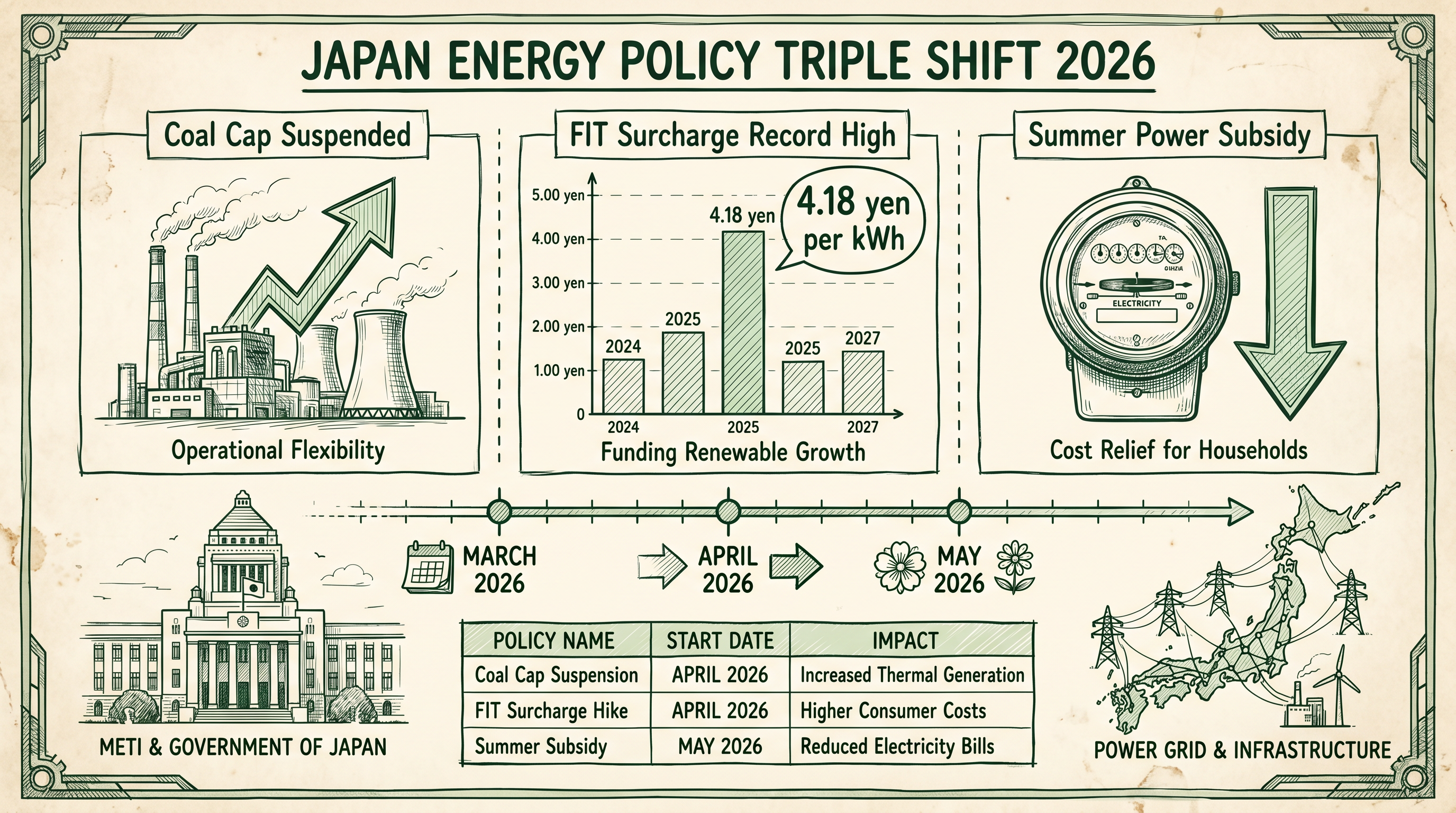
Discussions also included measures to suppress the operation of inefficient coal power plants for FY22026. However, in light of increasing uncertainties surrounding LNG procurement, particularly from the Middle East, the working group decided against applying these suppression measures as an emergency response for FY2026. This decision prioritizes stable supply security in the short term. It was estimated that suspending these measures could save approximately 500,000 tons of LNG, equivalent to over 10% of the annual LNG imports via the Strait of Hormuz [2]. This highlights the delicate balance between decarbonization goals and immediate energy security concerns.
Transition to the Power Stable Supply WG
Notably, the 113th meeting marked the final session of the System Review Working Group. It will be abolished and replaced by a new entity: the Power Stable Supply Working Group. This transition signifies a renewed focus and potentially a broader mandate for addressing the challenges of ensuring a stable and sustainable power supply in Japan [1].
Conclusion
The 113th System Review Working Group meeting in April 2026 represents a significant step in the ongoing reform of Japan's capacity market. The consensus to revise the Net CONE setting method and the preference for a two-stage single-price auction design underscore a commitment to enhancing supply security and market efficiency. While balancing decarbonization goals with immediate energy security concerns, METI is actively adapting its policies to navigate the complexities of the global energy landscape. The establishment of the new Power Stable Supply Working Group signals a continuous effort to build a resilient and sustainable electricity system for Japan.
References
[1] 第113回 総合資源エネルギー調査会 電力・ガス事業分科会 次世代電力・ガス事業基盤構築小委員会 制度検討作業部会(METI/経済産業省) -
[2] 電力審議会レポート|第113回 制度検討作業部会(2026/04/03)|enechain-biz - https://note.com/enechain_biz/n/n131bdb554900