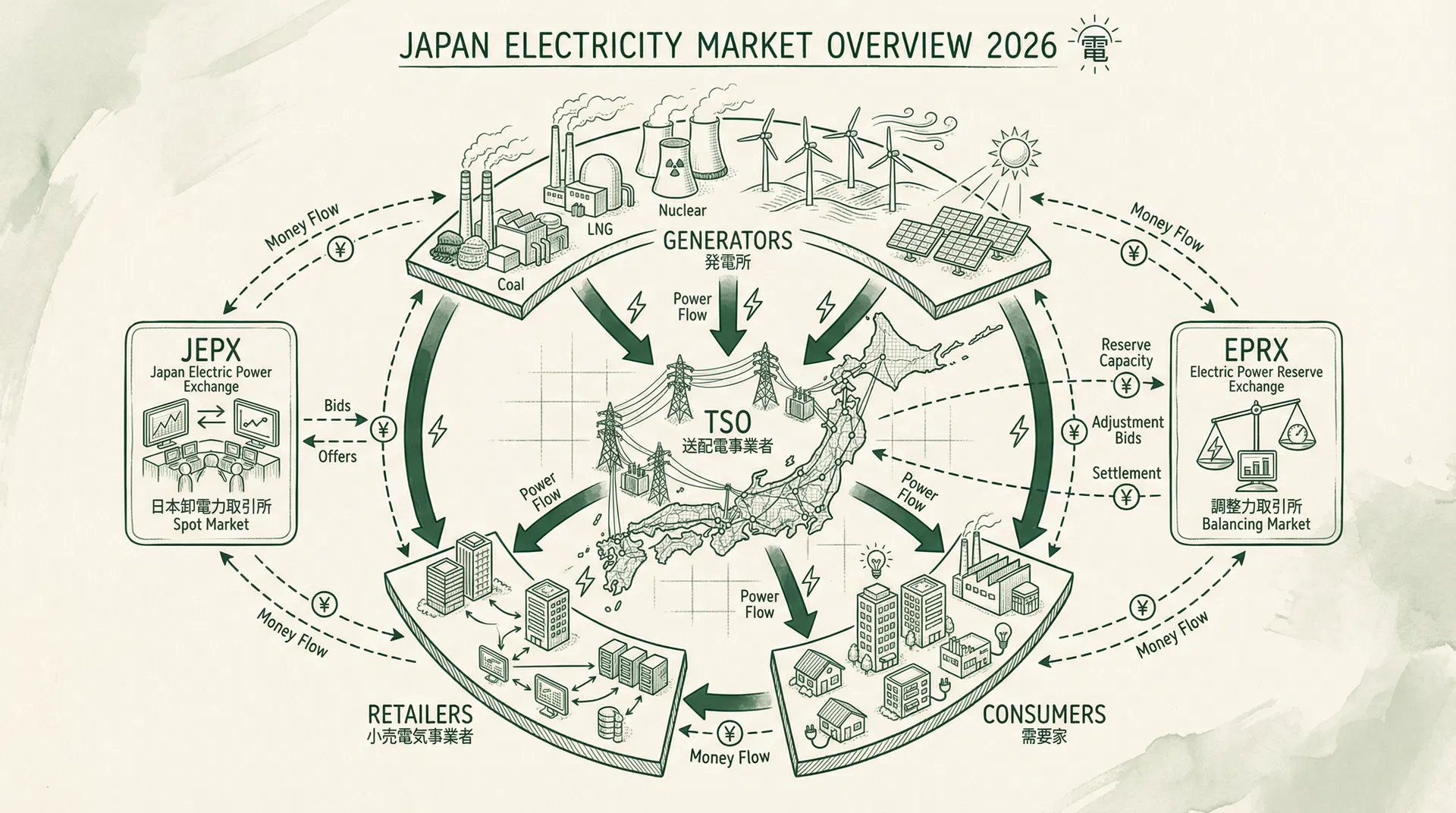
Introduction: Why Does Japan Need a Capacity Market?
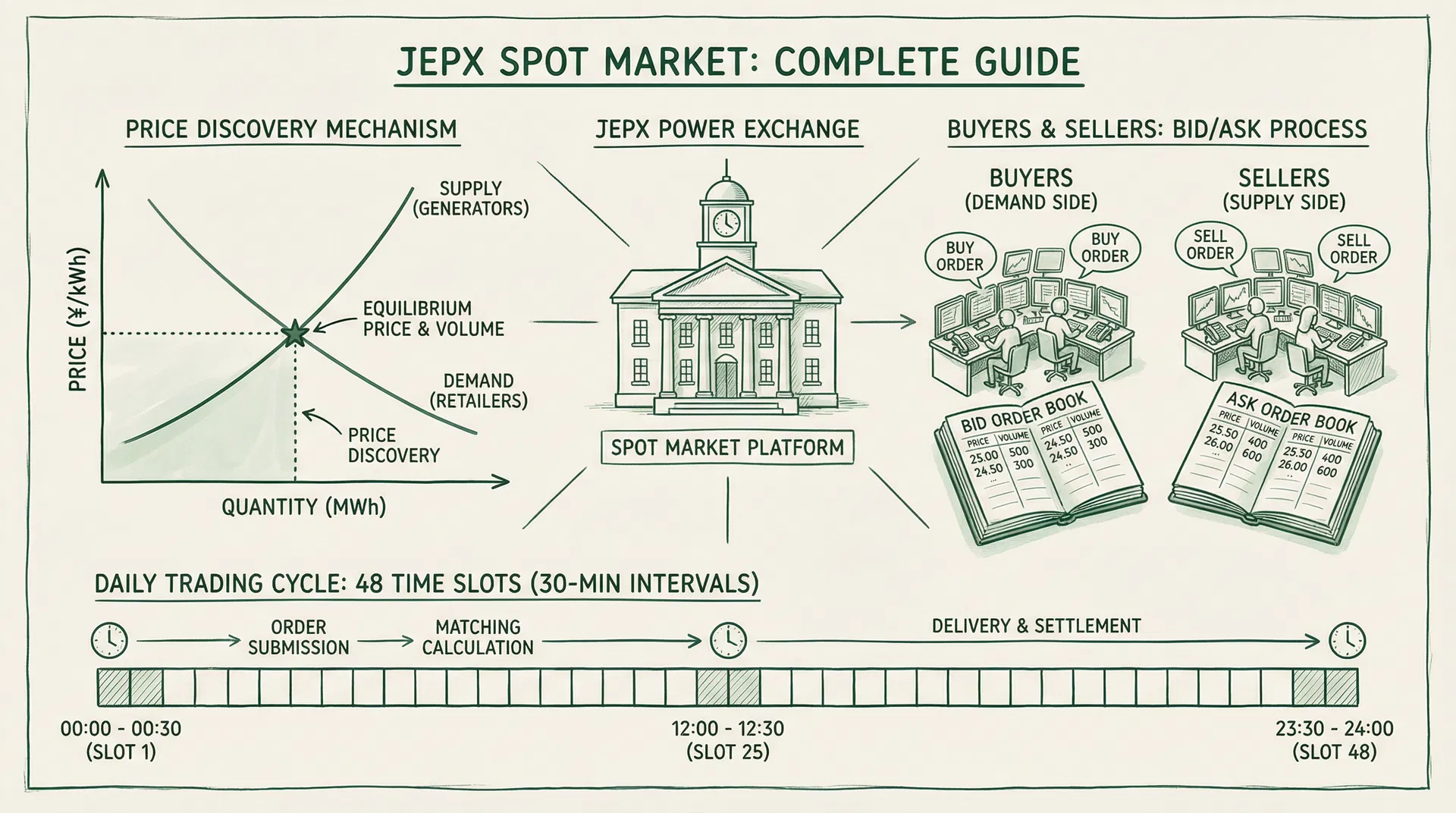
In the wake of electricity market liberalization, Japan's power system faces a fundamental paradox. While spot market price signals efficiently balance short-term supply and demand, they fail to provide sufficient incentives for generators to make long-term investments in new capacity or maintain aging facilities. As renewable energy penetration deepens and conventional thermal plants exit the market due to declining profitability, maintaining system reserve capacity — or supply adequacy — has become a critical challenge.
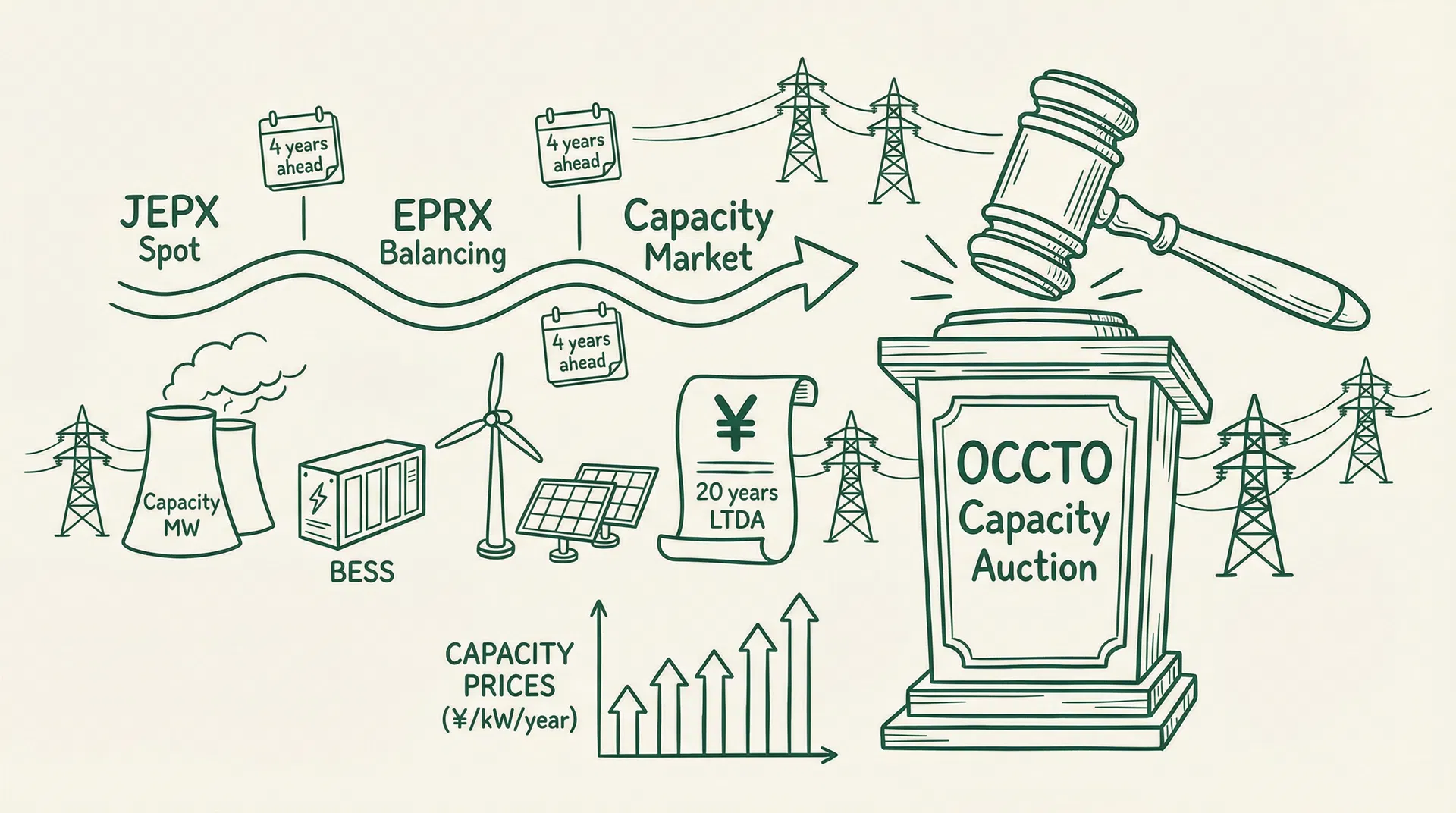
The capacity market (容量市場) is the institutional solution designed to address this "Missing Money" problem. Through capacity auctions held four years in advance, the Organization for Cross-regional Coordination of Transmission Operators (OCCTO) pays capacity providers a "Capacity Assurance Contract Amount" as compensation for maintaining available capacity during a specified future delivery year, thereby ensuring the long-term supply adequacy of Japan's national power system.
[REGULATORY HISTORY]
The Capacity Assurance Contract Terms were first enacted in June 2020 and have undergone 12 revisions through February 2026, reflecting the continuous refinement of the market framework. The latest version, issued by OCCTO in February 2026, represents the current applicable standard.
Market Architecture: Who Are the Participants?
OCCTO serves as the Market Operator at the core of the capacity market. Capacity providers — the supply side of the market — include owners and operators of conventional thermal power, nuclear, hydro, pumped storage, renewable energy (solar, wind), and demand response (DR) resources. Under Article 1 of the Contract Terms, capacity providers must be electricity retailers or entities recognized as prospective retailers during the delivery year, ensuring that participants have genuine power supply capabilities rather than being purely financial speculators.
| Power Source Type | Classification | Key Characteristics |
|---|
| Thermal (Gas, Coal, Oil) | Stable Power Source | Dispatchable, high availability |
| Nuclear | Stable Power Source | High baseload, low marginal cost |
| Run-of-River Hydro | Stable Power Source | Subject to hydrological conditions |
| Pumped Storage | Stable Power (with regulation) | Storage-capable, frequency regulation |
| Solar PV | Variable Power Source | Output dependent on irradiance |
| Wind | Variable Power Source (standalone) | Output dependent on wind speed |
| Demand Response | Dispatchable Power Source | Demand-side resource |
Auction Mechanism: Three-Market Parallel Overview
Japan's capacity market system comprises three auction mechanisms, each targeting different policy objectives and timelines, collectively ensuring long-term supply adequacy. Capacity revenues from all three markets are ultimately recovered through the Capacity Contribution Charge (容量拠出金), allocated to electricity retailers in proportion to their sales volume and passed through to end consumers.
| Market Type | Main Capacity Market | Additional Capacity Market | Long-Term Decarbonization Auction (LTDA) |
|---|
| Policy Purpose | Ensure national medium-to-long-term supply adequacy | Fill capacity gaps after Main Auction | Drive power sector decarbonization; incentivize long-term low-carbon investment |
| Procurement Timing | 4 years before delivery year (T-4) | ~1 year before delivery year (T-1) | 5–10+ years before delivery year |
| Contract Duration | 1 year | 1 year | 20-year fixed-income contract |
| Clearing Mechanism | Uniform price clearing (demand curve) | Uniform price clearing (demand curve) | Contract for Difference (CfD) settlement |
| FY2025 Results | Total contracted ≈¥2.21 trillion (announced 2026-01-20) | Contracted capacity ≈1.33 GW / contracted total ≈¥10.5 billion (announced 2025-07-16); Hokkaido ¥13,761/kW, Tokyo ¥3,495/kW, Kyushu ¥5,029/kW | Post-clawback contracted total ¥342.0 billion (announced 2026-05-13) |
| Eligible Resources | All dispatchable sources (thermal, nuclear, hydro, BESS, DR) | Same as Main; primarily new-build resources | Decarbonized sources (nuclear, renewables, BESS) and LNG thermal |
| Full Guide | This article | Additional Capacity Market Guide → | LTDA Complete Guide → |
Main Capacity Market: Procuring Capacity Four Years Ahead
The core trading mechanism of the capacity market is the Main Auction (メインオークション), conducted four years before the delivery year. OCCTO sets a Required Supply Capacity target based on future demand forecasts and solicits bids from capacity providers. The auction uses a uniform-price clearing mechanism, where all successful bidders receive the same market clearing price.
Article 6 of the Contract Terms establishes supplementary auction types to address post-Main Auction supply-demand changes. The Procurement Auction (調達オークション) is held one year before the delivery year when the Main Auction has procured insufficient capacity. Conversely, the Release Auction (リリースオークション) allows contracted providers to return excess capacity to the market when the Main Auction has over-procured. A Special Auction (特別オークション) may also be held when OCCTO identifies emerging supply security concerns.
Contract Amount Calculation: The Core Financial Formula
The Capacity Assurance Contract Amount is the central financial mechanism of the capacity market. Article 7 of the Contract Terms specifies the calculation formula:
[FORMULA (ARTICLE 7)]
Contract Amount = Unit Contract Price × Contract Capacity − Economic Penalties
Unit Contract Price = Weighted average of clearing prices from the Main Auction and Procurement Auction, weighted by cleared capacity (rounded down to the nearest yen)
Unit Contract Price: Weighted Average Formula
When both the Main Auction and Procurement Auction have successful bidders, the Unit Contract Price is calculated as:
[UNIT PRICE WEIGHTED AVERAGE FORMULA]
Pₙ = (P_M × Q_M + P_P × Q_P) ÷ (Q_M + Q_P)
P_M = Main Auction clearing price (¥/kW·year) Q_M = Main Auction cleared capacity (kW)
P_P = Procurement Auction clearing price (¥/kW·year) Q_P = Procurement Auction cleared capacity (kW)
Worked Example: Standard Gas-Fired Power Plant
Using a typical 100 MW natural gas combined-cycle power plant that wins the Main Auction as an example:
| Parameter | Value | Notes |
|---|
| Clearing Price (P_M) | ¥14,000/kW·year | Market clearing price (assumed) |
| Cleared Capacity (Q_M) | 100,000 kW | 100 MW |
| Contract Capacity | 100,000 kW | Assumed equal to cleared capacity |
Annual Contract Amount Calculation:
- Unit Contract Price: ¥14,000/kW·year
- Capacity Assurance Contract Amount: ¥14,000 × 100,000 kW = ¥1,400,000,000/year (assuming no economic penalties)
- Monthly Payment: ¥1,400,000,000 ÷ 12 = ¥116,666,666/month
Inefficient Coal Plant: 20% Reduction Calculation
From the FY2025 delivery year, coal plants with a design efficiency (Higher Heating Value basis) below 42% face a 20% reduction. Using the same 100 MW plant as an aging coal facility:
[INEFFICIENT COAL REDUCTION CALCULATION]
Base Contract Amount: ¥14,000 × 100,000 kW = ¥1,400,000,000
20% Reduction: ¥1,400,000,000 × 20% = ¥280,000,000
Actual Contract Amount: ¥1,400,000,000 − ¥280,000,000 = ¥1,120,000,000/year
Compared to a standard gas plant, annual revenue falls by ¥280 million — a differential that directly accelerates retirement decisions for aging coal units.
Capacity Contribution Fee: How Retailers Bear the Cost
The total capacity market cost is ultimately borne by electricity retailers as a "capacity contribution fee" (容量拠出金), calculated as:
[CAPACITY CONTRIBUTION FEE FORMULA]
Contribution Fee = Total Contract Amount × (Retailer Supply Volume / Total Retailer Supply Volume)
Retailer Supply Volume: actual electricity supplied by each retailer during the delivery year (kWh)
As a numerical example: assume a retailer's annual supply volume is 5 TWh, total market supply volume is 800 TWh, and the total Capacity Assurance Contract Amount is ¥600,000,000,000:
- Allocation ratio: 5 TWh ÷ 800 TWh = 0.625%
- Capacity Contribution Fee: ¥600,000,000,000 × 0.625% = ¥3,750,000,000/year
- Monthly allocation: ¥312,500,000/month
Monthly Payment Mechanism
The Capacity Assurance Contract Amount is not paid in a lump sum. It is distributed across 12 monthly payments from September of the delivery year through August of the following year. Each monthly payment equals the annual contract amount divided by 12 (with the final month receiving the annual total minus the sum of the prior 11 monthly payments). OCCTO processes payments or billing by the last business day of each month (or the preceding business day if that date falls on a bank holiday).
Performance Obligations: The Responsibilities of Capacity Providers
The core logic of the capacity market is "Pay for Availability." In exchange for receiving the contract amount, capacity providers assume stringent performance obligations spanning the entire contract lifecycle from execution through the delivery year.
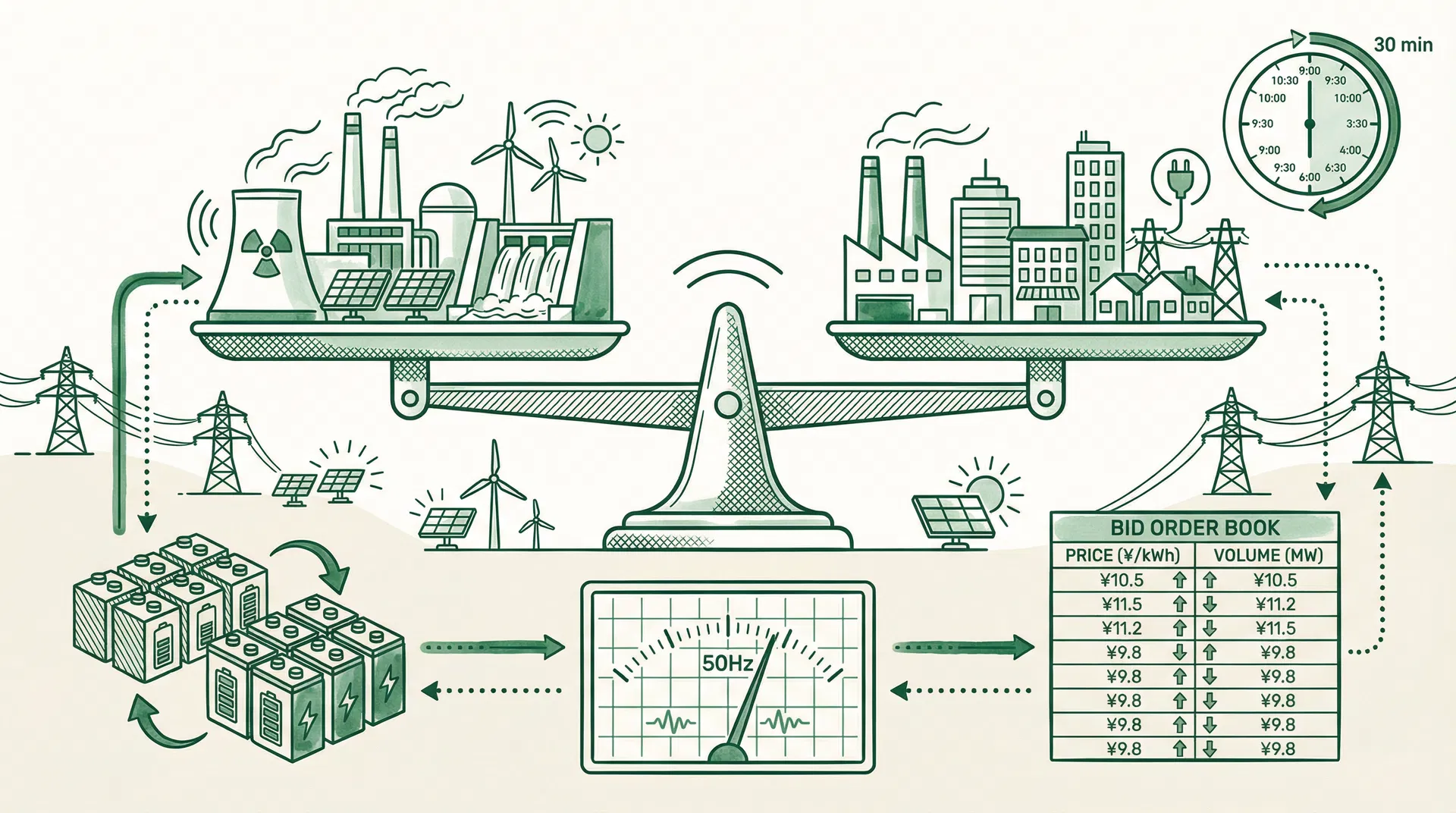
Under Article 9, OCCTO conducts a supply-demand balance assessment on the day before each delivery day, distinguishing between "normal conditions" and "low regional reserve margin conditions" in 30-minute intervals and publishing the results publicly. This mechanism serves as the critical interface between the capacity market and the spot market. Article 10 requires providers of stable power sources and standalone variable power sources to submit Capacity Suspension Plans by OCCTO-specified deadlines, with a tiered submission timeline that balances system predictability with operational flexibility for generators.
Market Exit: 13 Triggering Conditions
Article 12 enumerates 13 conditions that trigger full or partial market exit for a contracted power source. These range from retirement or decommissioning decisions and failed source substitutions to non-submission of required documents and post-contract discovery of FIT/FIP status. Two conditions deserve particular attention: first, if an existing thermal power source wins a bid in the Long-term Decarbonization Power Source Auction, its corresponding capacity exits the capacity market, preventing double subsidization. Second, dispatchable power sources that fail effectiveness tests (有效性測試) face partial or full market exit, ensuring that procured capacity is genuinely available when needed.
Penalty Structure: A Three-Tier Enforcement System
The capacity market establishes a comprehensive three-tier penalty system targeting non-compliance at different stages of the contract lifecycle, creating a robust compliance incentive structure.
| Penalty Type | Article | Trigger Condition |
|---|
| Market Exit Economic Penalty | Article 13 | Market exit event occurs for contracted source |
| Pre-Delivery Period Economic Penalty | Article 16 | Failure to meet requirements before delivery period |
| During-Delivery Period Economic Penalty | Article 19 | Failure to meet availability requirements during delivery |
Article 20 establishes a cap on during-delivery period penalties, preventing a single incident from causing disproportionate financial impact. Article 22 governs the monthly settlement of contract amounts, ensuring timely deduction of penalties from monthly payments and proper fund transfers between OCCTO and capacity providers.
Practical Implications for Market Participants
For electricity retailers, capacity market costs are ultimately passed through to end consumers as "capacity contribution fees" (容量拠出金), allocated proportionally based on each retailer's supply capacity share. Understanding the capacity market's mechanics enables retailers to more accurately forecast their cost structures and design more competitive retail tariffs. For generators, the capacity market provides stable capacity fee income that reduces the financial risk of long-term investment decisions, though the stringent performance obligations and penalty mechanisms require robust asset management and compliance systems. The 20% reduction for inefficient coal plants will accelerate retirement decisions for aging coal units. For renewable energy developers, the capacity market offers an additional revenue stream, but the recognized contract capacity for variable sources and effectiveness test requirements demand careful attention during project planning.
Conclusion: The Road Ahead for Japan's Capacity Market
Since its launch in 2020, Japan's capacity market has undergone continuous institutional refinement, establishing a relatively mature operational framework. The February 2026 revision — particularly the 20% reduction for inefficient coal power — clearly signals the policy direction: ensuring supply adequacy while driving the decarbonization of the generation mix. Looking ahead, how to provide appropriate market access mechanisms for new resource types — such as large-scale battery storage and hydrogen power generation — while maintaining system security will be the central challenge for the next phase of Japan's capacity market reform.