Japan's Simultaneous Market: Phase 1 Detailed Design and Seven Key Discussion Categories (April 2026)
Introduction
Japan's Ministry of Economy, Trade and Industry (METI) is undertaking a fundamental reform of its power market with the introduction of a simultaneous market, integrating day-ahead, intraday, and real-time markets with centralized dispatch. This initiative aims to enhance market efficiency, promote renewable energy integration, and ensure a stable power supply. Following the Second Interim Report published on October 15, 2025, Phase 1 of the detailed business design and technical research has now formally commenced. This article delves into the seven key discussion categories outlined in Document 4 of the 23rd Simultaneous Market Study Group, dated April 20, 2026, which will shape the future of Japan's electricity trading landscape.
The Road to a Simultaneous Market
The concept of a simultaneous market represents a significant paradigm shift from Japan's traditional power market structure. The integration of day-ahead, intraday, and real-time markets is expected to create a more dynamic and responsive system, allowing for better optimization of generation and demand. The Second Interim Report, released in October 2025, laid the groundwork for this transition, and the current Phase 1 is focused on the intricate details of its implementation.
Seven Key Discussion Categories for Phase 1
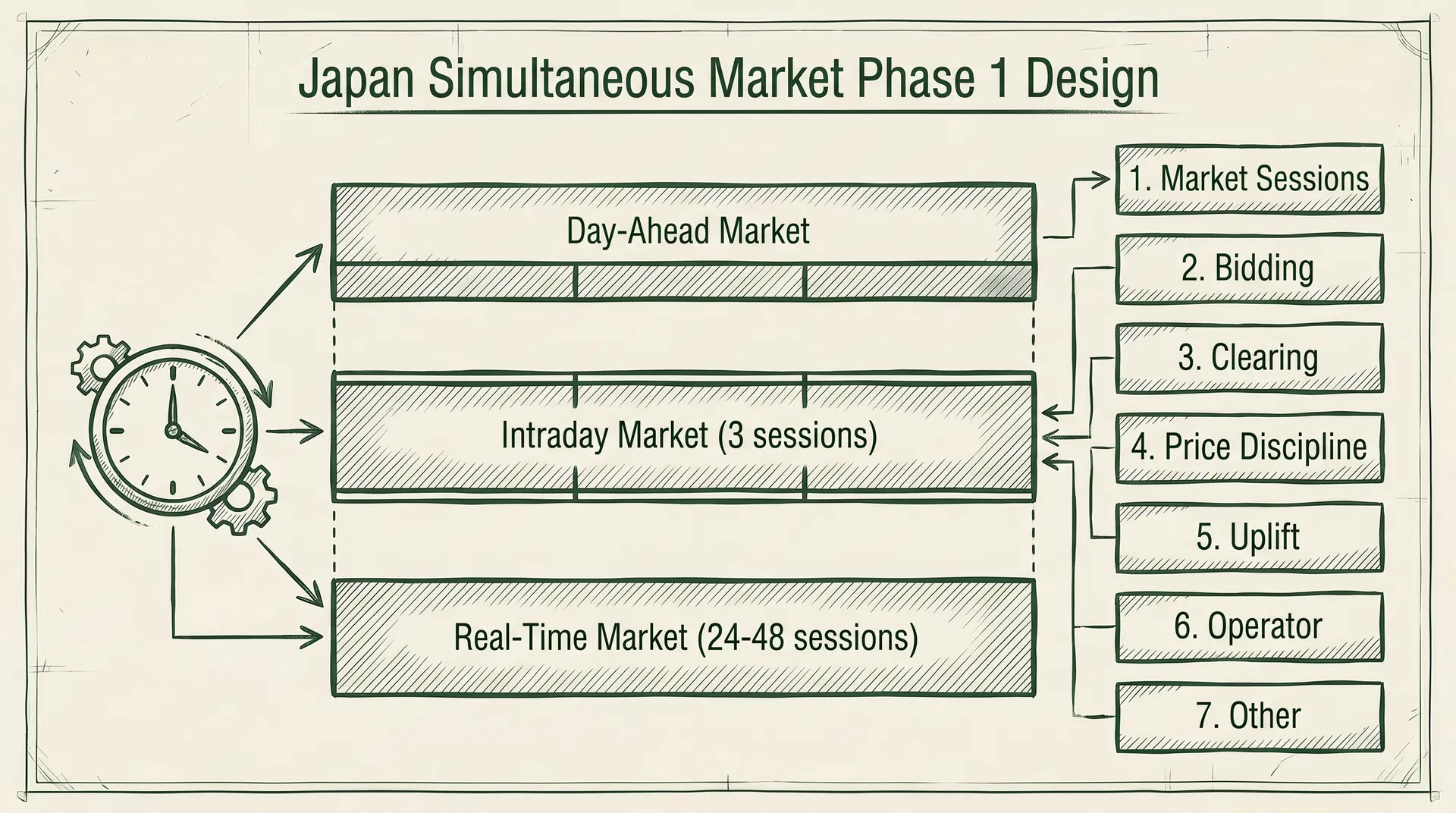
METI's 23rd Simultaneous Market Study Group has identified seven critical discussion categories for Phase 1, each addressing a crucial aspect of the market's design and operation. These categories are pivotal for establishing a robust and efficient simultaneous market.
1. Market Sessions
This category focuses on the structure and timing of market sessions:
- Day-ahead market: Discussions include considering bid deadline times other than the traditional 10 am, aiming for greater flexibility and responsiveness to evolving market conditions.
- Intraday market: Three sessions are proposed: one in the evening before the operating day and two on the day itself. The study also includes continuous trading (zaraba) to allow for real-time adjustments and optimize resource allocation.
- Real-time market: The design considers 24 or 48 sessions per day, with a strong emphasis on measures to reduce the burden on market participants, ensuring smooth and efficient operation.
2. Bidding/Registration
This category addresses how resources participate in the market:
- DER/FIP self-scheduled resources registration: Mechanisms for registering Distributed Energy Resources (DER) and Feed-in Premium (FIP) self-scheduled resources are being developed to facilitate their participation.
- Non-generator seller bids: The framework will accommodate bids from entities that are not traditional power generators, fostering a more diverse and competitive market.
- IBT (Internal Bilateral Transaction) as one option: Internal Bilateral Transactions are being considered as a viable option for market participants, offering flexibility in procurement and supply.
3. Clearing
This category focuses on the settlement and balancing mechanisms:
- Self-scheduled resource logic: The logic for clearing self-scheduled resources will be defined to ensure fair and accurate settlement.
- Handling of retailer/TSO demand forecasts: Two methods are under consideration: Method A, which uses Transmission System Operator (TSO) demand to determine startup and retailer demand to allocate output. This aims to balance system stability with market efficiency.
- Balancing mechanism settlement: The settlement procedures for the balancing mechanism will be established to ensure timely and accurate financial transactions.
- Differential settlement: Mechanisms for differential settlement will be developed to address price variations and ensure equitable outcomes.
- ΔkW price: The methodology for calculating and applying the ΔkW price will be determined, which is crucial for managing system imbalances.
4. Price Discipline/Monitoring
This category focuses on ensuring market fairness and preventing manipulation:
- Bid price rules (min/max prices): Rules for minimum and maximum bid prices will be set to prevent extreme price fluctuations and ensure market stability.
- Market price rules (price cap): A market price cap will be implemented to protect consumers and prevent excessive pricing during periods of high demand.
- Market power exercise rules: Regulations will be established to prevent market participants from exercising undue market power, promoting fair competition.
5. Uplift
This category addresses compensation mechanisms for certain costs:
- Specific compensation scope (referencing overseas markets): The scope of specific compensation will be defined, drawing insights from international best practices in similar markets.
- Cost allocation: The methodology for allocating uplift costs among market participants will be determined to ensure fairness and transparency.
- Compensation calculation for long-startup-time resources: Specific calculations for compensating resources with long startup times will be developed to ensure their continued participation and system reliability.
6. Market Operator
This category outlines the essential requirements for the market operator:
- Robust/stable operations: The market operator must ensure robust and stable operation of the simultaneous market, minimizing disruptions and ensuring continuous service.
- Neutrality/transparency trusted by participants: The operator must maintain neutrality and transparency in all its operations, fostering trust among market participants.
- Advanced system development capability: The ability to develop and adapt advanced systems is crucial for the operator to keep pace with evolving market needs and technological advancements.
- Proper governance: A strong governance framework will be established to ensure accountability and effective oversight of the market operator.
7. Other
This category covers additional important considerations:
- Pumped storage/BESS discretionary contracts: The role of discretionary contracts for pumped storage and Battery Energy Storage Systems (BESS) will be examined to optimize their contribution to grid stability.
- DER-specific bidding/pricing: Specific bidding and pricing mechanisms for Distributed Energy Resources (DER) will be developed to reflect their unique characteristics and value.
- Imbalance system: The design of the imbalance system will be refined to effectively manage deviations between scheduled and actual generation/consumption.
- Relationship with post-GC supply-demand operations: The interaction between the simultaneous market and post-Grid Code (GC) supply-demand operations will be clarified to ensure seamless coordination.
Future Outlook
It is important to note that not all items within these categories will be finalized in Phase 1; some will be deferred to Phase 2 and beyond. This phased approach allows for thorough consideration and adaptation as the market evolves. The successful implementation of the simultaneous market is crucial for Japan's energy future, paving the way for a more resilient, efficient, and sustainable power system.
References
[1] Ministry of Economy, Trade and Industry (METI). (2026, April 20). 23rd Simultaneous Market Study Group, Document 4. Retrieved from https://www.meti.go.jp/shingikai/energy_environment/doji_shijo_kento/023.html
[2] Ministry of Economy, Trade and Industry (METI). (2025, October 15). Second Interim Report.