Japan's Major Power Market Institutional Reform: METI Restructures Policy Working Groups into Three New WGs (April 2026)
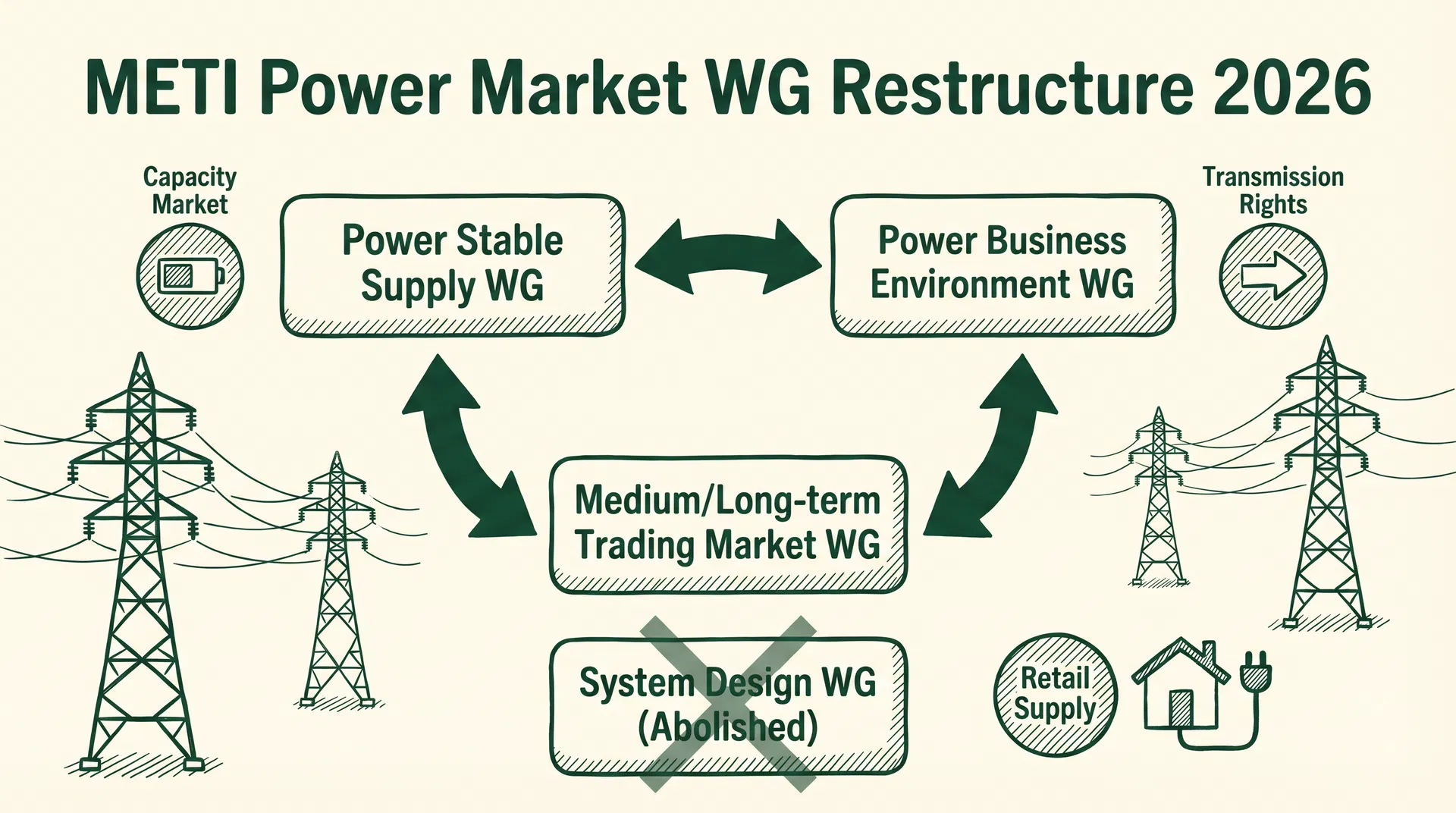
The Japanese power market is undergoing a significant transformation as it shifts from the foundational design phase to the critical implementation phase. In a pivotal move reflecting this transition, the Ministry of Economy, Trade and Industry (METI) has announced a comprehensive restructuring of its policy working groups. As of April 2026, the existing "System Design Working Group" and "System Review Working Group" have been officially abolished. In their place, METI has established three new, highly specialized working groups under the 5th Next-Generation Power and Gas Business Infrastructure Subcommittee [1]. This strategic realignment is designed to address the evolving complexities of Japan's energy landscape, ensuring a stable power supply while fostering a competitive and sustainable business environment.
This restructuring is not merely an administrative reshuffle; it represents a fundamental shift in regulatory focus. The previous working groups were instrumental in laying the groundwork for Japan's power system reform. However, as the market matures and new challenges emerge—such as the integration of renewable energy sources, the need for long-term decarbonization, and the complexities of market pricing—a more targeted approach is required. The three new working groups will delve into specific operational and structural issues, providing the detailed policy frameworks necessary for the next stage of market evolution. Each of these new groups is expected to convene approximately once per month, ensuring continuous and rigorous oversight of their respective domains.
The Three New Working Groups: A Targeted Approach
The newly established working groups are designed to tackle distinct yet interconnected aspects of the power market. By compartmentalizing these critical areas, METI aims to accelerate policy development and implementation. The three new entities are the Power Stable Supply Working Group, the Power Business Environment Working Group, and the Medium/Long-term Trading Market Working Group.
1. Power Stable Supply Working Group
The Power Stable Supply Working Group is tasked with ensuring the reliability and resilience of Japan's electricity grid. As the nation transitions towards a more decentralized and renewable-heavy energy mix, maintaining a stable supply is paramount. This group will oversee several critical mechanisms designed to secure adequate power capacity and manage supply-demand fluctuations.
Key areas of focus for this working group include the capacity market, which ensures that sufficient generation capacity is available to meet peak demand. It will also manage the long-term decarbonization power auction (LTDA), a crucial initiative for incentivizing investment in low-carbon generation technologies. Furthermore, the group will oversee the reserve power system and the supply-demand adjustment market, both of which are essential for maintaining grid stability in real-time. Notably, this group will also handle advance consultations regarding the retirement of large power sources, ensuring that such closures do not jeopardize overall system reliability. The non-fossil value trading market, which promotes the use of clean energy, also falls under its purview.
2. Power Business Environment Working Group
The Power Business Environment Working Group focuses on the regulatory and economic frameworks that shape the operations of power companies. Its mandate is to create a fair, competitive, and sustainable environment for all market participants, from large utilities to new retail entrants.
A significant responsibility of this group is the oversight of retail supply obligations, ensuring that retailers can reliably serve their customers. It will also manage the baseload market, which provides access to stable, low-cost power sources. Crucially, this working group has been explicitly tasked with handling indirect transmission rights (間接送電権) and transitional regulated tariffs (経過措置料金). These are complex mechanisms that require careful management to prevent market distortion and protect consumers. Additionally, the group will be responsible for the detailed design of the simultaneous market and will explore avenues for public finance to support power and grid development, recognizing the substantial investments required for infrastructure modernization.
3. Medium/Long-term Trading Market Working Group (Time-Limited)
The Medium/Long-term Trading Market Working Group is a specialized, time-limited entity established to address the specific challenges of forward and futures trading in the power sector. As the spot market matures, the development of robust medium- and long-term markets is essential for risk management and price discovery.
This group's comprehensive agenda includes establishing price discipline and monitoring mechanisms to prevent market manipulation. It will also design the settlement and clearing processes, which are vital for market integrity. Furthermore, the group will focus on product design, exploring methods to increase supply volume, and defining the rules for delivery. It will also determine the roles of the market operator and participants, and clarify the relationship between the medium/long-term market and other existing markets. This focused effort is expected to yield a more sophisticated and resilient trading environment.
Comparison of Old and New Working Group Structures
To fully grasp the magnitude of this restructuring, it is helpful to compare the previous framework with the new, specialized approach. The following table outlines the transition from the old working groups to the new structure.
| Previous Structure (Abolished) |
New Structure (Established April 2026) |
Primary Focus Areas |
| System Design Working Group |
Power Stable Supply Working Group |
Capacity market, LTDA, reserve power, supply-demand adjustment, non-fossil value trading. |
| System Review Working Group |
Power Business Environment Working Group |
Retail supply obligations, baseload market, indirect transmission rights, transitional regulated tariffs, public finance. |
| (No direct equivalent) |
Medium/Long-term Trading Market WG |
Price discipline, settlement/clearing, product design, market participant rules (Time-limited). |
Continuing Working Groups and Future Outlook
While the establishment of the three new working groups marks a significant change, METI is also maintaining several existing groups to ensure continuity in other critical areas. The Wide-Area Grid Verification Working Group, the Gas Business Environment Working Group, and the Distributed Energy Strategy Working Group will continue their operations. This hybrid approach ensures that while new challenges are addressed with fresh perspectives, ongoing initiatives are not disrupted.
The restructuring of these working groups is a clear signal that Japan's power system reform has entered a new, highly operational phase. The explicit inclusion of complex issues like indirect transmission rights and transitional regulated tariffs under the Power Business Environment Working Group demonstrates METI's commitment to addressing the nuanced challenges of a liberalized market. As these new groups begin their monthly meetings, market participants can expect a more dynamic and responsive regulatory environment, tailored to the realities of Japan's evolving energy sector.
Detailed Scope of the New Working Groups
The specific responsibilities assigned to each new working group highlight the depth of METI's regulatory strategy. The following table provides a detailed breakdown of the scope for each of the three new entities.
| Working Group |
Key Responsibilities and Scope |
Meeting Frequency |
| Power Stable Supply WG |
Capacity market management, Long-term decarbonization power auction (LTDA), Reserve power system oversight, Advance consultation on large power source retirement, Supply-demand adjustment market, Non-fossil value trading market. |
Approx. once per month |
| Power Business Environment WG |
Retail supply obligation enforcement, Baseload market regulation, Indirect transmission rights (間接送電権), Transitional regulated tariffs (経過措置料金), Simultaneous market detailed design, Public finance for power/grid development. |
Approx. once per month |
| Medium/Long-term Trading Market WG |
Price discipline and monitoring, Settlement and clearing mechanisms, Product design and delivery rules, Methods to increase supply volume, Operator and market participant guidelines, Relationship with other markets. |
Approx. once per month (Time-limited) |
This comprehensive realignment by METI underscores a proactive approach to managing Japan's energy future. By transitioning from broad system design to focused implementation, the regulatory framework is better equipped to handle the intricacies of a modern, decarbonized power market.
References
[1] Ministry of Economy, Trade and Industry (METI). "5th Next-Generation Power and Gas Business Infrastructure Subcommittee." March 27, 2026. https://www.meti.go.jp/shingikai/enecho/denryoku_gas/jisedai_kiban/005.html